Table of Contents
- What is a mobile proxy?
- How we evaluated the providers
- Quick comparison
- How they performed in our benchmark
- Phone or computer behind the IP?
- Shared IP pools
- Sticky sessions: promised vs measured
- Best mobile proxy providers
- Providers not benchmarked
- Pair with an antidetect browser: 1Browser
- Which mobile proxy provider should you choose?
- How to run a pilot in 1–2 weeks
- Conclusion
Most mobile proxy guides list pool sizes and carrier claims copied from marketing pages. This one is built on measurements. In October 2026 we sent over 63,000 requests through 11 mobile proxy networks, buying each provider’s rotating per-GB mobile traffic at its listed price and testing with the same scripts, servers and schedule.
For each provider we measured success rate on a Cloudflare endpoint, latency, sticky-session stability, duplicate IPs, geo accuracy, Google and Instagram success, TCP fingerprint, IP quality scores from three databases, and cost per successful request. The methodology, raw logs and scripts are public in our Mobile Proxy Benchmark 2026, and where possible we cross-check against Proxyway’s Proxy Market Research 2026.
That matters because mobile proxies cost more than residential ones, and not every provider’s “mobile” IPs actually come from carrier networks. The benchmark shows which ones do, which ones perform, and what each successful request actually costs.
TL;DR
- Most reliable in our test: Decodo, Oxylabs and SOAX — all at 99.8% Cloudflare endpoint success.
- Lowest cost per successful request: Floppydata at $0.012 per 1,000 requests, about 9× cheaper than Oxylabs ($0.113).
- Fastest connections: Byteful at 0.73 s median latency and 1.30 s P90.
- Best sticky sessions: Decodo (78.6%) and Oxylabs (78.4%) kept the same IP in 30-minute sessions.
- Highest mobile IP classification: SOAX — 99.1% classified as mobile by IP2Location and 88.9% by MaxMind.
- Best Google success: Floppydata (97.8%) and Oxylabs (97.0%).
Disclosure: we operate Floppydata. It was tested on the same terms as everyone else, and we report where it came out behind.
What is a mobile proxy?
A mobile proxy routes your connection through an IP address assigned by a mobile carrier on 3G, 4G, 5G or LTE networks. Because carriers place many subscribers behind shared addresses using carrier-grade NAT, websites are often more cautious about blocking mobile IPs outright.
That makes mobile proxies useful on mobile-first and heavily protected targets, but not automatically better for every job. They usually cost more per GB than residential proxies and can have higher latency, so residential remains the better default for many high-volume scraping workloads.
When to use mobile proxies
- Ad verification: check how ads and landing pages appear from mobile carrier networks in different locations.
- Social media management: platforms like Instagram and TikTok expect carrier traffic for mobile app sessions.
- App testing: reproduce real carrier network conditions that datacenter IPs cannot match.
- Bypassing IP bans: carrier IPs are harder to block broadly because a single address may represent many legitimate subscribers.
Rotating pools vs dedicated mobile proxies
Rotating mobile pools are billed per GB and give access to many carrier IPs. They fit scraping, geo-testing, ad verification and workloads that need IP rotation across many locations.
Dedicated mobile proxies are billed per port, SIM, day or month. They keep one carrier connection under your control and are better for long-lived accounts, persistent sessions and workflows where you need manual IP resets.
Do not compare headline prices directly: $2/GB for rotating traffic and a $100/month dedicated mobile line are different products.
How we evaluated the providers
We scored providers on six criteria and backed the performance part with our own measurements:
- Measured performance: success rate, latency, sticky-session stability and duplicate IPs from our October 2026 mobile benchmark, plus Google and Instagram success rates.
- IP quality: mobile classification rate across IP2Location (10,000 IPs per provider) and MaxMind (1,000 IPs per provider), fraud scores from Scamalytics, and proxy/VPN flag rates.
- Cost per successful request: price per GB × traffic from each provider’s dashboard counter, divided by successful requests.
- Geo accuracy: share of exit IPs that landed in the requested country, checked against Cloudflare’s database.
- Targeting and pricing: targeting depth, entry price, volume pricing, traffic expiry and minimum purchase.
- Session control: sticky-session limits and measured stability.
How the benchmark was run
Between 24 and 27 October 2026 we bought rotating per-GB mobile traffic from each provider at its listed price and sent requests from three Hetzner servers (US Ashburn, Germany and Singapore) through 12 exit countries. The test included:
- Infrastructure test: 100 requests per provider, per country, per server, to a Cloudflare trace endpoint at 08:00 and 20:00 UTC — about 28,800 requests per provider over four days.
- Target tests: Google search and Instagram profile from multiple countries using a Chrome 131 Android TLS fingerprint.
- Sticky sessions: 8 sessions per provider, four times daily, each requesting a 30-minute sticky IP and checked every 30 seconds.
- IP quality: Scamalytics fraud scores, IP2Location and MaxMind mobile classification, and TCP fingerprint analysis via p0f.
Full methodology, limitations and scripts are on our mobile proxy benchmark page and on GitHub.
Four providers could not be tested because they required identity verification, sales calls, or sold time-billed endpoints rather than per-GB rotating mobile traffic: Infatica, Proxy-Seller, Proxidize and Proxy-Cheap. They are covered briefly at the end of this article based on public documentation.
Quick comparison
Prices are public list prices at the time of writing. Success rate, latency and cost per 1,000 successful requests are from our October 2026 mobile benchmark.
| Provider | Best for | Entry price | Success rate | Latency med/P90 | Cost per 1k | Main limitation |
|---|---|---|---|---|---|---|
| Floppydata | Lowest cost per request | $1/GB | 98.6% | 1.11 / 2.42 s | $0.012 | Weakest sticky sessions (27.6%) |
| Decodo | All-round reliability + long sessions | $3.75/GB | 99.8% | 0.91 / 1.63 s | $0.064 | Lowest rates need volume |
| Oxylabs | Enterprise reliability + compliance | $7.50/GB | 99.8% | 0.86 / 1.53 s | $0.113 | Highest cost per request |
| SOAX | Carrier targeting + mobile IP quality | $4.60/GB | 99.8% | 0.96 / 1.79 s | $0.067 | $200/mo entry |
| Byteful | Speed | $4.25/GB | 99.7% | 0.73 / 1.30 s | $0.064 | High duplicate-IP rate (30.4%) |
| DataImpulse | Pay-as-you-go + sticky sessions | $2/GB | 99.3% | 0.94 / 2.92 s | $0.028 | Weak geo accuracy (93.1%) |
| Evomi | Low-cost tested alternative | $3.98/GB | 98.7% | 0.88 / 1.71 s | $0.059 | Success varies by server location |
| NodeMaven | IP quality screening | $5/GB | 99.1% | 1.34 / 3.30 s | $0.075 | Slow P90 latency |
| IPRoyal | Dedicated + rotating options | $7.65/GB | 98.8% | 1.25 / 3.35 s | $0.112 | Weak in Turkey (93.0%) |
| ProxyEmpire | Data rollover | $9/GB | 99.5% | 1.07 / 2.43 s | $0.132 | Most expensive per request |
| ResiProx | Geo filters + AI routing | $6/GB | 99.4% | 1.11 / 2.21 s | $0.087 | No comparable external benchmark |
How they performed in our benchmark
All 11 providers were tested on identical terms. Success rate is the share of requests that returned a valid response from a Cloudflare endpoint. Sticky stability is the share of 30-minute sessions that kept the same IP. Cost is an estimated blended value per 1,000 successful requests. Mobile IP share is from IP2Location (10,000 IPs) and MaxMind (1,000 IPs).
| Provider | Success | Latency med / P90 | Sticky 30 min | Dup. rate | Shared IPs | Windows TCP | Cost / 1k | Geo acc. | Mobile IP2L / MaxMind | ||
|---|---|---|---|---|---|---|---|---|---|---|---|
| Floppydata | 98.6% | 1.11 / 2.42 s | 27.6% | 16.4% | 5.5% | 0.2% | $0.012 | 99.9% | 97.8% | 97.1% | 95.1% / 88.7% |
| Decodo | 99.8% | 0.91 / 1.63 s | 78.6% | 18.9% | 31.5% | 24.5% | $0.064 | 99.9% | 96.8% | 99.4% | 96.2% / 16.0% |
| Oxylabs | 99.8% | 0.86 / 1.53 s | 78.4% | 19.2% | 31.7% | 23.5% | $0.113 | 99.8% | 97.0% | 99.7% | 96.3% / 17.4% |
| SOAX | 99.8% | 0.96 / 1.79 s | 37.0% | 42.7% | 36.8% | 41.1% | $0.067 | 99.9% | 96.4% | 96.5% | 99.1% / 88.9% |
| Byteful | 99.7% | 0.73 / 1.30 s | 56.5% | 30.4% | 55.7% | 49.3% | $0.064 | 100.0% | 95.5% | 99.2% | 98.7% / 97.2% |
| ProxyEmpire | 99.5% | 1.07 / 2.43 s | 1.6% | 20.3% | 53.3% | 31.0% | $0.132 | 99.9% | 96.0% | 98.6% | 97.5% / 76.6% |
| ResiProx | 99.4% | 1.11 / 2.21 s | 31.5% | 32.9% | 26.9% | 10.4% | $0.087 | 99.9% | 95.0% | 98.8% | 95.2% / 48.0% |
| DataImpulse | 99.3% | 0.94 / 2.92 s | 72.4% | 49.3% | 41.5% | 11.6% | $0.028 | 93.1% | 91.1% | 98.2% | 90.6% / 80.5% |
| NodeMaven | 99.1% | 1.34 / 3.30 s | 59.4% | 23.5% | 56.4% | 47.3% | $0.075 | 99.9% | 95.4% | 98.1% | 99.2% / 97.4% |
| IPRoyal | 98.8% | 1.25 / 3.35 s | 66.1% | 13.4% | 10.1% | 6.7% | $0.112 | 100.0% | 95.0% | 97.1% | 97.5% / 15.1% |
| Evomi | 98.7% | 0.88 / 1.71 s | 54.4% | 35.7% | 52.8% | 18.0% | $0.059 | 99.8% | 93.1% | 98.7% | 99.3% / 98.7% |
What stands out. First, the top three by success rate — Decodo, Oxylabs and SOAX — all hit 99.8%, but the cost per 1,000 successful requests differed by nearly 2×: SOAX at $0.067, Decodo at $0.064 and Oxylabs at $0.113. Second, Floppydata had the lowest cost at $0.012 per 1,000 requests but also the weakest sticky-session stability (27.6%) and a slightly lower success rate (98.6%). Third, MaxMind disagreed with IP2Location on whether many IPs from Decodo (16.0% vs 96.2%), Oxylabs (17.4% vs 96.3%) and IPRoyal (15.1% vs 97.5%) were truly mobile — classifying them as Cable/DSL instead. SOAX, Evomi, NodeMaven and Byteful had the strongest mobile classification across both databases.
Limits of these numbers. The test covers four days and a standard HTTP client. Amazon results varied too much between runs to rank providers. Performance on your targets may differ. Choose by the workload you actually run and validate with a pilot.
Full results for all 11 providers — per-country success rates, per-server latency, IP quality details and the raw request logs — are in our Mobile Proxy Benchmark 2026.
Phone or computer behind the IP?
Mobile proxies should route traffic through phones, not desktops. We used p0f to fingerprint the TCP stack of each connection and checked whether the operating system signature matched a mobile device or a desktop.
| Provider | Windows TCP fingerprint |
|---|---|
| Floppydata | 0.2% |
| IPRoyal | 6.7% |
| ResiProx | 10.4% |
| DataImpulse | 11.6% |
| Evomi | 18.0% |
| Oxylabs | 23.5% |
| Decodo | 24.5% |
| ProxyEmpire | 31.0% |
| SOAX | 41.1% |
| NodeMaven | 47.3% |
| Byteful | 49.3% |
Floppydata, IPRoyal and ResiProx had the lowest share of Windows fingerprints, suggesting nearly all traffic genuinely exits from mobile devices. At the other end, almost half of Byteful’s and NodeMaven’s connections presented a Windows TCP stack. SOAX was at 41.1%.
This does not prove fraud — a Windows signature can come from a tethered phone or a VPN app on a laptop sharing the same mobile connection. But if your target inspects TCP fingerprints, these numbers matter. The method was validated on a real iPhone; Android was not separately verified.
Shared IP pools
We collected 10,000 exit IPs per provider and compared them pairwise. A shared IP is one that appeared in two or more providers’ pools during the same test window.
| Provider | Shared IPs | Largest overlap with |
|---|---|---|
| Floppydata | 5.5% | — |
| IPRoyal | 10.1% | ResiProx |
| ResiProx | 26.9% | IPRoyal |
| Decodo | 31.5% | Oxylabs |
| Oxylabs | 31.7% | Decodo |
| SOAX | 36.8% | NodeMaven |
| DataImpulse | 41.5% | Evomi |
| Evomi | 52.8% | DataImpulse |
| ProxyEmpire | 53.3% | NodeMaven |
| Byteful | 55.7% | NodeMaven |
| NodeMaven | 56.4% | Byteful |
Floppydata had the most exclusive pool — only 5.5% of its IPs appeared in another provider’s traffic. NodeMaven and Byteful shared roughly a third of their pools with each other. Decodo and Oxylabs had about a quarter overlap.
Overlap is not inherently bad. Mobile IPs often sit behind CGNAT, meaning many users — and many proxy networks — share the same public address. But a high overlap means your target is more likely to have seen the IP flagged by another customer’s traffic.
Sticky sessions: promised vs measured
Providers advertise sticky session durations of 10 to 30 minutes or more. We tested how often the exit IP actually survived a full 30-minute session.
| Provider | Advertised sticky | Measured 30 min survival |
|---|---|---|
| Decodo | Up to 30 min | 78.6% |
| Oxylabs | Up to 30 min | 78.4% |
| DataImpulse | Up to 30 min | 72.4% |
| IPRoyal | Up to 30 min | 66.1% |
| NodeMaven | Up to 30 min | 59.4% |
| Byteful | Up to 30 min | 56.5% |
| Evomi | Up to 30 min | 54.4% |
| SOAX | Up to 30 min | 37.0% |
| ResiProx | Up to 30 min | 31.5% |
| Floppydata | Up to 30 min | 27.6% |
| ProxyEmpire | Up to 30 min | 1.6% |
Decodo and Oxylabs held the IP in nearly 4 out of 5 sessions. ProxyEmpire kept it in fewer than 1 in 50 — its advertised 10–30 minute sticky sessions did not survive our test. Floppydata was second from last at 27.6%.
If your workflow requires long-lived sessions — account management in an antidetect browser, multi-step checkouts, or extended scraping sessions — Decodo and Oxylabs are the safest choices. For short-lived tasks like ad verification or search scraping, sticky stability matters less.
Best mobile proxy providers
Rather than forcing an arbitrary 1–11 ranking, we recommend providers by use case. Each review names the workload the provider fits best, its benchmark results and the limitation that matters most.
Floppydata
Best for: cost-sensitive teams running high request volumes across mobile, residential and datacenter traffic.
Why it stands out: Residential, mobile and datacenter traffic share one balance at a flat $1/GB, and traffic that does not expire costs $1.50/GB. In our mobile benchmark that translated into $0.012 per 1,000 successful requests — the lowest of all 11 providers tested and about 9× cheaper than Oxylabs.
Floppydata also led on Google success (97.8%) and had strong geo accuracy (99.9%). On the other hand, sticky-session stability was the weakest in the test at 27.6%, and overall success rate (98.6%) was the second-lowest. We operate Floppydata; it was tested with the same scripts as everyone else.
Key features:
- Network: 65M+ IPs across all proxy types (vendor-stated); mobile-only pool size not disclosed
- Proxy types: rotating residential, mobile and datacenter on one GB balance; static residential (ISP) and static datacenter
- Targeting: country and city; 195+ countries for rotating proxies
- Protocols: HTTP, HTTPS, SOCKS5
Pricing:
- Mobile, residential and datacenter: $1/GB; unused traffic expires at the end of the period
- Non-expiring traffic: $1.50/GB
- Minimum purchase: 19 GB for $19
- No free trial
In our benchmark: 98.6% success rate, 1.11 s median / 2.42 s P90 latency, 27.6% sticky-session stability, 16.4% duplicate IPs, 97.8% Google success and 97.1% Instagram success.
Main limitation: Session-heavy work. Only 27.6% of 30-minute sticky sessions kept the same IP, the weakest in the test, and no security certifications are published.
| Pros | Cons |
|---|---|
| Lowest cost per request ($0.012/1k) | Weakest sticky sessions (27.6%) |
| Top Google success (97.8%) | Lower overall success rate (98.6%) |
| One balance for mobile, residential and datacenter | Mobile-only pool size not disclosed |
| Non-expiring traffic at $1.50/GB | No free trial |
Verdict: The value pick for high-volume, mostly rotating mobile workloads where cost per request matters more than session stability. For long sessions, Decodo or DataImpulse held IPs far better in our test.
Decodo
Best for: teams that want top-tier reliability with the best sticky-session stability in our test.
Why it stands out: Decodo tied for the highest success rate in our benchmark (99.8%) and had the best sticky-session stability: 78.6% of 30-minute sessions kept the same IP, with a median lifetime of 30 minutes. It also had accurate geo targeting (99.9%) and strong Instagram success (99.4%).
Plans are self-serve from 2 GB up, so a team can pilot before moving to an enterprise contract. Proxyway’s separate 2026 test corroborates the reliability: 99.75% infrastructure success and 0.74 s average response time.
Key features:
- Network: 10M+ mobile IPs from 700+ carriers (vendor-stated), 160+ countries
- Proxy types: residential, mobile, ISP, datacenter
- Targeting: continent, country, state, city
- Sessions: rotating; sticky up to 24 hours
- Protocols: HTTP, HTTPS, SOCKS5
Pricing:
- Mobile: $3.75/GB for 2 GB; $4/GB pay-as-you-go; enterprise from $2.25/GB
- 3-day trial with limited traffic; 14-day refund on eligible first purchases
In our benchmark: 99.8% success, 0.91 s / 1.63 s latency, 78.6% sticky stability, 18.9% duplicate IPs, 96.8% Google success and 99.4% Instagram success.
Main limitation: The lowest advertised per-GB rate requires enterprise volume. MaxMind classified only 16.0% of Decodo’s IPs as mobile (IP2Location: 96.2%) — a database disagreement rather than a proven quality issue, but worth noting if your target checks MaxMind specifically.
| Pros | Cons |
|---|---|
| Tied for highest success rate (99.8%) | About 5× Floppydata’s cost per request |
| Best sticky-session stability (78.6%) | MaxMind mobile classification only 16.0% |
| Self-serve onboarding with trial | Lowest rates need enterprise volume |
| 700+ carriers |
Verdict: The best all-round pick for teams that want proven reliability and strong session stability with self-serve onboarding.
Oxylabs
Best for: enterprise-scale mobile data collection with compliance requirements.
Why it stands out: Oxylabs tied for the highest success rate (99.8%), had the second-fastest latency (0.86 s median) and recorded the highest Instagram success in our test (99.7%). Proxyway’s separate 2026 test measured 99.84% infrastructure success — the best in its mobile benchmark.
It pairs the network with Web Scraper API, Web Unblocker and datasets, and publishes security documentation (ISO 27001, SOC 2/3) for vendor reviews.
Key features:
- Network: 20M+ mobile IPs, 140+ countries
- Proxy types: residential, mobile, ISP, dedicated ISP, datacenter
- Targeting: country, state, city, ZIP, coordinates, ASN
- Sessions: rotating; sticky up to 24 hours
- Compliance: ISO/IEC 27001:2022, SOC 2, SOC 3
Pricing:
- Mobile: $7.50/GB for 4 GB; $5/GB at 100 GB; $3.50/GB on the 715 GB corporate plan
- No general free trial; contact sales for business evaluation
In our benchmark: 99.8% success, 0.86 s / 1.53 s latency, 78.4% sticky stability, 19.2% duplicate IPs, 97.0% Google success and 99.7% Instagram success.
Main limitation: Cost. At $0.113 per 1,000 successful requests, it was the second most expensive in our test. MaxMind classified only 17.4% of its IPs as mobile.
| Pros | Cons |
|---|---|
| Tied for highest success (99.8%) | Second most expensive per request |
| Best Instagram success (99.7%) | No general free trial |
| Deepest geo-targeting (coordinate-level) | MaxMind mobile classification only 17.4% |
| Strongest published certifications |
Verdict: The enterprise pick when compliance documentation and reliability matter more than price.
SOAX
Best for: carrier-specific mobile workflows with the highest confirmed mobile IP quality.
Why it stands out: SOAX tied for the highest success rate (99.8%) and had the strongest mobile IP classification in our test: 99.1% by IP2Location and 88.9% by MaxMind. It offers named 3G/4G/5G/LTE carrier targeting, which no other provider in this test matches, and supports UDP and QUIC alongside standard protocols.
Key features:
- Network: 33M+ mobile IPs (vendor-stated), 195+ countries
- Proxy types: residential, mobile; datacenter US-only
- Targeting: country, region, city, ISP; ASN and ZIP on top plans; named carrier selection
- Sessions: rotating; sticky up to 60 minutes
- Protocols: HTTP, HTTPS, SOCKS5, UDP, QUIC
Pricing:
- Sandbox: free, no traffic included
- Builder: $200/month, Tier 1 mobile $3/GB
- Team $500, Scale $1,500, Enterprise $3,000/month
- Minimum: $25 top-up (25 credits)
In our benchmark: 99.8% success, 0.96 s / 1.79 s latency, 37.0% sticky stability, 42.7% duplicate IPs, 96.4% Google success and 96.5% Instagram success.
Main limitation: The $200/month Builder plan is a high entry point, and the duplicate-IP rate (42.7%) was the second highest in our test. Sticky-session stability at 37.0% is moderate.
| Pros | Cons |
|---|---|
| Tied for highest success (99.8%) | $200/month entry |
| Highest mobile IP classification (99.1% / 88.9%) | High duplicate-IP rate (42.7%) |
| Named carrier targeting | Moderate sticky stability (37.0%) |
| UDP and QUIC support |
Verdict: The strongest pick for workflows that require confirmed mobile carrier IPs and named carrier targeting.
Byteful
Best for: speed-sensitive workflows that need the lowest latency.
Why it stands out: Byteful (formerly Ping Proxies) had the fastest connections in our test: 0.73 s median and 1.30 s P90 latency. It also had perfect geo accuracy (100.0%) and near-perfect mobile IP classification (98.7% IP2Location, 97.2% MaxMind). Proxyway’s 2026 test corroborates the speed: 0.48 s average global infrastructure response time, the fastest in its mobile benchmark.
Key features:
- Network: 6M+ mobile IPs, 195+ countries
- Proxy types: mobile with country, region, city and ISP targeting
- Sessions: sticky up to 24 hours
- Protocols: HTTP, SOCKS5
Pricing:
- $4.25/GB for 10 GB; $3.85/GB at 25 GB; $3.45/GB at 100 GB
- Traffic does not expire
- Minimum: 2 GB for $8.50
In our benchmark: 99.7% success, 0.73 s / 1.30 s latency, 56.5% sticky stability, 30.4% duplicate IPs, 95.5% Google success and 99.2% Instagram success.
Main limitation: The duplicate-IP rate (30.4%) was above average, and the shared-IP rate (55.7%) was one of the highest in our test.
| Pros | Cons |
|---|---|
| Fastest latency (0.73 s / 1.30 s) | High duplicate-IP rate (30.4%) |
| Perfect geo accuracy (100%) | High shared-IP rate (55.7%) |
| Strong mobile classification (98.7% / 97.2%) | Moderate Google success (95.5%) |
| Non-expiring traffic |
Verdict: The speed pick for latency-sensitive workloads. Corroborated by Proxyway’s separate infrastructure test.
DataImpulse
Best for: pay-as-you-go teams with seasonal workloads and long sticky sessions.
Why it stands out: DataImpulse had the second-lowest cost per request ($0.028) and the third-best sticky-session stability (72.4%) with a median lifetime of 30 minutes. Traffic never expires and there is no subscription, so it suits irregular workloads.
Key features:
- Network: 16M+ mobile IPs (vendor-stated), 195+ countries
- Proxy types: residential, premium residential, mobile, datacenter
- Targeting: country, state, city, ZIP, ASN; exclusion filters
- Sessions: rotating; sticky up to 2 hours
Pricing:
- Mobile: $2/GB
- Premium residential: $5/GB
- $5 introductory package with 2.5 GB for new users
- Location targeting doubles the per-GB rate
In our benchmark: 99.3% success, 0.94 s / 2.92 s latency, 72.4% sticky stability, 49.3% duplicate IPs, 91.1% Google success and 98.2% Instagram success.
Main limitation: Geo accuracy was the weakest in our test at 93.1%, the duplicate-IP rate was the highest (49.3%), and Google success (91.1%) lagged behind other providers. Mobile IP classification by IP2Location was also the lowest at 90.6%.
| Pros | Cons |
|---|---|
| Second-lowest cost per request ($0.028) | Worst geo accuracy (93.1%) |
| Strong sticky stability (72.4%) | Highest duplicate-IP rate (49.3%) |
| Non-expiring pay-as-you-go | Lowest Google success (91.1%) |
| No subscription required | Targeting doubles the price |
Verdict: A low-cost pick for flexible volumes and session-based work, if geo accuracy is not critical.
Evomi
Best for: cost-conscious teams that want independently verified mobile IP quality.
Why it stands out: Evomi had the highest mobile IP classification across both databases in our test: 99.3% by IP2Location and 98.7% by MaxMind. Its cost per request ($0.059) is competitive, and Proxyway measured 99.66% infrastructure success with a notably strong US pool (99.95%).
Key features:
- Network: 3M+ mobile IPs, 150+ countries
- Proxy types: mobile with 3G/4G/5G carrier networks
- Targeting: city and carrier
- Sessions: rotating and sticky
Pricing:
- $3.98/GB pay-as-you-go; volume rates down to $2.20/GB
- Minimum: 4 GB for $15.92
In our benchmark: 98.7% success, 0.88 s / 1.71 s latency, 54.4% sticky stability, 35.7% duplicate IPs, 93.1% Google success and 98.7% Instagram success.
Main limitation: Success rate varied by server location: 99.9% from the US but only 98.0% from Germany and Singapore. Google success (93.1%) was below average.
| Pros | Cons |
|---|---|
| Highest mobile classification (99.3% / 98.7%) | Success varies by server location |
| Competitive cost ($0.059/1k) | Below-average Google success (93.1%) |
| Strong Proxyway results (99.66%) | Best rate requires enterprise volume |
Verdict: A strong value alternative with the best-confirmed mobile IP quality in our test.
NodeMaven
Best for: quality-sensitive workflows where verified mobile IP classification matters.
Why it stands out: NodeMaven had one of the highest mobile IP classification rates: 99.2% by IP2Location and 97.4% by MaxMind. It emphasizes IP screening and traffic rollover, and offers residential and mobile traffic on one plan.
Key features:
- Network: 295K+ mobile IPs plus 30M+ residential on the same plan (vendor-stated)
- Targeting: 190+ countries
- Sessions: rotating and sticky
- Protocols: HTTP, HTTPS, SOCKS5
Pricing:
- From $5/GB (about $4.25/GB at 2 GB plan); $2.20/GB at volume
- Paid trial: $3.50 for 750 MB
- Traffic rolls over
In our benchmark: 99.1% success, 1.34 s / 3.30 s latency, 59.4% sticky stability, 23.5% duplicate IPs, 95.4% Google success and 98.1% Instagram success.
Main limitation: The slowest P90 latency in our test at 3.30 s, and the mobile pool (295K) is much smaller than larger providers.
| Pros | Cons |
|---|---|
| Near-perfect mobile classification (99.2% / 97.4%) | Slowest P90 latency (3.30 s) |
| Traffic rollover | Very small mobile pool (295K) |
| Pre-filtered IP quality | No free trial |
Verdict: Best for small-scale, quality-sensitive workflows where IP classification matters more than speed.
IPRoyal
Best for: teams that want both dedicated mobile endpoints and rotating mobile traffic.
Why it stands out: IPRoyal had the lowest duplicate-IP rate in our test (13.4%), perfect geo accuracy (100.0%) and the lowest shared-IP rate (10.1%). It sells two separate mobile products: rotating traffic per GB and dedicated proxies per day or month.
Key features:
- Network: 4.5M+ mobile IPs (vendor-stated)
- Proxy types: rotating mobile (per GB) and dedicated mobile (per day/month)
- Targeting: country, carrier; varies by product
- Protocols: HTTP, HTTPS, SOCKS5
Pricing:
- Rotating mobile: $7.65/GB for 2 GB; $5.20/GB at 100 GB
- Dedicated mobile: from $10.11/day or $130/30 days (30 GB/day limit)
- Minimum: 2 GB for $15.30
In our benchmark: 98.8% success, 1.25 s / 3.35 s latency, 66.1% sticky stability, 13.4% duplicate IPs, 95.0% Google success and 97.1% Instagram success.
Main limitation: Slow P90 latency (3.35 s) and a notably weak performance in Turkey (93.0% success). MaxMind classified only 15.1% of its IPs as mobile.
| Pros | Cons |
|---|---|
| Lowest duplicate-IP rate (13.4%) | Slow P90 latency (3.35 s) |
| Perfect geo accuracy (100%) | Weak in Turkey (93.0%) |
| Dedicated + rotating options | MaxMind mobile classification only 15.1% |
| Lowest shared-IP rate (10.1%) | High entry price |
Verdict: Choose the dedicated per-day option for a long-lived identity and the rotating per-GB plan for scraping; test your target countries first.
ProxyEmpire
Best for: long-running automations with data rollover.
Why it stands out: ProxyEmpire had a solid 99.5% success rate and allows unused bandwidth to roll over. It offers both rotating and dedicated 4G/5G proxies with country, region, city and ISP targeting.
Key features:
- Network: 4M+ mobile IPs, 170+ countries
- Proxy types: rotating and dedicated mobile
- Targeting: country, region, city, ISP
- Sessions: sticky 10–30 minutes
- Protocols: HTTP, HTTPS, SOCKS5
Pricing:
- $9/GB at 1 GB; volume rates lower
- Paid trial: $1.97 for 150 MB (non-expiring)
In our benchmark: 99.5% success, 1.07 s / 2.43 s latency, 1.6% sticky stability, 20.3% duplicate IPs, 96.0% Google success and 98.6% Instagram success.
Main limitation: The most expensive per successful request ($0.132) and effectively zero sticky-session stability (1.6%) — sessions rotated almost immediately in our test despite the advertised 10–30 minute range.
| Pros | Cons |
|---|---|
| Good success rate (99.5%) | Most expensive per request ($0.132) |
| Data rollover | Near-zero sticky stability (1.6%) |
| Both rotating and dedicated options | High entry price ($9/GB) |
Verdict: Consider it for workflows that need bandwidth rollover and do not depend on sticky sessions.
ResiProx
Best for: workflows that need deep geo-targeting with coordinate-level precision.
Why it stands out: ResiProx advertises 18M+ mobile IPs with advanced filters including continent, country, state, city, coordinates and ASN. It had a 99.4% success rate in our test and near-perfect geo accuracy (99.9%).
Key features:
- Network: 18M+ mobile IPs (vendor-stated); published country counts vary (140+, 180+, 200+)
- Targeting: continent, country, state, city, coordinates, ASN
- Sessions: sticky 10–30 minutes
- Protocols: HTTP, HTTPS, SOCKS5
Pricing:
- $6/GB for 1 GB; advertised from $3.50/GB at volume
- No free trial
In our benchmark: 99.4% success, 1.11 s / 2.21 s latency, 31.5% sticky stability, 32.9% duplicate IPs, 95.0% Google success and 98.8% Instagram success.
Main limitation: Published country coverage is inconsistent across its own site. No comparable large-scale external benchmark is available for cross-checking.
| Pros | Cons |
|---|---|
| Coordinate-level targeting | Inconsistent country counts on site |
| Good success rate (99.4%) | No external benchmark for comparison |
| Large advertised pool (18M+) | Moderate sticky stability (31.5%) |
Verdict: Worth testing for coordinate-level targeting workflows.
Providers not benchmarked
These providers could not be tested because they required identity verification, sales-only onboarding, or sold time-billed endpoints rather than per-GB rotating mobile traffic:
Infatica

ISO-certified, compliance-oriented provider with 5M+ mobile IPs in 100+ countries. Pricing from $8/GB PAYG to $4/GB at 200 GB. Proxyway’s 2026 test measured 96.59% infrastructure success and 2.22 s average response — weaker than the leaders. Best for compliance-driven teams where ISO documentation is a procurement requirement.
Proxy-Seller
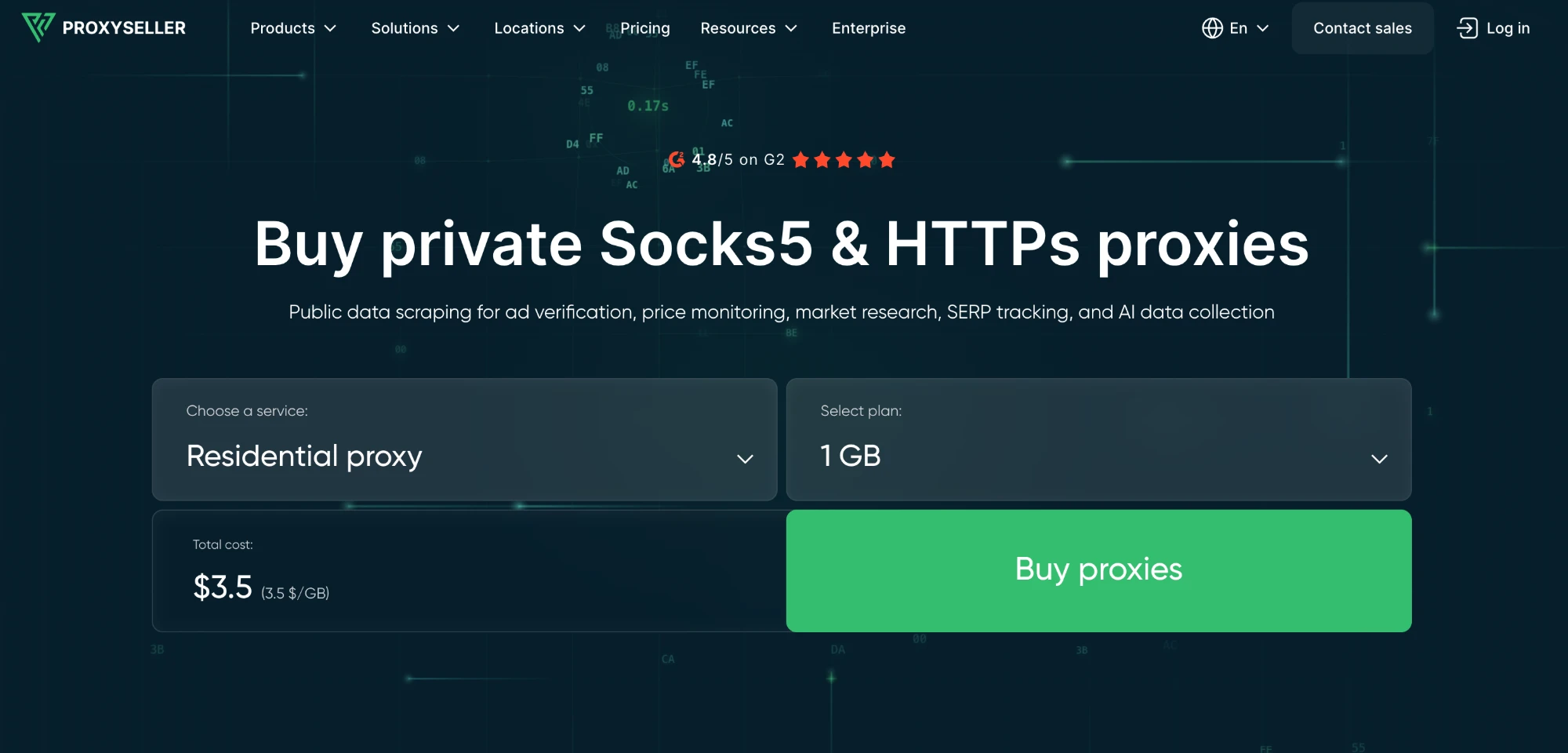
Dedicated 4G/5G/LTE mobile endpoints with manual or timed rotation, priced per IP from $10 with a one-week minimum. Pool size undisclosed. Best for users who manage their own cellular infrastructure.
Proxidize

Private SIM-based 4G/5G mobile proxy platform, not a shared pool. Pricing from $2/GB with KYC required before access. Sticky sessions up to 3 days. Best for teams that need fully dedicated carrier connections.
Proxy-Cheap
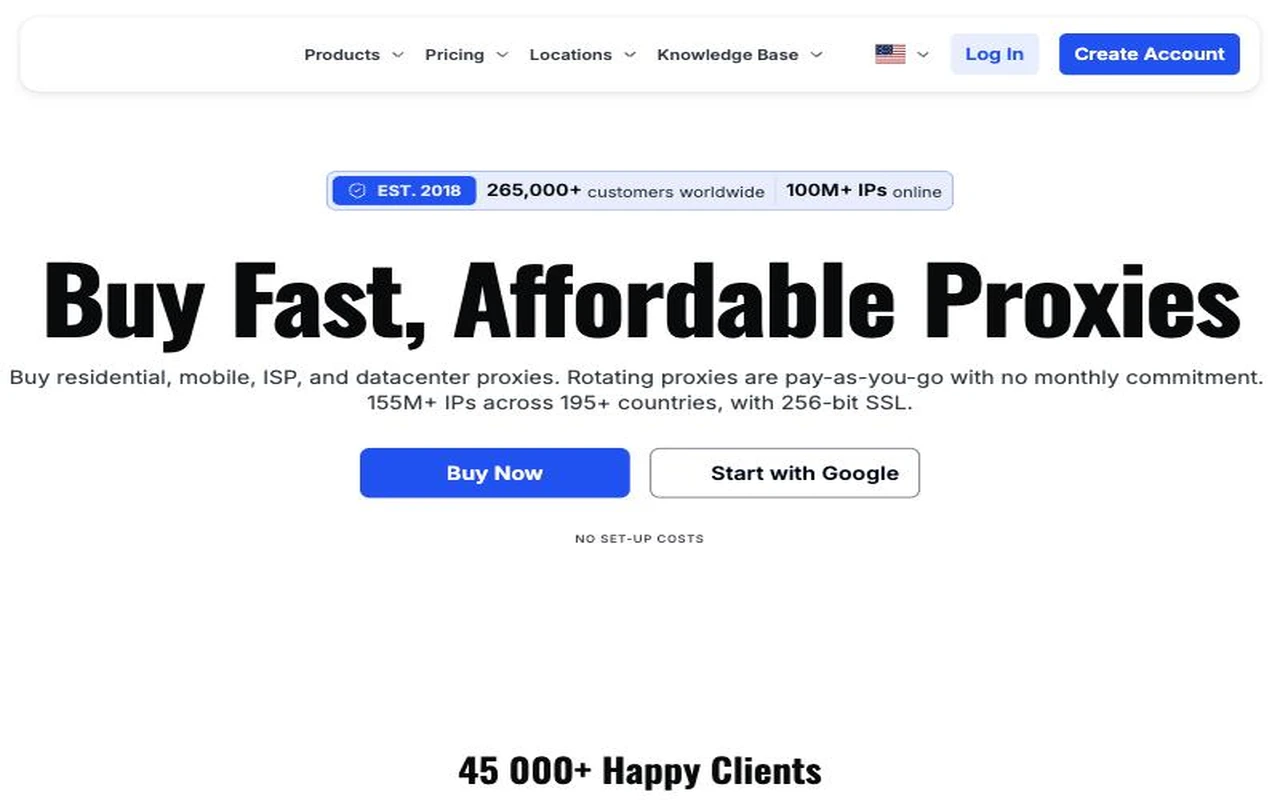
Rotating mobile from $5.99/GB and static mobile per IP. 5M+ mobile IPs in 100+ countries (vendor-stated). Static and rotating products use different billing and session rules. Best for basic app testing at a low absolute cost.
Pair with an antidetect browser: 1Browser
1Browser is not a proxy network, so it is not ranked above. For teams that manage many accounts on social or e-commerce platforms, an antidetect browser isolates each profile’s fingerprint (timezone, language, WebGL, cookies) and works with any provider on this list.
- Free plan with 10 profiles
- Basic from $7/month: 20 profiles, 2 GB of residential proxy traffic
- Professional $27/month: 100 profiles, 2 GB of residential proxy traffic
- Built-in proxies with country and city-level targeting across many locations
Which mobile proxy provider should you choose?
| Need | Pick | Why |
|---|---|---|
| Lowest cost per request | Floppydata | $0.012 per 1,000 successful requests in our benchmark |
| Highest reliability | Decodo, Oxylabs, SOAX | All at 99.8% success in our test |
| Fastest connections | Byteful | 0.73 s median, confirmed by Proxyway |
| Best sticky sessions | Decodo, Oxylabs | 78.6% and 78.4% in 30-minute sessions |
| Best confirmed mobile IPs | SOAX, Evomi, NodeMaven | 99%+ mobile classification by both IP2Location and MaxMind |
| Best for Instagram | Oxylabs, Decodo | 99.7% and 99.4% success in our test |
| Best for Google | Floppydata, Oxylabs | 97.8% and 97.0% in our test |
| Carrier targeting | SOAX, Decodo | Named carriers; SOAX adds 3G/4G/5G/LTE selection |
| Pay-as-you-go | DataImpulse, Floppydata | Non-expiring traffic; no subscription |
| Private SIM | Proxidize, Proxy-Seller | Dedicated endpoints or SIM-based access |
How to run a pilot in 1–2 weeks
Week 1 — setup and baseline (2–3 providers)
- Pick two or three providers from your shortlist and buy the smallest package from each.
- Set up the same script pointed at your actual target sites — not just a test endpoint. Use our benchmark scripts as a starting point.
- Run 5,000–10,000 requests per provider per day for five days. Log every request: status code, response time, response size, exit IP and whether the response contained the expected data.
- Check mobile IP classification with IP2Location or MaxMind on a sample of exit IPs.
Week 2 — stress and decision
- Double the concurrency on the provider that looked best. Watch for rate-limit errors and latency spikes.
- If your workload needs sticky sessions, run a session-stability test: open 50 sessions for 30 minutes each and count how many kept the same IP.
- Compare providers on the four metrics that matter for your case. The cheapest per GB is often not the cheapest per successful request.
What to watch for:
- Dashboard traffic counters can differ from your logs. Use your own logs for cost calculations.
- Test from the geography your production traffic will use.
- A provider that scores well on a Cloudflare endpoint may score differently on your target. Always test on your actual sites.
- Check whether your target specifically inspects MaxMind or IP2Location for mobile classification — the databases disagree on several providers.
Conclusion
There is no single best mobile proxy for every target. Floppydata, our own product, had the lowest cost per successful request in our benchmark ($0.012 per 1,000), but also the weakest sticky sessions and a lower overall success rate than the leaders. For raw reliability, Decodo, Oxylabs and SOAX all reached 99.8% success. For speed, Byteful was fastest at 0.73 s median. For confirmed mobile IP quality, SOAX, Evomi and NodeMaven had the strongest classification across multiple databases.
These are measurements from one test, not a permanent ranking. Mobile proxy performance changes with country, carrier, target site and session strategy. Run a pilot on your own targets, and check the raw benchmark data to compare providers on the metrics that matter for your workload.
How much do mobile proxies cost?
Rotating mobile traffic ranges from $1/GB (Floppydata) to $9/GB (ProxyEmpire) at entry level. Cost per successful request varies more: in our benchmark it ranged from $0.012 (Floppydata) to $0.132 (ProxyEmpire) per 1,000 requests. Dedicated mobile endpoints are sold per IP, day or month and are not directly comparable to per-GB rotating pools.
Which mobile proxy provider is the most reliable?
In our October 2026 mobile benchmark, Decodo, Oxylabs and SOAX all reached 99.8% success rate on a Cloudflare endpoint. Byteful was close at 99.7%. Performance on protected targets like Google and Instagram varied: Oxylabs led Instagram at 99.7% and Floppydata tied for the highest Google success at 97.8%.
Are mobile proxies faster than residential proxies?
Not necessarily. Mobile proxies route through carrier networks and can have higher latency than datacenter or some residential proxies. In our test, median latency ranged from 0.73 s (Byteful) to 1.34 s (NodeMaven). Choose mobile proxies when you need carrier-issued IPs, not when speed is the only concern.
What is the difference between rotating and dedicated mobile proxies?
Rotating mobile pools are billed per GB and give access to many carrier IPs — best for scraping, geo-testing and ad verification. Dedicated mobile proxies are billed per IP, day or month and keep one carrier connection under your control — best for long-lived accounts and manual IP management.
How do I know if a provider's IPs are really mobile?
In our benchmark we checked 10,000 IPs per provider against IP2Location and 1,000 against MaxMind. IP2Location classified 90–99% as mobile at every provider. MaxMind disagreed on some networks, classifying many as Cable/DSL. No single database is definitive — check against multiple sources if mobile classification matters for your use case.
Can I use a residential proxy benchmark to judge mobile proxies?
No. Residential and mobile pools use different networks, sourcing, routing and session behavior. Our mobile benchmark tests mobile traffic specifically and its results differ from our [residential benchmark](/residential-proxy-benchmark/) even for the same providers.
What is the best mobile proxy for social media management?
For Instagram specifically, Oxylabs (99.7%) and Decodo (99.4%) had the highest success rates in our test. For carrier targeting on social platforms, SOAX offers named 3G/4G/5G/LTE carrier selection. Pair any provider with an antidetect browser like 1Browser for multi-account isolation.
How should I test a mobile proxy before scaling?
Use the same target URLs, country, session rules, request client and success criteria for every provider. Track success rate, median and P90 latency, IP reuse, mobile-network classification, geo accuracy, sticky-session stability and cost per successful request. Our benchmark scripts are on GitHub.