
Table of Contents
- TL;DR
- What Are IPv6 Proxies & Why Use Them?
- IPv4 vs IPv6 Proxies: Which Should You Choose?
- Types of IPv6 Proxies
- How I Tested and Ranked IPv6 Proxy Providers
- 1. Floppydata: Best Overall IPv6 Proxy
- 2. 1Browser: Best IPv6 Proxy Browser
- 3. ColdProxy: USA-Only Residential IPv6
- 4. PlainProxies: Affordable IPv6 Proxies
- 5. Rainproxy: Cheapest Unlimited IPv6 Ports
- 6. Infatica: Premium Residential IPv6
- 7. Proxy-Seller: Static Carrier IPv6 at Ultra-Low Cost
- How Floppydata ranks across three independent benchmarks
- IPv6 Proxy Pricing Comparison
- Which IPv6 proxy should you choose?
- Conclusion
TL;DR
- Cheapest IPv6 residential: Floppydata at $1/GB — ranked #1 by cost per request across all three of our benchmarks (residential, mobile, cloud browsers)
- Fastest IPv6: Evomi at 0.68 s median latency, 99.9% success
- Best sticky sessions: DataImpulse at 87.2% (highest tested), $1/GB
- Free IPv6: 1Browser includes IPv6 when sites support it
What Are IPv6 Proxies & Why Use Them?
There are a total number of 4.3 billion possible IPv4 combinations. Right after the internet got mainstream, we ran out of IPv4 addresses since they are all being used in billions of devices today. That is the problem IPv6 solves with effectively unlimited address space. A single /64 subnet contains more IPs than the entire IPv4 technology.
There are about 340 undecillion or 3.4 × 10³⁸) unique IPv6 addresses in the world. In short, we’re never running out of this address space, ever. This means, you don’t have to reuse IPs from other people when using a proxy. You can use a completely new IP, never used before, to access major websites that support IPv6.
IPv4 addresses are more expensive because they are scarce, and supported by the entire internet. IPv6 can be acquired cheaply, and used on major platforms like Google, Facebook, CDN providers, etc. This eliminates the problem of reusing IPs from other people again and again, or accidently using an abused IPv4 address that can result in account ban.
IPv4 vs IPv6 Proxies: Which Should You Choose?
IPv6 is not automatically better or safer than IPv4. Most of the internet still hasn’t moved onto IPv6 so compatibility becomes the biggest bottleneck. The right choice depends on the websites you access and what you are trying to do.
| Feature | IPv4 Proxies | IPv6 Proxies |
|---|---|---|
| Address pool | 4.3 billion (exhausted) | 3.4 × 10³⁸ (unlimited) |
| IP cleanliness | Often reused and flagged | Fresh, never-used IPs |
| Website support | Universal (100%) | Partial (~40% of top sites) |
| Cost per IP | Higher (scarce supply) | Lower (abundant supply) |
| Best for | Multi-site automation, legacy targets | High-volume scraping, single-platform ops |
| Risk | Shared IPs may be blacklisted | Target may not support IPv6 |
| Geo accuracy | Well-established databases | Less consistent |
Choose IPv6 when your targets support it and you need large volumes of affordable, clean IPs. Choose IPv4 when you need universal compatibility or work with older sites. Every website supports IPv4, so when your automation spans many different sites, IPv4 is still the safer default.
Types of IPv6 Proxies
Most proxy providers offer IPv6 datacenter and residential proxies. It is hard to find reliable mobile IPv6 proxies because only a few mobile carriers have shifted to IPv6 infrastructure internally. We will consider residential and datacenter IPv6 proxies in this blog.
You can either get a static (dedicated) or rotating IPv6 proxy defending on your use case. In a static proxy, you get a fixed subnet or a single IPv6 address that won’t change. You use it as much as you want and need to buy another one separately if you need more addresses. Rotating IPv6 gives you unlimited address but limits your bandwidth. You pay per GB and use as many IPs you need until you run out of bandwidth. An IPv4 address is shorter and uses four sets of numbers separated by dots.
An IPv4 address looks like: 192.168.2.1
An IPv6 address is much longer and uses hexadecimal characters, numbers 0–9 and letters a–f separated by colons
An IPv6 address looks like: 2001:0db8:85a3:0000:0000:8a2e:0370:7334
Residential vs Datacenter IPv6 Proxies
When choosing an IPv6 proxy provider, it is important to note what kind of IPv6 proxy they provide, and whether it fits your intended use-case.
| Residential IPv6 | Datacenter IPv6 | |
|---|---|---|
| Source | Consumer ISP connections | Server / hosting provider |
| Trust level | High — looks like a real user | Low — easily detected |
| Price | $1–6/GB | $0.07–0.50/day unlimited |
| Best for | Social media, multi-accounting, sensitive tasks | Scraping, bulk requests, speed-first tasks |
| Risk | More expensive at scale | Account bans on strict platforms (Google, Facebook, TikTok) |
| Providers | Floppydata, Infatica, ColdProxy | PlainProxies, Rainproxy, Proxy-Seller |
Residential IPv6 addresses are considered safer because they are consumer internet connections and carry a better reputation. You can use a residential IP when trust matters more (automating social media jobs, posting on platforms with strict detection systems). Datacenter IPv6 proxies are usually easier to scale and much cheaper because these IPs originate from a server, and are sometimes shared between multiple users. I prefer them for high-volume tasks where the target accepts datacenter traffic and I do not need the proxy to resemble a normal household connection.
How I Tested and Ranked IPv6 Proxy Providers
Several pages in search results, and the AI overview itself misdirects you about IPv6 proxies. They list services that don’t actually provide any IPv6 addresses, and only have landing pages or blogs on them. I landed on Webshare, Oxylabs and other providers but after signing up, I found no IPv6 proxies. I even asked the Oxylabs bot to guide me to IPv6 proxies and it said the platform doesn’t provide any (even when Google AI overview told me they do).
So, my ranking in this blog is based on:
- Actual IPv6 availability: Whether you can currently buy or use IPv6 proxies, rather than the provider simply mentioning IPv6 support.
- Proxy type: Whether the IPv6 addresses are residential, datacenter, static, rotating, or part of a mixed IPv4/IPv6 pool.
- Speed and stability: How suitable the proxies are for repeated requests, scraping, automation, and longer sessions.
- Geo accuracy: How much control you get over countries, regions, or cities and how consistently the IP location matches the selected target.
- Pricing model: Whether you pay per GB, per IP, or through a subscription, plus the minimum cost to get started.
Here is a quick summary table of my top IPv6 proxy providers ranked in order.
| Provider | IPv6 Offering | Pool / Coverage | Price (IPv6) | Best for | Main Limitation |
|---|---|---|---|---|---|
| Floppydata | Rotating IPv6 (per-GB bandwidth) | “All countries” residential pool | $1.00/GB (flat rate) | Overall cheapest & global | IPv6 cannot be selected manually |
| 1Browser | Browser with built-in proxies | 100+ countries (residential & mobile built-in) | Free tier (10 profiles) or $9/mo (20 profiles + 2 GB) | Multi-account browsing (free) | IPv6 is not guaranteed on every proxy rotation |
| ColdProxy | USA Residential IPv6 (/32), rotating or sticky | USA only (Ashburn), /32 subnet | $3.99/day or $0.99/hr for unlimited traffic (10 Mbps) | US-only IPv6, reliable targets | USA only |
| PlainProxies | Dedicated/rotating IPv6 | Unlimited IPv6 pool (not metered) | €6.00/day (roughly $6/day) (unlimited traffic) | Very low cost, high volume | Limited to 4 countries |
| Rainproxy | Dedicated IPv6 port (10 Mbps–1 Gbps) | /64 subnets, ≈2^64 IPs, 10 Gbps backbone | $0.50/day for 10 Mbps datacenter | Ultra-cheap unlimited traffic | Datacenter-only IPv6 with limited geo control |
| Infatica | Rotating IPv6 (residential-style) | Large pool (45M+ IPs claimed) | $6/GB | Clean IPs, pay-as-you-go | Expensive pricing and KYC required |
| Proxy-Seller | Static IPv6 (carrier-sourced) | 47M+ IPs (direct LIR allocation) | $0.08/IP (static, unlimited bandwidth) | Static IPv6 at rock-bottom cost | Static-only IPs with weaker geo consistency |
1. Floppydata: Best Overall IPv6 Proxy
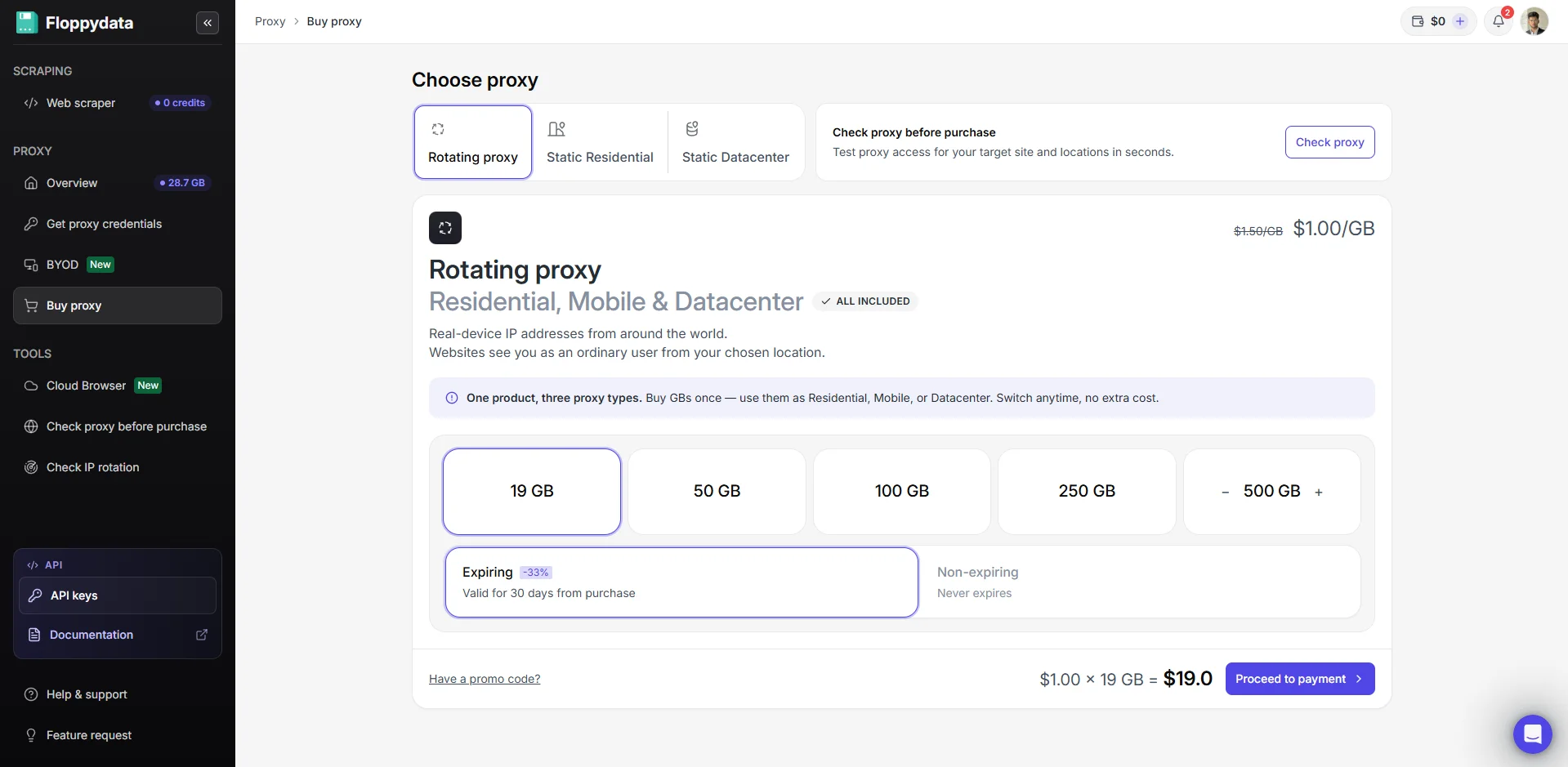
Floppydata has the best performing IPv6 proxies in my opinion. They offer rotating IPv6 residential proxies. The most useful feature of Floppydata is that I don’t need to buy a separate IPv6 proxy pool. I can use my existing bandwidth to use IPv6 residential proxies.
Floppydata lets you use any proxy (residential, mobile or datacenter) in one usage subscription. If you have 20GB bandwidth, you can rotate as many IPs you want. In my test, the residential proxy type gave me IPv6, while mobile and datacenter proxies returned IPv4 addresses. The best part is that proxy bandwidth can be purchased at a flat $1/GB rate with no additional or hidden charges.
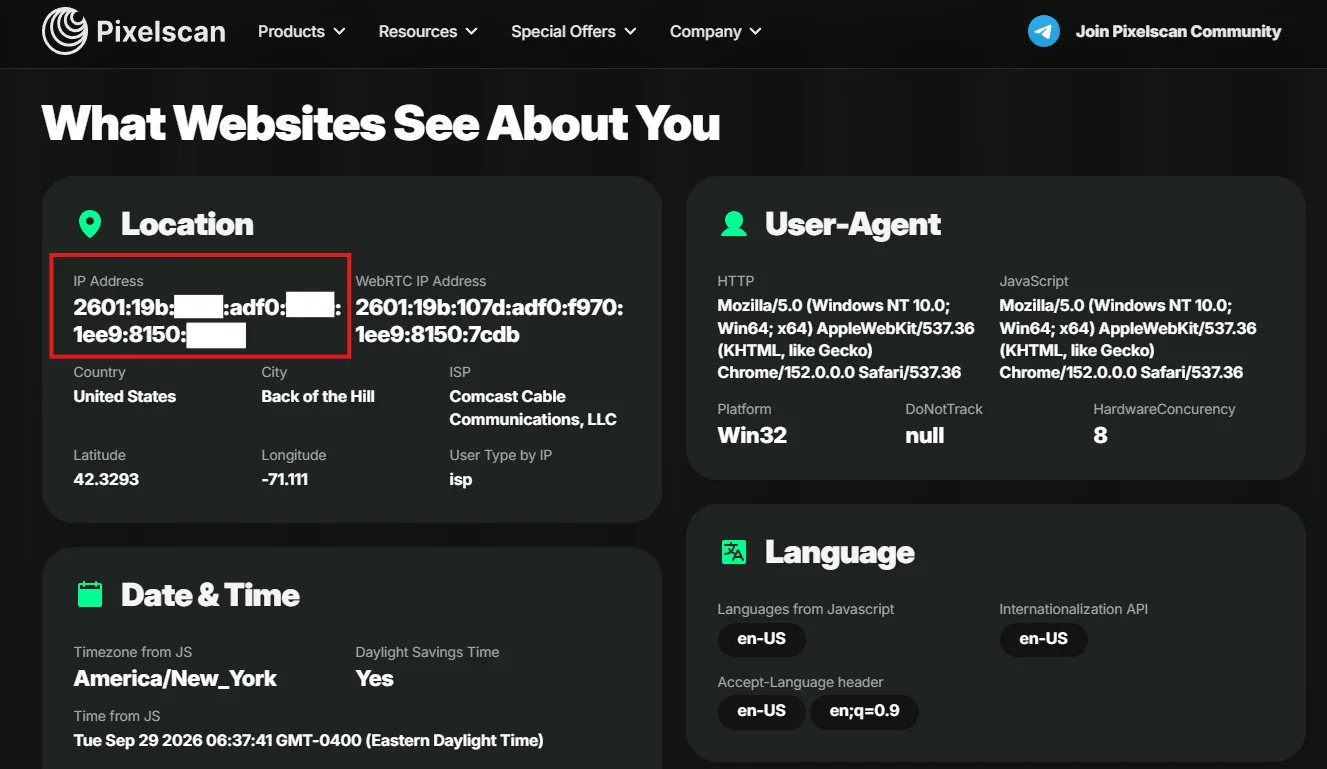
I tested Floppydata rotating residential proxy in my Gologin antidetect browser and both Iphey and Pixelscan showed me an IPv6 address. You can’t specifically select an IPv6 option within the app but all residential IPs can be IPv6 if the target platform (Google, CDN providers, Facebook) support IPv6 connection. As you can see in my test, Pixelscan and Iphey detect and use your IPv6 address when available. The same test on their rotating mobile proxy returned an IPv4 address in my test.
- IPv6 Proxy Quality: Excellent
- Pricing: Flat $1/GB for all rotating proxy types
Verdict: Best overall IPv6 value. $1/GB with IPv6 included. See benchmark results below. Skip if you need dedicated IPv6 subnets.
2. 1Browser: Best IPv6 Proxy Browser
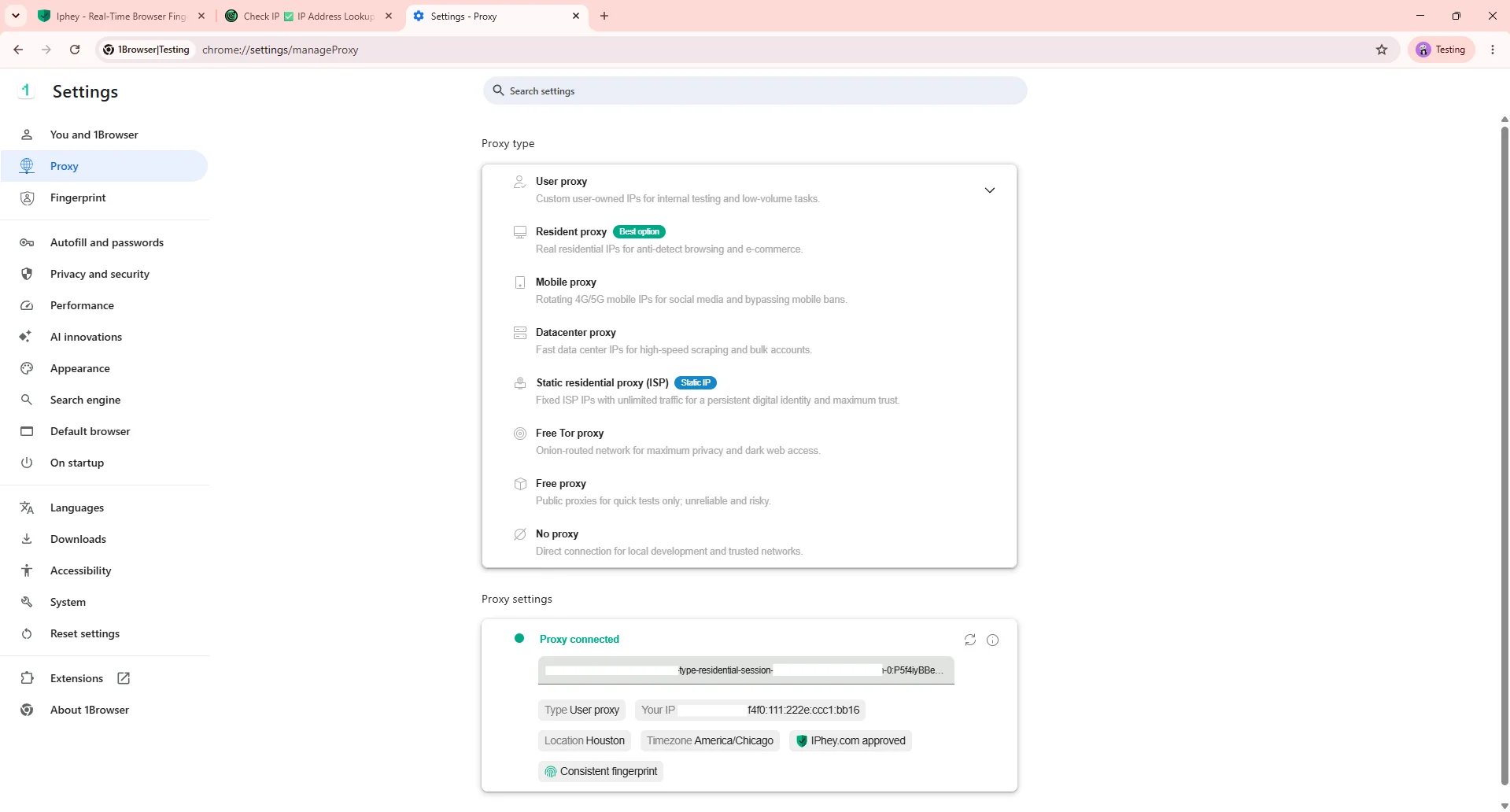
1Browser is not a proxy provider but an antidetect browser with built-in proxies. I love 1Browser because it not only provides built-in proxies, I can also create real-looking antidetect browser profiles with them. 1Browser says they provide IPv6 proxies. However, there is no option in their app to specifically select IPv6 proxy. You get a rotating residential proxy, and automatically get assigned an IPv6 address.
Honestly, with 1Browser, it is a hit and miss. Out of 4 tests, I got an IPv6 proxy 3 times and got an IPv4 one time. Since their proxy pool is randomly assigned based on availability, you might not always get an IPv6 out of the box. It is best to check using Iphey and Pixelscan to see whether you’re using an IPv6 address. If not, just rotate the proxy and test again to see if the new proxy is IPv6.
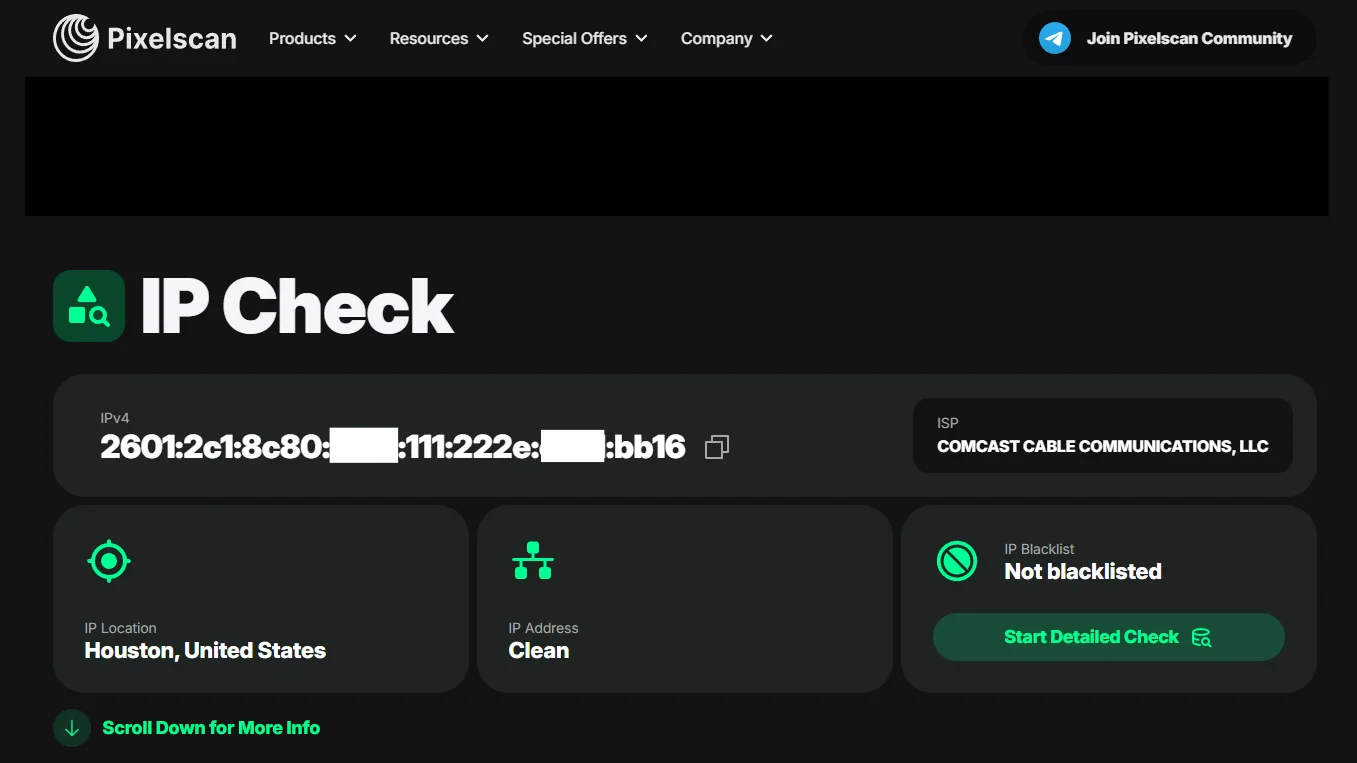
1Browser’s free plan gives you 10 profiles and limited country coverage (USA, Germany, Australia, India, Canada) at no cost. The Basic plan is $9/mo and unlocks 20 profiles, 100+ country proxies. I included it in the list because proxies are great, there is a high chance of IPv6 proxy in residential type, and most people connect proxy to a browser, which in this case comes attached to the browser itself and is a way more convenient option.
- IPv6 Proxy Quality: Good
- Pricing: Free tier offers 5 countries; $9/mo pro tier for 100+ countries
Verdict: Best free IPv6. Auto-IPv6 when sites support it. Skip if you need to force IPv6 on every request.
3. ColdProxy: USA-Only Residential IPv6
ColdProxy provides USA-only residential IPv6 proxies. They provide a whole 32 bit IPv6 subnet in Ashburn, VA so all your traffic comes from US residential proxies. You can choose to stick to one IP, or rate it from 5 seconds to 24 hours which is impressive control over rotation.
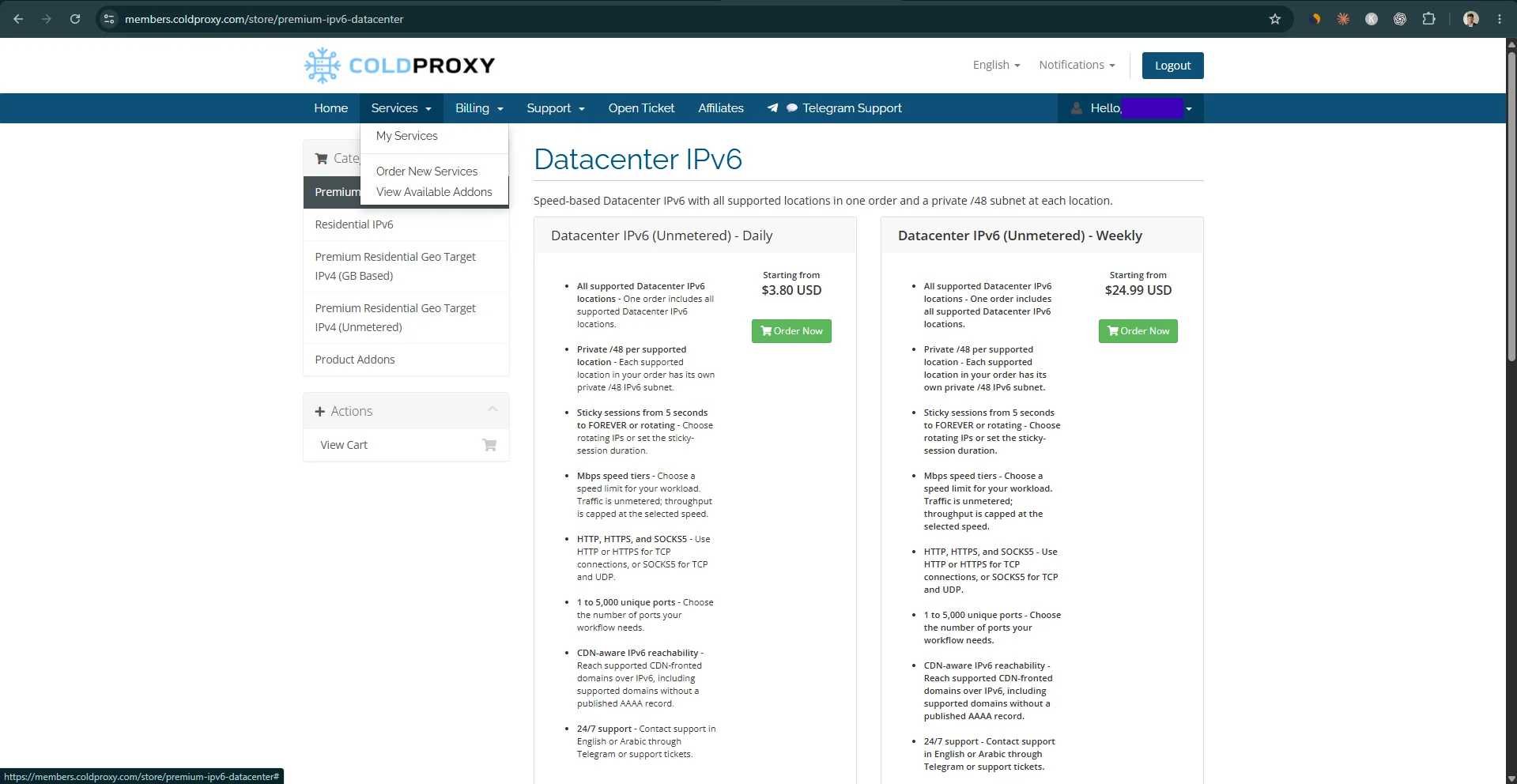
ColdProxy is best when your target website supports IPv6 addresses from the USA. I just found their dashboard very outdated and confusing. It is hard to navigate proxy services, types, payment process, or even create your own proxies from your package. As someone with experience with so many proxy providers, this was the most difficult and cumbersome to figure out.
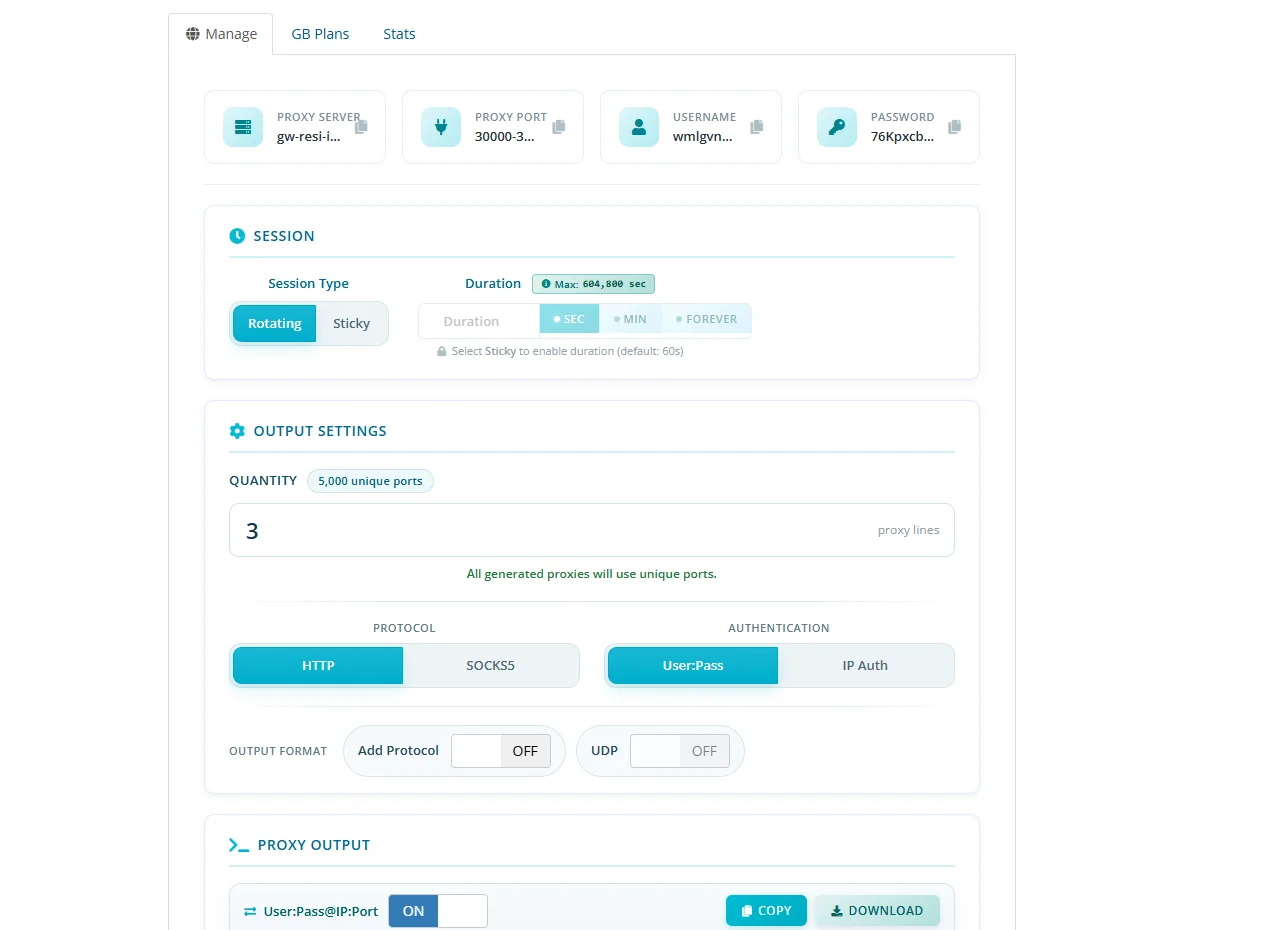
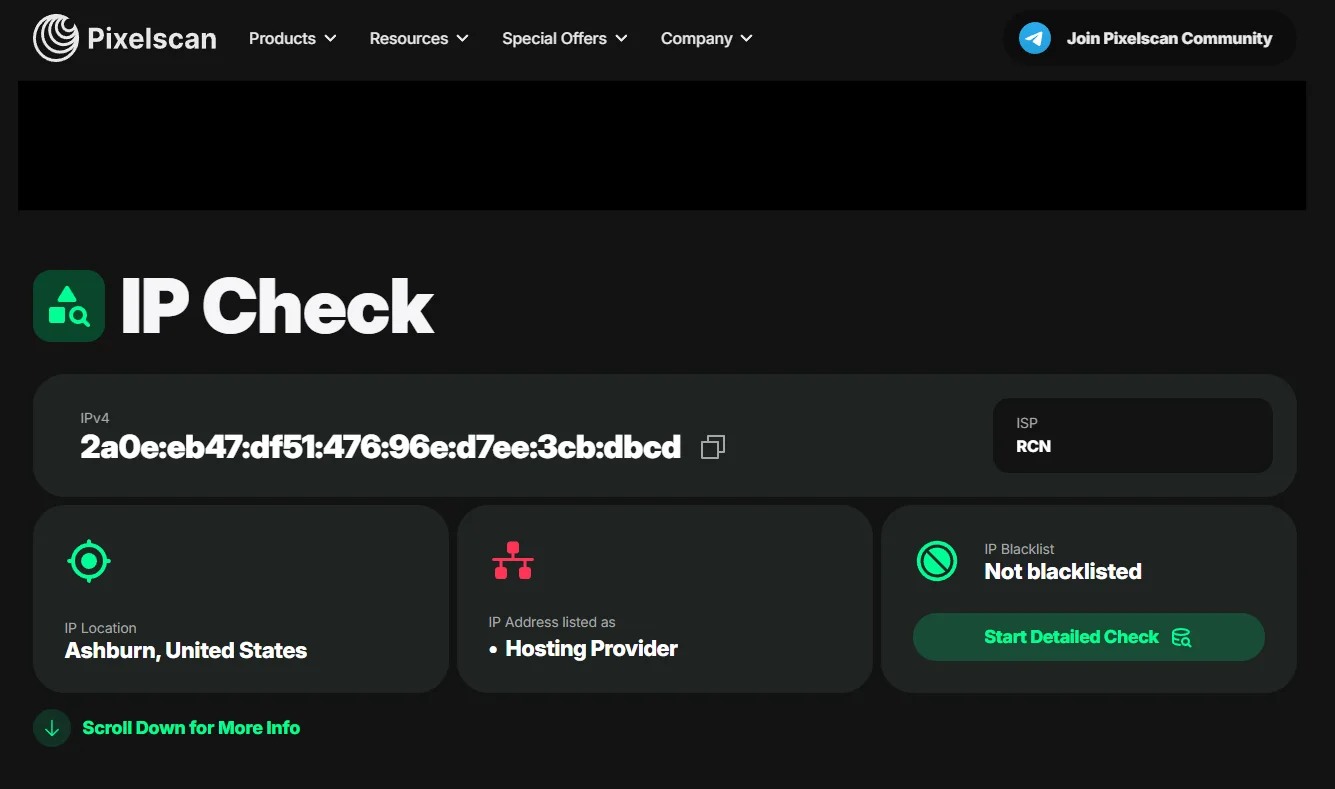
However, proxy results were promising. ColdProxy explicitly offers a pool of residential and datacenter IPv6 proxies for use cases that absolutely need it. I tested residential IPv6 proxies and here are the results.
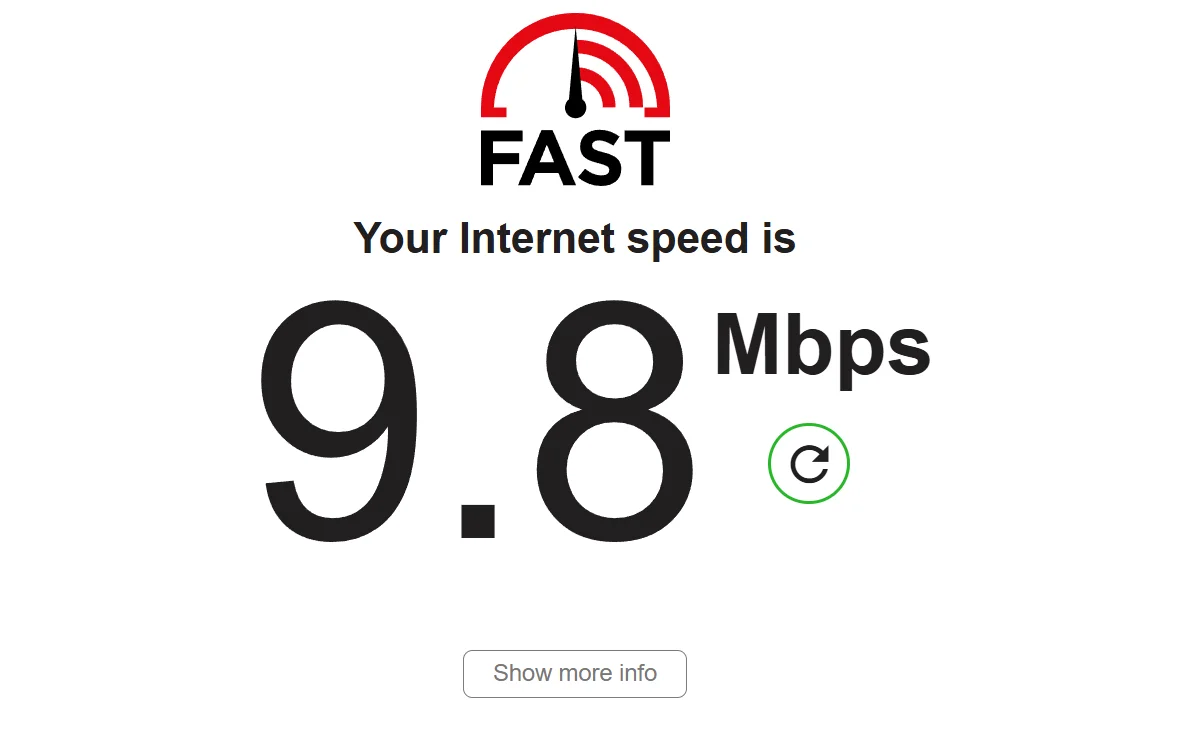
I checked the proxy speed and was able to get 9.8 Mbps since I bought the 10 Mbps proxy plan. Higher speed plans can cost significantly more and that’s one of the reasons ColdProxy is ranked third. Their dashboard is hard to use, and with decent 30-50 Mbps, you are looking at huge monthly bills compared to Floppydata.
- IPv6 Proxy Quality: Excellent
- Pricing: $0.99/hr, $3.99/day, $41.99/mo for IPv6 residential (10Mbps speed)
Verdict: Best USA-only IPv6 with subnet control. Skip for global geo coverage.
4. PlainProxies: Affordable IPv6 Proxies
PlainProxies has one of the most affordable IPv6 proxies but they come with restrictions you might not see at first. For starters, they only support 4 countries in both unlimited and limited bandwidth plans. 1100 locations in 4 countries is all you can choose from (USA, UK, Romania, Germany).
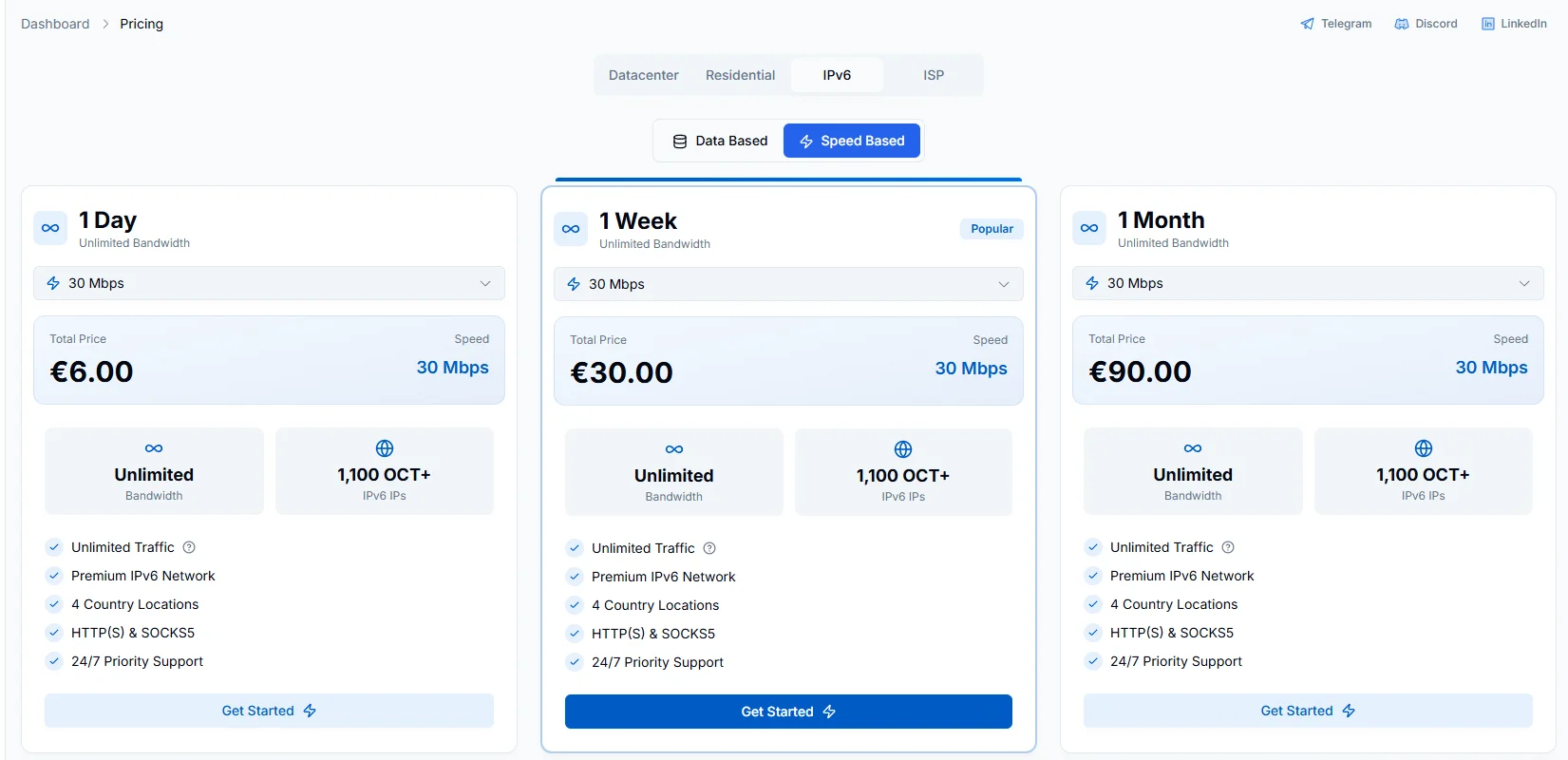
Instead of going with a limited bandwidth plan, I decided to test their 1 day 30Mbps plan. After payment, I was easily able to generate proxies using the proxy credentials generator. I selected a rotating US IPv6 proxy and tested the generated credentials in 1Browser for speed and authenticity.
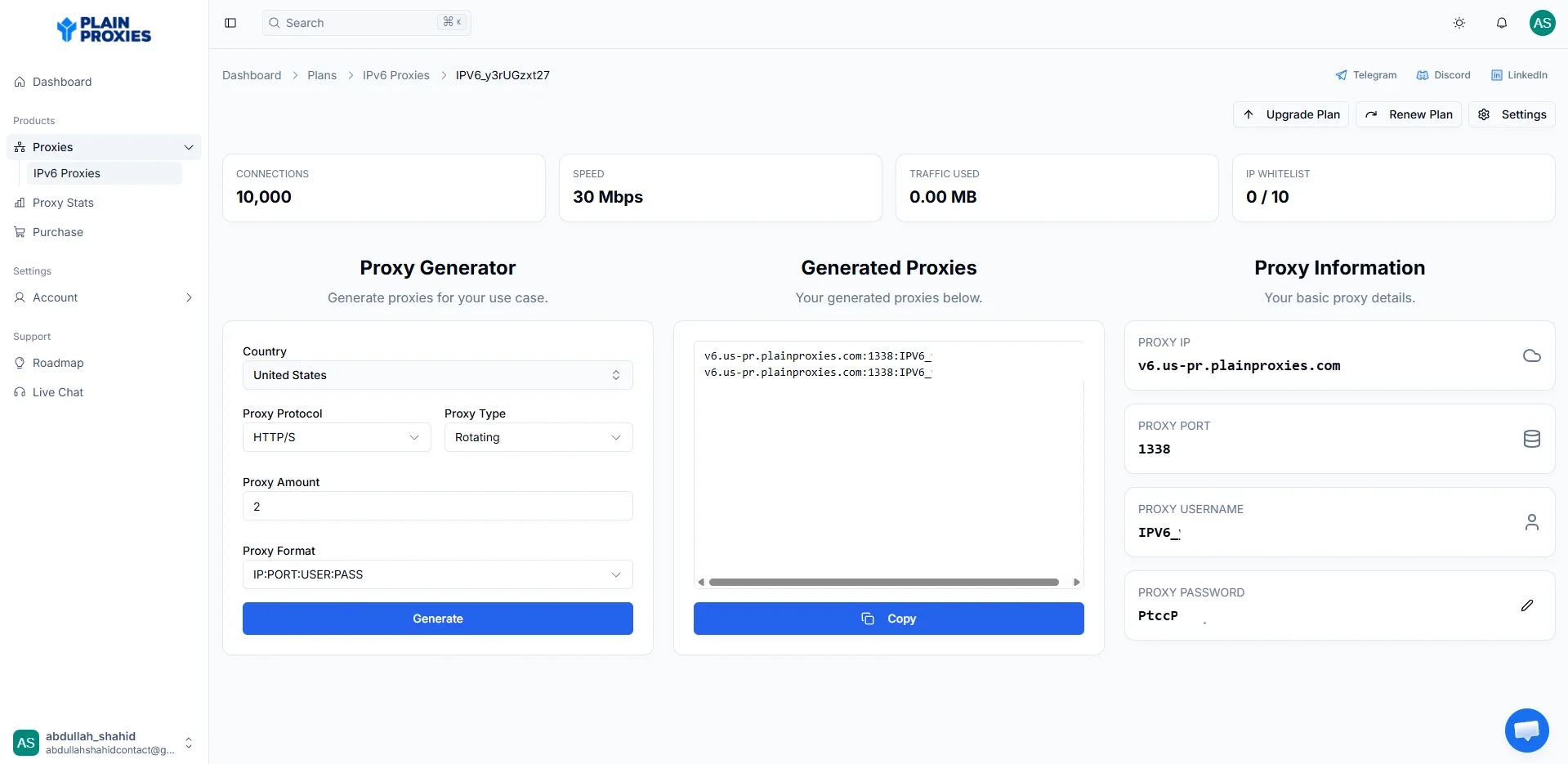
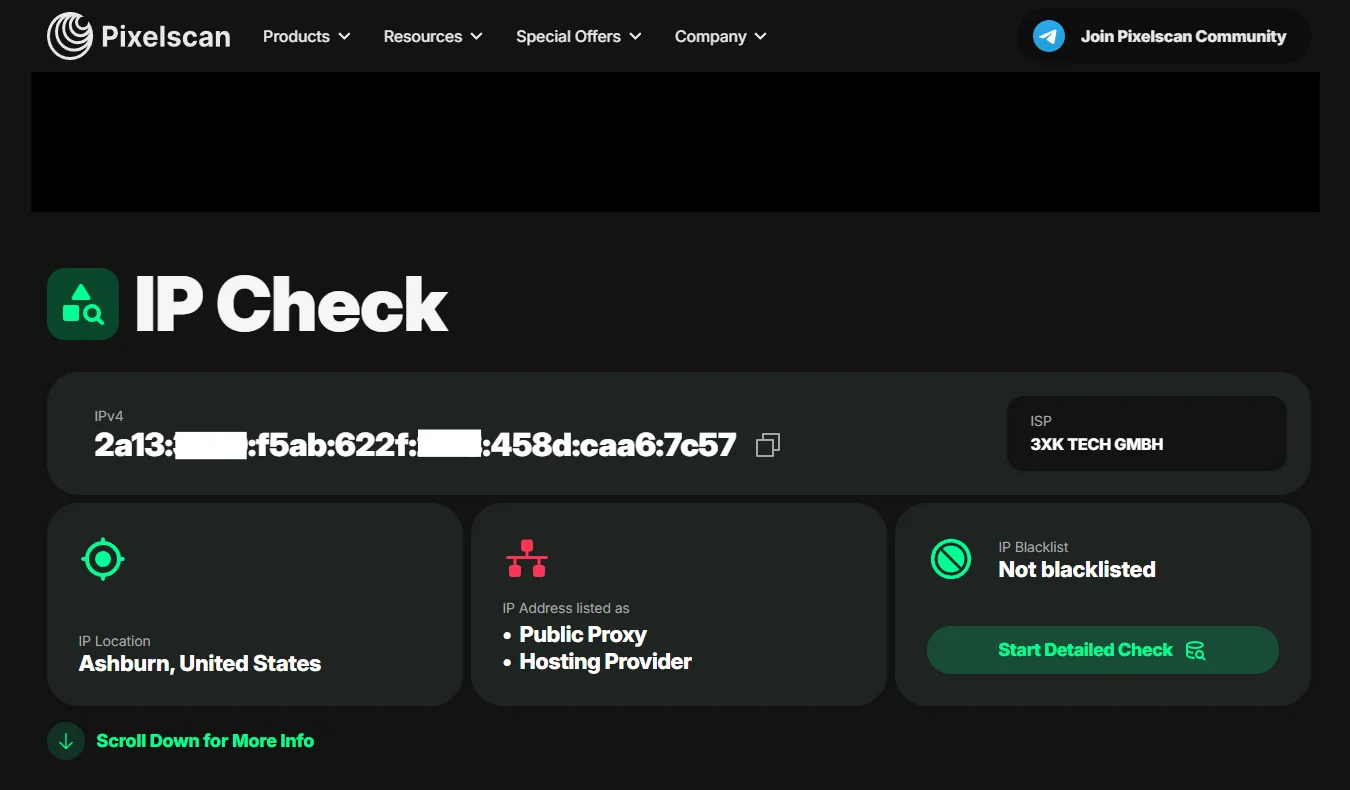
I got a fast 32Mbps speed from my test on Fast.com and an IPv6 address from Ashburn, US (same as ColdProxy). Although 1Browser marked their proxy as unreliable, Iphey and Pixelscan tests came back perfectly fine so safe to say that PlainProxies IPv6 address is a solid start.
- IPv6 Proxy Quality: Excellent
- Pricing: €6/day for 30Mbps unlimited bandwidth, €15/100GB bandwidth
Verdict: Best unlimited-bandwidth IPv6 datacenter. Skip for residential.
5. Rainproxy: Cheapest Unlimited IPv6 Ports
Rainproxy is even cheaper than Plainproxies, starting at $.50/day for 10Mbps speed. You can create many proxies through their proxy generator and use unlimited bandwidth for the whole day. I tried their 30 Mbps unlimited package and was surprised by how fast and stable their proxy speed was.
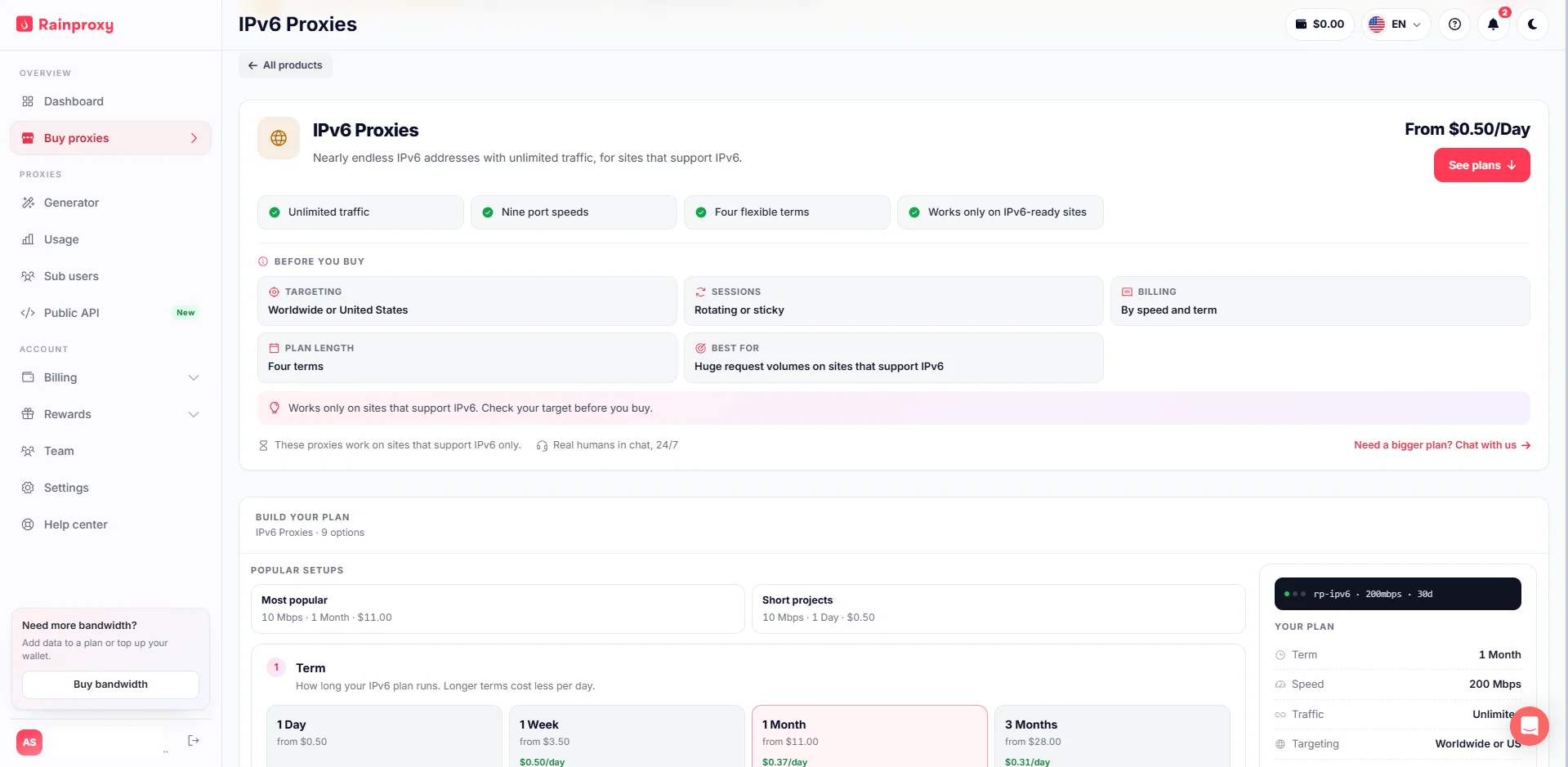
Rainproxy does not let you select any other specific country other than the USA. You can only select the worldwide option which randomly assigns a proxy, or the USA subnet. However, everything went great other than the fact that I was assigned an Ontario, Canada proxy with New York timezone. This could be problematic for multiaccounting and other sensitive workflows where location accuracy matters. Other than that, I got a stable speed at a very low price point which makes Rainproxy one of the most attractive IPv6 options.
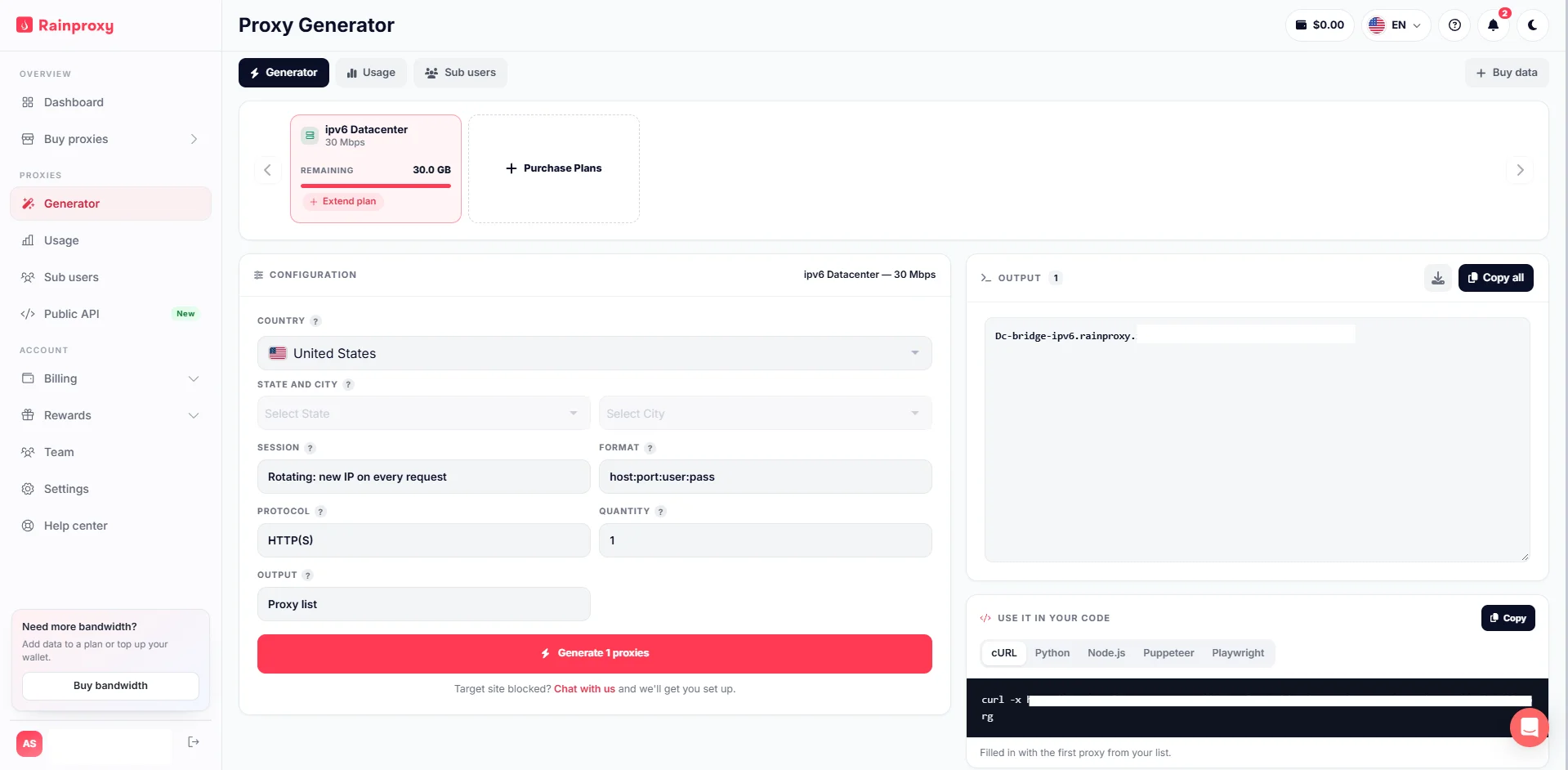
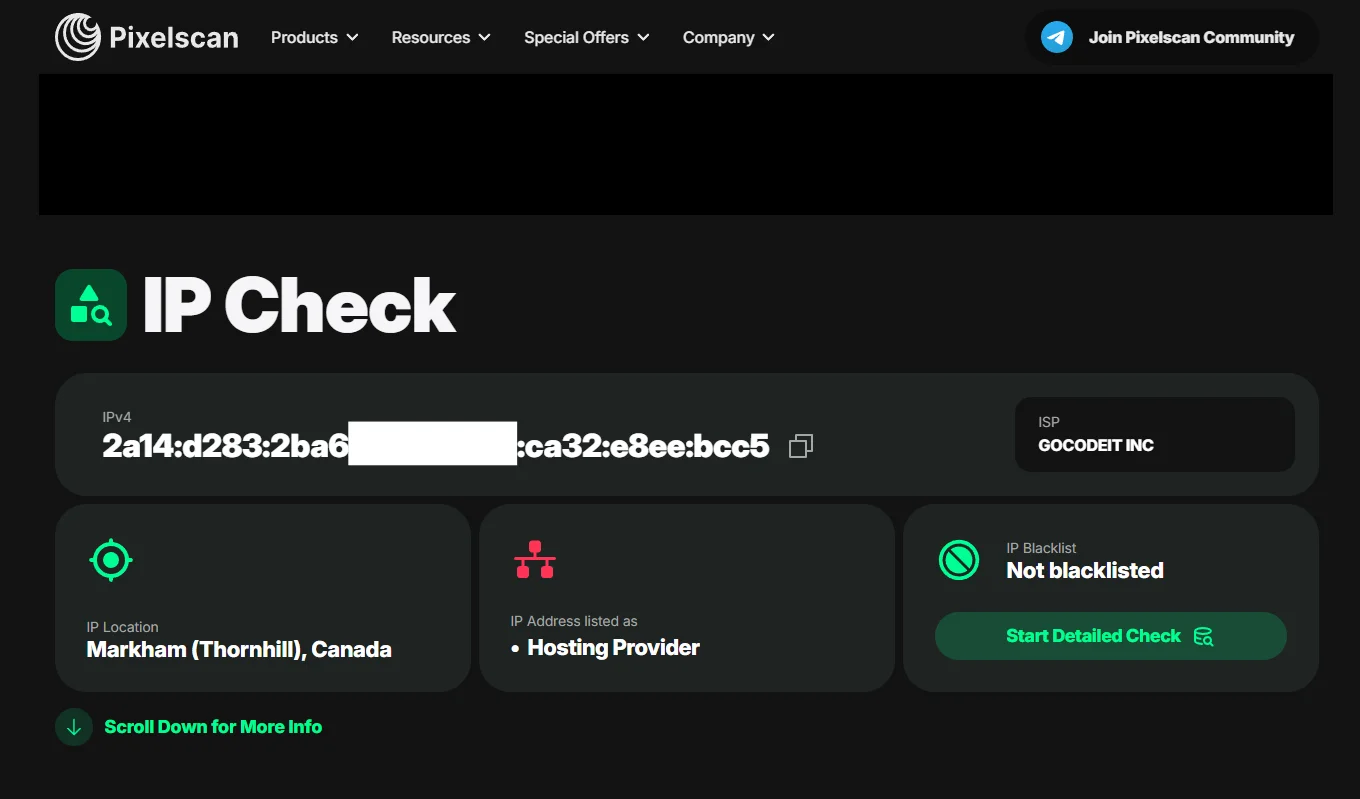
The drawback of Rainproxy is that their IPv6 proxies are datacenter IPs, not residential. This changes the pricing economics entirely because although Rainproxy is cheap, datacenter proxies are less trusted for platforms like Facebook and Google, especially for multi-accounting workflows.
- IPv6 Proxy Quality: Good
- Pricing: $2/day for 30Mbps unlimited bandwidth, $27/mo for 30 Mbps unlimited bandwidth
Verdict: Cheapest unlimited IPv6 at $0.50/day. Skip above 10 Mbps.
6. Infatica: Premium Residential IPv6
Infatica is the most expensive IPv6 residential proxy provider known for its ‘ethically sourced’ residential proxies. They offer premium IPv6 addresses starting at $6/GB in the pay-as-you-go model. The starting price point with Infatica is higher than the rest of the providers since if you don’t go with the PAYG model, you have to commit at least a few hundred dollars to get a decent discount.
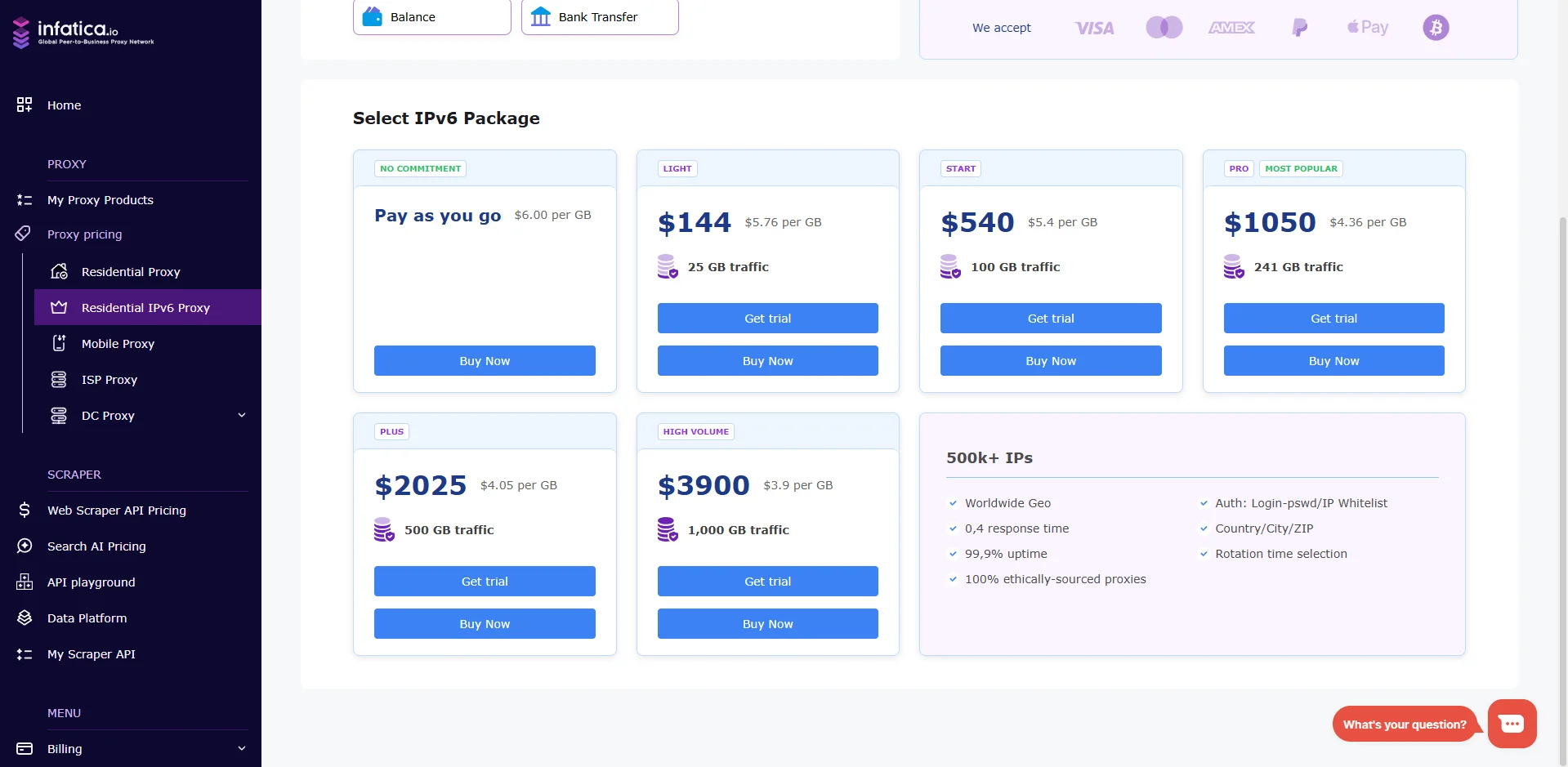
Note that Infatica requires KYC verification before you can make any purchase on their platform. There was a bug during payment where it didn’t go through and I had to contact customer support to be able to pay. Whenever I clicked the payment button, nothing went through. After resolving this bug, I went to test their IP. Infatica does not advertise any speed cap and it is based entirely on how far the proxy server is from you and how reliable your internet connection is.
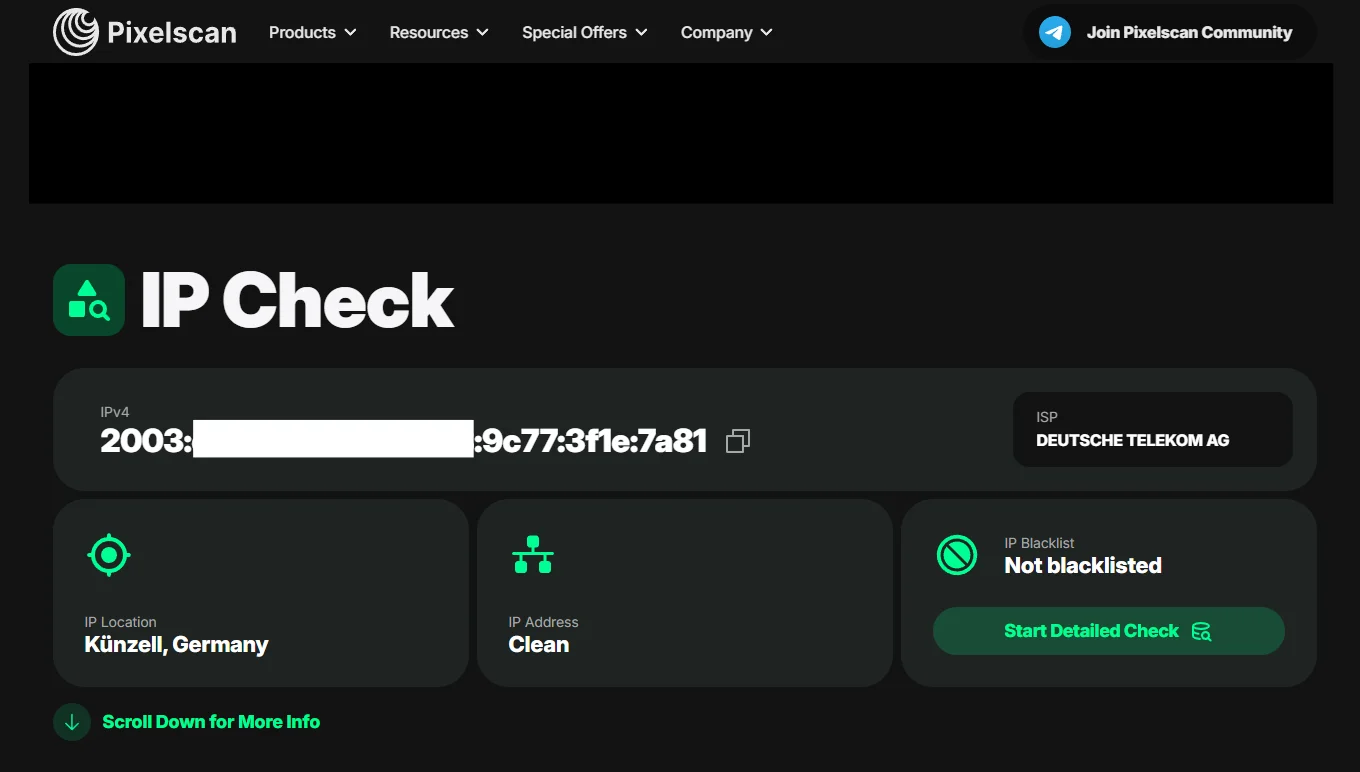
- IPv6 Proxy Quality: Excellent
- Pricing: $6/GB pay-as-you-go, $144 ($5.76/GB) at 25GB commitment
Verdict: $3/GB. Skip — Floppydata offers better at $1/GB.
7. Proxy-Seller: Static Carrier IPv6 at Ultra-Low Cost
Proxy-Seller has one of the cheapest proxies and is the most marketed proxy provider out there. However, their proxies are not always the best. I tested their IPv6 residential proxies which start at $0.08/IP which looks super cheap on paper. You can buy a minimum of 10 proxies so $0.8 is a decent starting point.
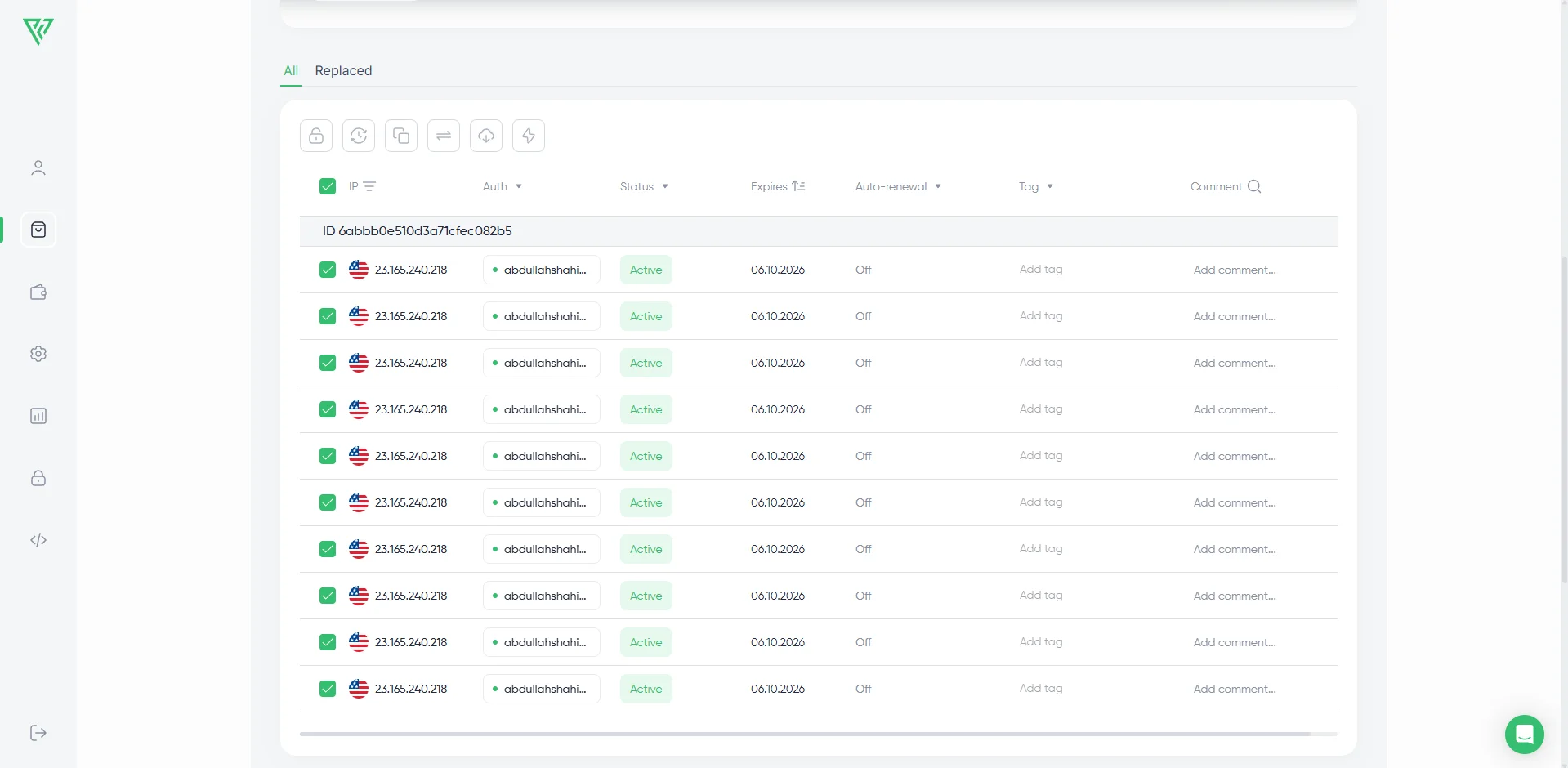
However, I was unable to copy-paste Proxy-Seller proxy credentials into 1Browser because they are not in the right format. Moreover, there is no way to decide whether you want to use SOCKS5, HTTP, or HTTPs proxy format when exporting. I had to use the Gologin browser and add the proxy manually after making sense of their proxy format. This is definitely not a good image for a proxy provider that markets their product everywhere I go.
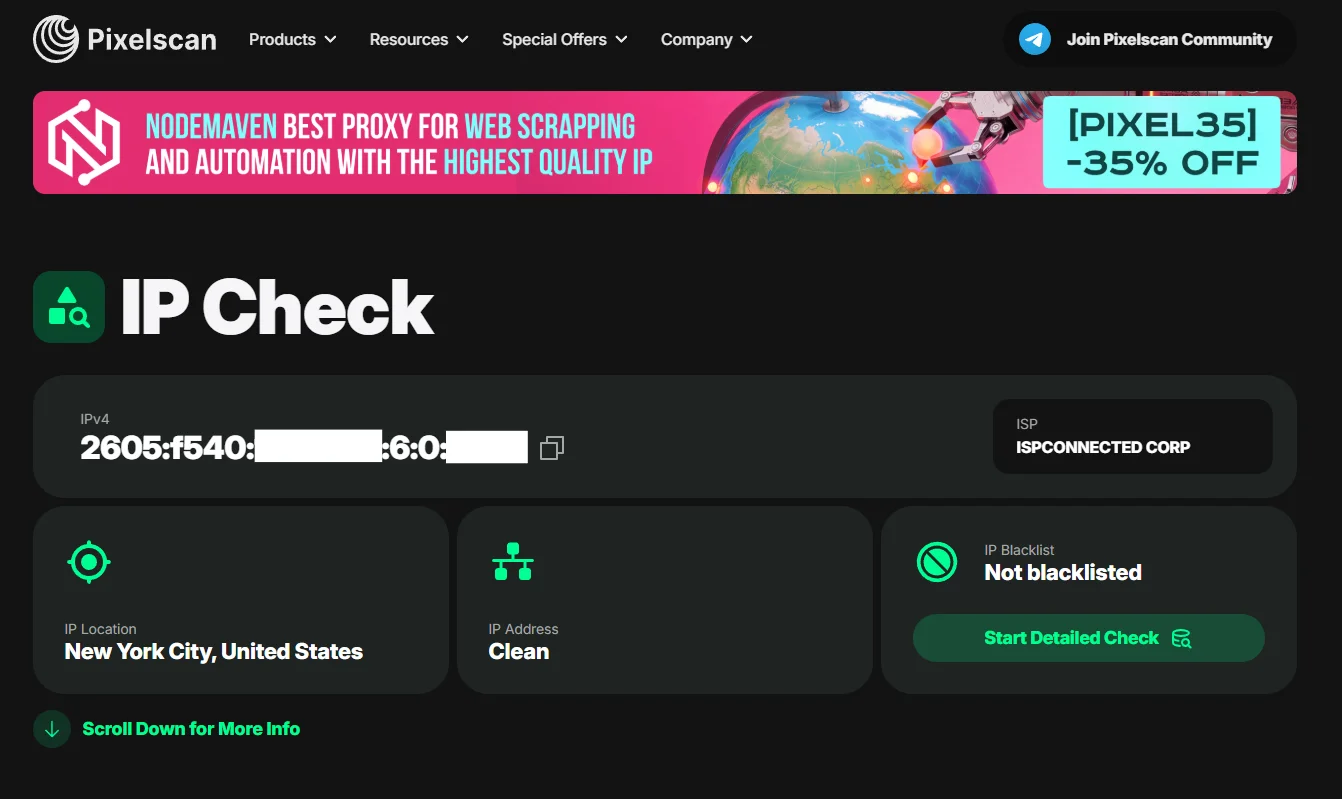
I tested their proxy after setting it up and the IP address is IPv6. However, Iphey marked it as potentially unsafe for multi-accounting tasks. I was provided New Jersey IP with Chicago timezone which was an instant signal for Iphey to mark it as unsafe. Moreover, you can only select a specific country when buying IPs. You can’t create more IPs or switch countries and these proxies expire after their duration is over.
- IPv6 Proxy Quality: Fine
- Pricing: $0.8/10 IPs for a specific country
Verdict: Best static IPv6 at scale. $0.08/IP unlimited. Static only.
How Floppydata ranks across three independent benchmarks
We run three independent proxy benchmarks. All scripts and raw data are public on GitHub.
Full results and raw data are in our residential proxy benchmark, mobile proxy benchmark and cloud browser benchmark. All scripts are open-source: residential, mobile and cloud browser.
IPv6 Proxy Pricing Comparison
| Provider | Pricing model | Min cost to start | Equivalent $/GB | Bandwidth cap |
|---|---|---|---|---|
| Floppydata | Per GB | $1 (1 GB) | $1.00 | No cap |
| 1Browser | Subscription | Free / $9 mo | Included | 2 GB on paid |
| ColdProxy | Per day/hour | $0.99 (1 hr) | ~$4–6 | 10 Mbps speed |
| PlainProxies | Per day or GB | €6 (1 day) | ~€0.20 at 30 Mbps | Unlimited |
| Rainproxy | Per day | $0.50 (1 day) | ~$0.07 at 10 Mbps | Unlimited |
| Infatica | Per GB | $6 (1 GB) | $6.00 | No cap |
| Proxy-Seller | Per IP | $0.80 (10 IPs) | N/A (static) | Unlimited |
Which IPv6 proxy should you choose?
| Need | Pick | Why |
|---|---|---|
| Cheapest IPv6 | Floppydata | $1/GB flat rate |
| Free IPv6 | 1Browser | Built-in proxies, auto IPv6 |
| USA-only IPv6 | ColdProxy | Dedicated /32 subnet |
| Unlimited bandwidth | PlainProxies or Rainproxy | Per day, no cap |
| Fastest | Evomi | 0.68 s median, 99.9% success, $1.04/GB |
| Static IPv6 | Proxy-Seller | $0.08/IP, unlimited |
Conclusion
IPv6 proxies give you access to fresh, never-flagged IP addresses at a fraction of IPv4 cost. The tradeoff is compatibility: not every website supports IPv6 yet, so check your target sites before committing.
For most users, Floppydata at $1/GB is the best starting point. It had the lowest cost per request in our residential, mobile and cloud browser benchmarks and includes IPv6 on residential proxies by default. If you need free IPv6, 1Browser bundles proxies with its antidetect browser. For USA-only tasks with subnet control, ColdProxy is the specialist. For unlimited-bandwidth datacenter IPv6 at the lowest price, Rainproxy starts at $0.50/day.
Whatever provider you choose, pair your IPv6 proxies with an antidetect browser like 1Browser or Gologin to manage fingerprints and sessions alongside your proxy rotation.
What are IPv6 proxies?
IPv6 proxies route your traffic through an IPv6 address instead of the older IPv4 format. Because IPv6 has a virtually unlimited address space (3.4 × 10³⁸ unique addresses), you can use fresh IPs that have never been flagged or abused by other users.
Are IPv6 proxies better than IPv4?
IPv6 proxies are cheaper and offer cleaner IPs since the address pool is much larger. However, not all websites support IPv6 yet. IPv4 proxies have universal compatibility. Use IPv6 when your target sites support it and you need large volumes of affordable, clean IPs.
Which is the cheapest IPv6 proxy provider?
Floppydata offers the cheapest IPv6 residential proxies at a flat $1/GB rate. It scored the lowest cost per request across three independent benchmarks covering residential, mobile and cloud browser proxies.
Can I get free IPv6 proxies?
1Browser includes free built-in proxies with its free tier (10 profiles, 5 countries). When a site supports IPv6, you automatically get an IPv6 address. However, IPv6 is not guaranteed on every rotation.
How much do IPv6 proxies cost?
IPv6 proxy pricing varies widely. Rotating residential IPv6 starts at $1/GB (Floppydata). Datacenter IPv6 with unlimited bandwidth starts at $0.50/day (Rainproxy). Static IPv6 addresses start at $0.08/IP (Proxy-Seller). Premium residential IPv6 costs up to $6/GB (Infatica).
Are IPv6 proxies faster than IPv4?
Not necessarily. Speed depends on the provider and server location, not the IP version. In our tests, Evomi delivered 0.68s median latency on IPv6, while Floppydata achieved 98% success rate. IPv6 proxies can be faster when the target site has native IPv6 support, since the connection avoids NAT translation overhead.