Table of Contents
- What are enterprise proxy services?
- How we evaluated the providers
- Quick comparison
- How they performed in our benchmark
- Enterprise terms at a glance
- Choosing by proxy type and workload
- Proxy vs Web Scraping API / Unblocker
- Best enterprise proxy services
- Pair with an antidetect browser: 1Browser
- How to run a pilot in 1–2 weeks
- What an enterprise proxy SLA should include
- How to vet a provider’s IP sourcing
- Which should you choose?
- Conclusion
Most “best enterprise proxy” lists repeat what vendors say about pool size and uptime. This one is built on measurements. In October 2026 we sent 302,400 requests through 12 residential proxy networks, including seven of the eight providers reviewed here, using the same scripts, servers and schedule for every provider.
For each provider we measured success rate on a Cloudflare endpoint, latency (median and P90), sticky-session stability, duplicate IPs and cost per successful request in our test mix. The methodology, raw logs and scripts are public in our Residential Proxy Benchmark 2026, and where possible we cross-check the results against the independent Proxyway Proxy Market Research 2026.
That matters because at enterprise scale the entry price per GB says little. What counts is what each successful request costs, how reliably the network delivers, and whether the vendor can pass a procurement and compliance review.
TL;DR
- Most reliable in two independent tests: Decodo and Oxylabs, at 99.9% success in our October test and above 99.9% in Proxyway's separate March–April 2026 test.
- Lowest cost per successful request in our test mix: Floppydata and DataImpulse, at about $0.02 per 1,000 successful requests, against $0.124 at Oxylabs.
- Best for long sessions: DataImpulse held the same IP in 87.2% of our 30-minute sticky sessions.
- Best for compliance-heavy procurement: Oxylabs and Bright Data.
Disclosure: we operate Floppydata. It was tested on the same terms as everyone else, and we report where it came out behind.
What are enterprise proxy services?
An enterprise proxy service routes a company’s requests through a managed network of IP addresses so teams can collect public web data, check localized content and run automation at scale. Typical workloads include web scraping, ad monitoring, price intelligence and security research.
What separates an enterprise offer from a consumer plan is not the IPs themselves but what comes around them: volume pricing, contracts and SLAs, dedicated account management, team controls, and compliance documentation such as a Data Processing Agreement (DPA).
How we evaluated the providers
We scored providers on five criteria and backed the performance part with measurements rather than vendor claims:
- Measured performance: success rate, latency, sticky-session stability and duplicate IPs from our October 2026 benchmark, cross-checked against Proxyway’s March–April 2026 tests.
- Cost per successful request: the price per GB multiplied by the traffic each provider’s dashboard counted, divided by successful requests. Dashboard counters differ between providers, so the figure describes our test mix rather than every workload.
- Compliance and sourcing: published certifications, DPA availability, KYC policy, and whether the brand has been linked to compromised-device networks.
- Enterprise terms: contractual SLA, account management, team and sub-user controls.
- Targeting and pricing model: targeting depth, entry price, price at 1 TB, and whether traffic expires.
How the benchmark was run
Between 5 and 8 October 2026 we bought a residential package from each provider at its listed price and sent requests from three servers (Germany, the US and Singapore) through 12 exit countries: 302,400 requests in total, plus sticky-session, IP-quality and target tests. Full methodology, limitations and scripts are on the residential proxy benchmark page. Bright Data was not tested because it requires identity verification (KYC) before the residential pool opens.
Quick comparison
Prices are public list prices at the time of writing; enterprise rates are negotiated and usually lower. Pool sizes, targeting and compliance details for each provider are in the reviews below.
| Provider | Best for | Entry price | ~1 TB price | Success rate* | Main limitation |
|---|---|---|---|---|---|
| Floppydata | High-volume rotating work on a budget | $1/GB (expiring); $1.50/GB non-expiring | $1/GB | 98.0% | Weakest sticky sessions in our test (47.3%) |
| Decodo | All-round reliability with self-serve onboarding | $3.75/GB (3 GB) | $2/GB | 99.9% | Sticky sessions drop after 60 s idle |
| SOAX | Fine geo-targeting | $3/GB on the $200/mo plan | From $0.85/GB (Enterprise) | 99.8% | $200/mo entry; ASN and ZIP on top plans only |
| IPRoyal | Bursty traffic and very long sessions | $7/GB | $3.15/GB | 99.5% | Slow P90 latency (3.14 s); mixed results across tests |
| Oxylabs | Compliance-heavy, large data programs | $6/GB (5 GB) | $2.50/GB | 99.9% | Highest cost per successful request ($0.124 per 1,000) |
| Webshare | Pilots and low-cost entry | $3.50 for 1 GB (promo) | $1.50/GB | 99.6% | No mobile proxies; country and city targeting only |
| Bright Data | Full data stack for regulated teams | $4/GB PAYG (promo; $8 list) | $2.50/GB (798 GB plan) | Not tested (KYC) | KYC before testing; expensive at entry volumes |
| DataImpulse | Long sessions on pay-as-you-go | $1/GB | $0.80/GB | 99.7% | Location targeting doubles the price |
*Success rate from our residential proxy benchmark, 5–8 October 2026: the share of requests that returned a valid answer, with the same scripts, servers and schedule for every provider. Bright Data could not be tested because it requires KYC. ~1 TB prices for IPRoyal and Webshare are Proxyway’s standardized 1,000 GB rates from March–April 2026.
How they performed in our benchmark
Seven of the eight providers were tested on identical terms. Cloudflare endpoint success rate is the share of requests that returned a valid response from that endpoint; it is not a general success rate for arbitrary target websites. Sticky stability is the share of 30-minute sessions that kept the same IP. Cost is an estimated blended value per 1,000 successful requests for this test mix. The last column is Proxyway’s global-pool success rate from its own, separate test in March–April 2026, shown for comparison rather than merged with ours.
| Provider | Success rate | Latency median / P90 | Sticky stability | Duplicate IPs | Cost per 1k | Proxyway success |
|---|---|---|---|---|---|---|
| Floppydata | 98.0% | 0.93 / 1.76 s | 47.3% | 11.7% | $0.019 | not tested |
| DataImpulse | 99.7% | 0.87 / 2.08 s | 87.2% | 5.3% | $0.020 | 99.74% |
| Webshare | 99.6% | 1.00 / 1.81 s | 77.2% | 2.2% | $0.052 | 99.28% |
| Decodo | 99.9% | 0.79 / 1.41 s | 82.7% | 2.2% | $0.077 | 99.92% |
| SOAX | 99.8% | 0.72 / 1.37 s | 70.2% | 9.1% | $0.091 | 99.78% |
| IPRoyal | 99.5% | 1.23 / 3.14 s | 80.4% | 7.0% | $0.104 | 96.11% |
| Oxylabs | 99.9% | 0.75 / 1.32 s | 80.8% | 2.2% | $0.124 | 99.93% |
Three things stand out. First, Decodo and Oxylabs recorded the highest Cloudflare endpoint success in our test and similarly high global success rates in Proxyway’s separate test. Because the experiments differ in date, locations, targets, and load, the results are supporting context rather than a pooled or definitive reliability ranking. Second, the estimated blended cost differed substantially in this test mix: Oxylabs was about six times more expensive per 1,000 successful requests than Floppydata or DataImpulse. This ratio may change with response sizes, target sites, request mix, traffic accounting, and negotiated enterprise rates. Third, IPRoyal’s numbers differ between the two tests (99.5% in ours, 96.11% in Proxyway’s), which reflects different dates, locations and load rather than an error in either.
Limits of these numbers. The test covers four days and a plain HTTP client; it does not establish performance under high concurrency or guarantee results on other target sites. Amazon results varied substantially between runs, so we do not use them to rank providers. Choose by the workload you actually run and validate with a pilot.
Full results for all 12 providers — per-country success rates, time to first byte, IP quality and the raw request logs — are in our Residential Proxy Benchmark 2026.
Enterprise terms at a glance
Performance numbers tell half the story. Procurement teams also need to know what each vendor offers around the product. This table covers the most common questions from enterprise buyers; details come from public documentation and pricing pages.
| Floppydata | Decodo | SOAX | IPRoyal | Oxylabs | Webshare | Bright Data | DataImpulse | |
|---|---|---|---|---|---|---|---|---|
| Contractual SLA | On request | Enterprise plans | Enterprise plans | Enterprise plans | Yes | No public SLA | Yes | On request |
| Dedicated account manager | Volume customers | Enterprise plans | Scale+ plans | Enterprise | Yes | No | Yes | On request |
| Sub-users / team seats | Yes | Yes | Yes | Yes (orgs, projects) | Yes | Yes | Yes | No public info |
| SSO / SAML | No | Enterprise | No public info | No | Yes | No | Yes | No |
| Invoice / PO billing | On request | Enterprise plans | Enterprise plans | Enterprise | Yes | No | Yes | On request |
| Certifications | None published | No public info | No public info | No public info | ISO 27001, SOC 2, SOC 3 | No public info | SOC 2, ISO 27001 | No public info |
| DPA available | On request | Yes | Yes | No public info | Yes | No public info | Yes | Yes |
| KYC on customers | No | No | No | No | No | No | Yes | No |
| Trust Center / security page | No | No | No | No | Yes | No | Yes | No |
Where the table says “On request” or “No public info,” the vendor may still offer it on a custom contract. Ask during procurement.
Choosing by proxy type and workload
Enterprise buyers often need more than one proxy type. Here is when each type fits, with representative prices from the providers in this article.
| Proxy type | Best for | Typical price range | Providers |
|---|---|---|---|
| Rotating residential | High-volume scraping, price monitoring, ad verification | $1–7/GB entry; $0.80–2.50/GB at 1 TB | All eight |
| Static residential (ISP) | Long-lived accounts, social-media management, ad verification | $2.45–5/IP/month at small volume | Floppydata, Decodo, Oxylabs, IPRoyal, Bright Data, Webshare |
| Datacenter | SEO monitoring, speed-sensitive scraping, testing | $0.79–2.50/IP/month | Floppydata, Decodo, SOAX (US only), IPRoyal, Oxylabs, Webshare, Bright Data, DataImpulse |
| Mobile (4G/5G) | Carrier-specific testing, app verification | $2–10/GB or $10+/day per line | Floppydata, Decodo, SOAX, IPRoyal, Oxylabs, DataImpulse |
Rule of thumb: start with rotating residential for broad data collection, add ISP proxies for accounts that must keep a stable address, and use datacenter when speed matters more than stealth. Mobile proxies are a specialty tool — reach for them when the target specifically checks for carrier IPs.
Proxy vs Web Scraping API / Unblocker
A raw proxy gives you an IP; you handle retries, headers, fingerprinting and parsing yourself. A managed scraping API or “unblocker” does that for you and charges per successful request or per result.
| Raw proxy | Web Scraping API / Unblocker | |
|---|---|---|
| You control | Everything: headers, sessions, timing, parsing | The URL and parameters |
| Provider handles | IP rotation | Rotation, retries, fingerprinting, CAPTCHA solving |
| Pricing | Per GB of traffic | Per successful request or per 1,000 results |
| Best when | You have engineering capacity and want full control | Targets are heavily protected and you want to move fast |
Among the providers in this article, Oxylabs (Web Scraper API, Web Unblocker), Bright Data (Web Unlocker, Scraping Browser, SERP API), Decodo (Web Scraping API, Site Unblocker) and SOAX (Web Data API) offer managed solutions. If your team spends more time on anti-bot evasion than on using the data, a managed product may cost less per successful result even at a higher headline price.
Best enterprise proxy services
Rather than forcing an arbitrary 1–8 ranking, we recommend providers by enterprise use case. Each review names the workload the provider fits best, its benchmark results and the limitation that matters most; for a one-line pick per use case, see “Which should you choose?” below.
Floppydata
Best for: cost-sensitive teams running high request volumes across residential, mobile and datacenter traffic.
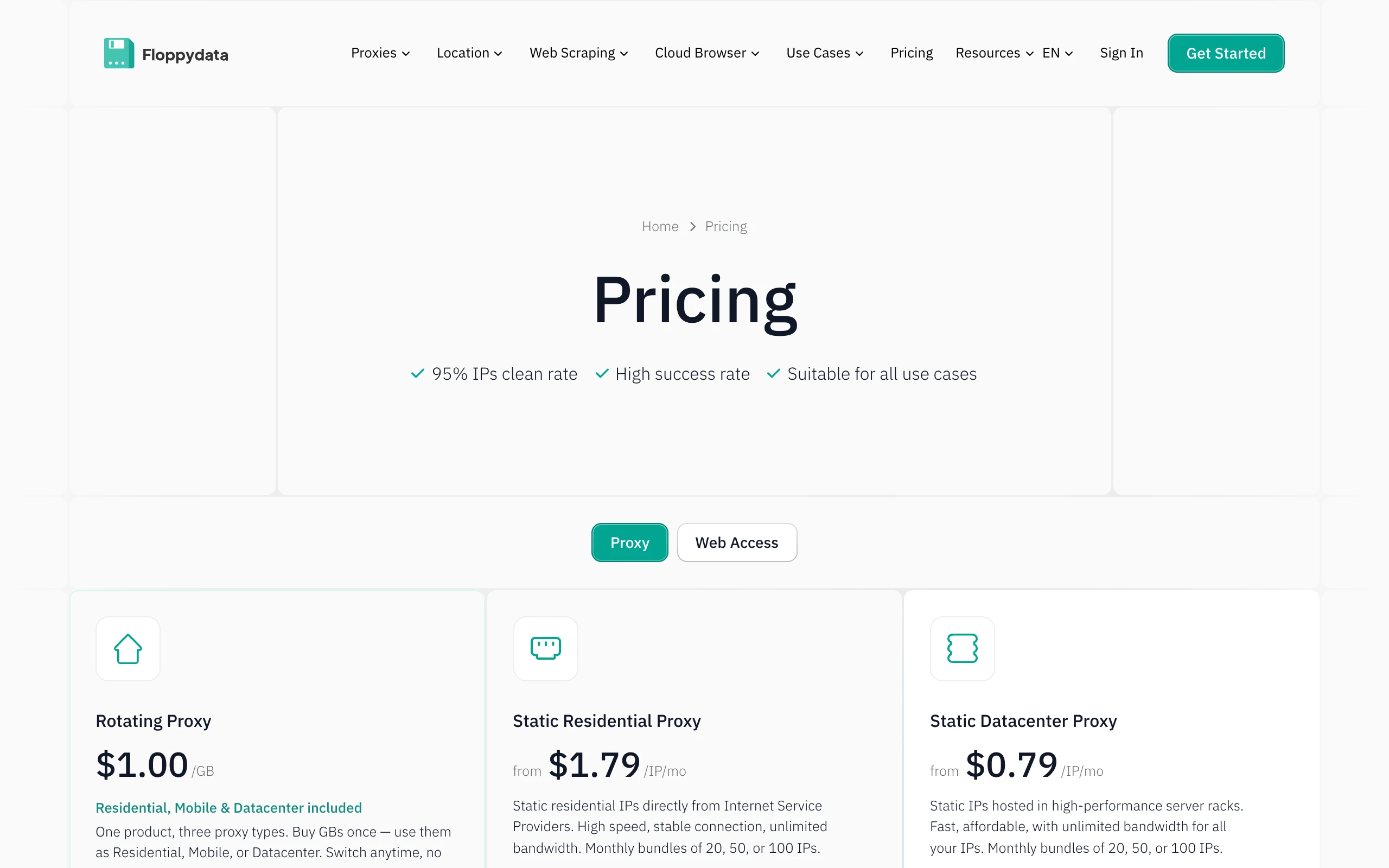
Why it stands out: Residential, mobile and datacenter traffic share one GB balance at a flat $1/GB, and traffic that does not expire costs $1.50/GB. In our benchmark that translated into $0.019 per 1,000 successful requests, the second-lowest of 12 providers tested and about six times less than Oxylabs.
It also had the second-lowest share of IPs flagged as proxies by Scamalytics (60.7%; most providers were between 77% and 99%) and the fastest connections from our Singapore server (0.73 s median latency). The weak spots are equally clear: the lowest sticky-session stability in the test and a higher share of repeated IPs. We operate Floppydata; it was tested with the same scripts as everyone else.
Enterprise offering: Floppydata offers dedicated account management, volume discounts and invoice billing for enterprise customers on request. Custom contracts with tailored SLAs are available. A DPA can be provided for GDPR compliance. No public security certifications (ISO, SOC) are published at this time.
Key features:
- Network: 65M+ IPs (vendor-stated)
- Proxy types: rotating residential, mobile and datacenter on one GB balance; static residential (ISP) and static datacenter
- Targeting: country and city; 195+ countries for rotating proxies, 9 for static residential and 4 for static datacenter (vendor-stated)
- Authorization: credentials, IP whitelist
- Protocols: HTTP, HTTPS, SOCKS5
- Integrations: works with Selenium and other standard HTTP and SOCKS5 clients
Pricing:
- Residential, mobile and datacenter: $1/GB; unused traffic expires at the end of the period
- Non-expiring traffic: $1.50/GB
- Static residential (ISP): $19 for one IP for four months, or $49/month for 20 IPs, falling to $1.79/IP at 100. Static datacenter: $19/month for 20 IPs ($0.95/IP), falling to $0.79/IP at 100. Unlimited bandwidth on static IPs
- No free trial
In our benchmark: 98.0% success rate (98.7% excluding a one-off failure in India), 0.93 s median latency, 47.3% sticky-session stability and 11.7% duplicate IPs.
Main limitation: Session-heavy work. Only 47.3% of 30-minute sticky sessions kept the same IP, the lowest in the test, and no security certifications are published. Teams that need a contractual SLA should agree one before signing.
| Pros | Cons |
|---|---|
| Lowest cost among the providers reviewed here | Weakest sticky sessions in the test (47.3%) |
| Few IPs flagged as proxies (60.7%) | More repeated IPs (11.7%) |
| Fastest from Singapore in our test | Smaller pool than Oxylabs or Bright Data |
| One GB balance for residential, mobile and datacenter | No free trial |
Verdict: The value pick for high-volume, mostly rotating workloads. For long logged-in sessions, DataImpulse or Decodo held IPs far better in our test.
Decodo
Best for: mid-market and growing enterprise teams that want top-tier reliability without top-tier pricing.
Why it stands out: Formerly Smartproxy, Decodo tied with Oxylabs for the highest success rate in our benchmark (99.9%) and came second in Proxyway’s global test (99.92%). It also had one of the lowest duplicate-IP rates (2.2%) and 99.8% of its exit IPs landed in the requested country.
Plans are self-serve from a few gigabytes up to 1 TB, so a team can pilot and scale on the same account before moving to an enterprise contract.
Key features:
- Network: 115M+ residential IPs (125M+ across all proxy types), 195+ locations
- Proxy types: residential, mobile, ISP, datacenter
- Targeting: continent, country, state, city, ZIP, ASN
- Protocols: HTTP, HTTPS, SOCKS5; UDP and QUIC available but not enabled by default
- Tools: Web Scraping API, Site Unblocker, browser extensions
Pricing:
- Residential: $11.25 for 3 GB ($3.75/GB) or $4/GB pay-as-you-go
- Enterprise: $2.50/GB at 250 GB, $2/GB at 1 TB
- 3-day trial with 100 MB; 14-day refund on eligible first purchases
In our benchmark: 99.9% Cloudflare endpoint success, 0.79 s median latency, 82.7% sticky-session stability, 2.2% duplicate IPs, and an estimated $0.077 per 1,000 successful requests for our test mix.
Main limitation: Sticky sessions rotate automatically after 60 seconds of inactivity, so idle-heavy workflows need keep-alive requests. Custom SLAs require a sales contract.
| Pros | Cons |
|---|---|
| Top reliability in two independent tests | About four times Floppydata’s cost per successful request |
| Low duplicate-IP rate | Pricing structure is complex across products |
| Accurate country targeting | Sessions drop after 60 s idle |
| Trial and refund policy |
Verdict: The safest all-round pick for teams that want proven reliability and self-serve onboarding.
SOAX
Best for: location-sensitive work that needs fine targeting, and teams that want proxies and a data API on one allowance.
Why it stands out: SOAX had the second-lowest median latency of 12 providers tested (0.72 s) and a 99.8% success rate, matching Proxyway’s 99.78%. Its plans use shared credits across proxies and its Web Data API, which suits teams that mix raw proxy traffic with managed scraping.
Key features:
- Network: 155M+ residential IPs (vendor-stated), 195+ locations
- Proxy types: residential, mobile; datacenter in the US only
- Targeting: country, region, city, ISP; ASN and ZIP on Scale and Enterprise plans
- Protocols: HTTP, HTTPS, SOCKS5, UDP, QUIC
Pricing:
- Sandbox: free, no traffic included
- Builder: $200/month, $3/GB for Tier 1 locations
- Team $500, Scale $1,500, Enterprise $3,000/month; Enterprise from $0.85/GB (Tier 1)
- 3-day trial: 400 MB for $1.99
In our benchmark: 99.8% success, 0.72 s median latency, 70.2% sticky stability, 9.1% duplicate IPs. Effective price $4.67/GB on the package we bought.
Main limitation: The $200 monthly entry point is high for pilots, and ASN/ZIP targeting is locked to the two top plans. Proxyway also notes that its unfiltered pool returns IPs near the requester’s location unless configured otherwise.
| Pros | Cons |
|---|---|
| Fast connections | High entry price |
| Fine-grained targeting on top plans | Datacenter proxies US-only |
| UDP and QUIC support | Sticky stability below Decodo and Oxylabs |
| One allowance for proxies and data API |
Verdict: A strong fit for geo-precise verification work on Scale or Enterprise plans.
IPRoyal
Best for: teams that need non-expiring traffic and very long sticky sessions.
Why it stands out: IPRoyal sells pay-as-you-go traffic that does not expire, which suits seasonal or bursty workloads. Residential sessions can stay on the same IP for up to seven days if the device stays online. In Proxyway’s IP-quality check, IPRoyal’s global pool was the least often identified as proxies by IPinfo and had the lowest average Scamalytics risk score.
Key features:
- Network: 32M+ residential IPs (vendor-stated), 195 countries
- Proxy types: residential, ISP, datacenter, mobile
- Targeting: country, state, city
- Sessions: sticky up to 7 days
- Team features: organizations, projects, permissions, dedicated account management
Pricing:
- Residential: $7/GB subscription or $7.35/GB pay-as-you-go
- Enterprise: from $1.75/GB at 10 TB+
- ISP: from $2.70/IP for 30 days ($1.80 for a single day); dedicated mobile from $10.11/day
In our benchmark: 99.5% success, 1.23 s median and 3.14 s P90 latency, 80.4% sticky stability, $0.104 per 1,000 successful requests.
Main limitation: Results vary between tests: 99.5% success in ours but 96.11% in Proxyway’s, down from above 99% a year earlier, and a slow P90 in both. The headline $1.75/GB applies only at 10 TB.
| Pros | Cons |
|---|---|
| Traffic does not expire | High entry price per GB |
| Sticky sessions up to 7 days | Slow P90 latency |
| Clean IP reputation in Proxyway’s test | Mixed reliability across tests |
| Team and enterprise controls |
Verdict: A good fit for bursty workloads and long-lived sessions; test success rates on your own targets first.
Oxylabs
Best for: large-scale data programs with compliance requirements and procurement reviews.
Why it stands out: Oxylabs tied for the highest success rate in our test (99.9%), had the lowest P90 latency of 12 providers tested (1.32 s), and led Proxyway’s global success rate (99.93%). Proxyway also surfaced the most unique IPs from Oxylabs’ pool: 3.24 million in 3.6 million requests.
It pairs the network with Web Scraper API, Web Unblocker and datasets, and publishes security documentation for vendor reviews.
Key features:
- Network: 175M+ residential IPs, 195 countries
- Proxy types: residential, mobile, ISP, dedicated ISP, datacenter
- Targeting: country, state, city, ZIP, coordinates, ASN
- Compliance: ISO/IEC 27001:2022, SOC 2, SOC 3; GDPR and CCPA documentation in its Trust Center
- Support: dedicated account manager, 24/7 support
Pricing:
- Residential: $30/month for 5 GB ($6/GB)
- Corporate: $2,500/month for 1 TB ($2.50/GB); custom offers above
- Free trial for verified companies on request
In our benchmark: 99.9% Cloudflare endpoint success, 0.75 s median / 1.32 s P90 latency, 80.8% sticky-session stability, 2.2% duplicate IPs, and an estimated $0.124 per 1,000 successful requests for our test mix.
Main limitation: Cost. A successful request cost about six times more than through Floppydata or DataImpulse in our test mix, and no pay-as-you-go plan is currently listed.
| Pros | Cons |
|---|---|
| Top reliability in two tests | Highest cost per successful request among the seven tested here |
| Largest observed unique-IP pool | No pay-as-you-go |
| Strongest published certifications | Complex for small projects |
| Mature scraping tools |
Verdict: The default pick when compliance paperwork and reliability matter more than price.
Webshare
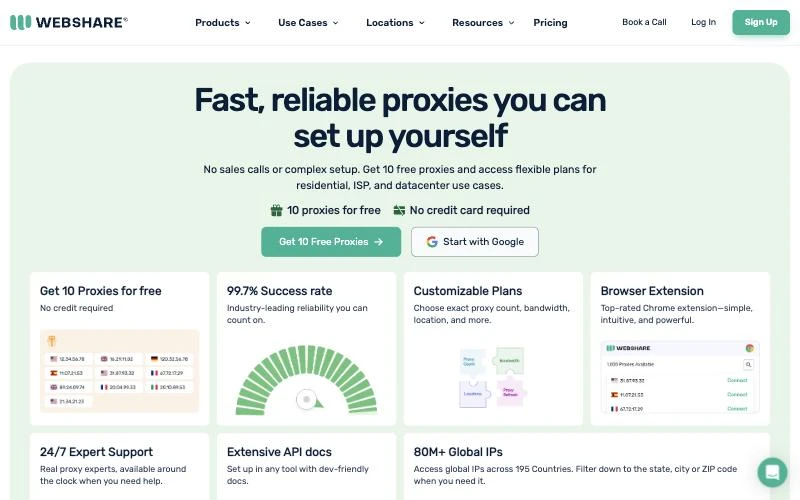
Best for: developers and growing teams that want low entry cost and self-serve setup.
Why it stands out: Webshare had one of the lowest duplicate-IP rates in our test (2.2%) and the third-lowest cost per successful request among the seven providers reviewed here ($0.052). A permanent free plan with 10 datacenter proxies makes it easy to test integrations before buying. Webshare has been owned by Oxylabs since 2022.
Key features:
- Network: 80M+ residential IPs (vendor-stated)
- Proxy types: datacenter, static residential, rotating residential
- Targeting: country; city for rotating residential
- Protocols: HTTP, SOCKS5 over TCP; no UDP
Pricing:
- Free: 10 datacenter proxies, 1 GB/month
- Rotating residential: $3.50 for 1 GB (promo); $1.40/GB at 3,000 GB monthly
- Datacenter: from $2.99/month for 100 proxies
In our benchmark: 99.6% success, 1.00 s median latency, 77.2% sticky stability, 2.2% duplicate IPs.
Main limitation: No mobile proxies, limited targeting, and thread limits and network priority are paid plan options, so heavy parallel workloads need a plan check.
| Pros | Cons |
|---|---|
| Free plan for testing | No mobile proxies |
| Low duplicate-IP rate | Country and city targeting only |
| Low cost per successful request | Concurrency depends on plan |
| Self-serve setup |
Verdict: A practical choice for pilots and mid-sized workloads that value price and quick setup.
Bright Data
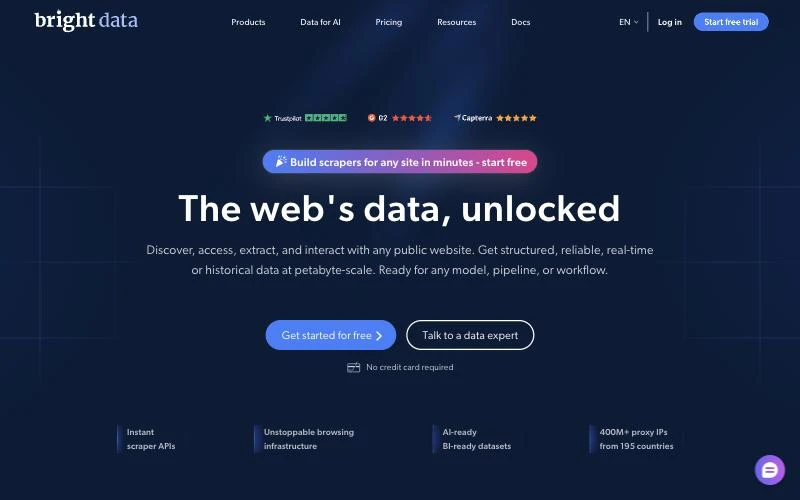
Best for: compliance-heavy organizations that want proxies and managed data products from one vendor.
Why it stands out: Bright Data publishes the largest residential pool on this list (400M+) and the widest tool set: Web Unlocker, SERP API, Scraping Browser and datasets for an end-to-end data ingestion pipeline. AIMultiple’s ongoing benchmark ranked it highest in its unblocker tests.
We could not benchmark it: the residential pool opens only after KYC and a use-case review. It also did not take part in Proxyway’s 2026 report, so the numbers in this article cannot speak to its proxy performance.
Key features:
- Network: 400M+ residential IPs (vendor-stated), 195 countries
- Proxy types: residential, ISP, datacenter (its mobile proxy product was discontinued in April 2026)
- Targeting: country, state, city, ZIP, ASN
- Tools: Web Unlocker, SERP API, Scraping Browser, datasets
Pricing:
- Residential: $4/GB pay-as-you-go (promotional; $8/GB list)
- $2.50/GB on the $1,999/month plan with 798 GB
- Datacenter and ISP billed per IP
Main limitation: Price and onboarding. KYC and a use-case review are required before you can test the residential network.
| Pros | Cons |
|---|---|
| Largest published pool | Expensive at entry volumes |
| Most complete data tooling | KYC before testing |
| Enterprise compliance documentation | No independent 2026 proxy benchmark |
Verdict: The strongest option for regulated teams that need a full data stack and can accept the price and onboarding.
DataImpulse
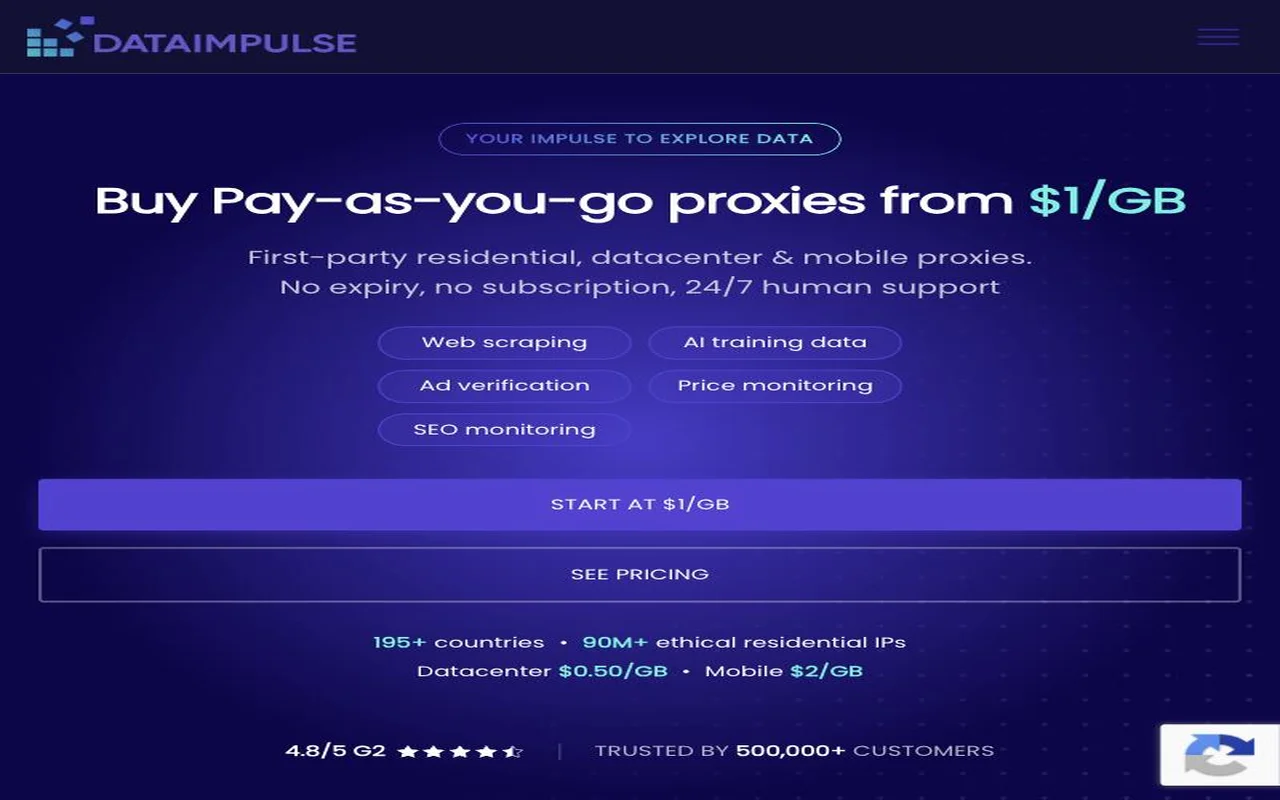
Best for: pay-as-you-go teams with seasonal workloads and long logged-in sessions.
Why it stands out: DataImpulse matched Floppydata on cost ($0.020 per 1,000 successful requests) and had the best sticky-session stability in our test: 87.2% of 30-minute sessions kept the same IP. Proxyway measured a 99.74% success rate, in line with our 99.7%. Traffic never expires and there is no subscription.
Key features:
- Network: 90M+ IPs (vendor-stated), 195 countries
- Proxy types: residential, premium residential, mobile, datacenter
- Targeting: country, state, city, ZIP, ASN; exclusion filters
- Compliance: DPA available, states GDPR alignment
Pricing:
- Residential: $1/GB, $0.80/GB at 1 TB
- Premium residential: $5/GB
- Mobile: $2/GB
- Location targeting doubles the per-GB rate
In our benchmark: 99.7% success, 0.87 s median and 2.08 s P90 latency, 87.2% sticky stability, $0.020 per 1,000 successful requests.
Main limitation: Targeting doubles the price, and Proxyway found a lower share of residential-classified IPs in the regular pool (93.3%) than in the premium one. No scraping API yet.
| Pros | Cons |
|---|---|
| Best sticky-session stability in our test | Targeting costs 2x |
| Lowest-tier cost per request | Slower P90 latency |
| Non-expiring pay-as-you-go traffic | No managed scraping tools |
Verdict: A low-cost pick for flexible volumes and session-based work.
Pair with an antidetect browser: 1Browser
1Browser is not a proxy network, so it is not ranked above. For teams that manage many accounts on social or e-commerce platforms, an antidetect browser isolates each profile’s fingerprint (timezone, language, WebGL, cookies) and works with any provider on this list.
- Free plan with 10 profiles
- Basic from $7/month: 20 profiles, 2 GB of residential proxy traffic
- Professional $27/month: 100 profiles, 2 GB of residential proxy traffic
- Built-in proxies in five locations: the US, UK, Canada, Germany and India
How to run a pilot in 1–2 weeks
“Run a pilot” appears in almost every guide, but without specifics it stays wishful. Here is a concrete plan.
Week 1 — setup and baseline (2–3 providers)
- Pick two or three providers from your shortlist and buy the smallest package from each.
- Set up the same scraping script (or use ours from the benchmark repository) pointed at your actual target sites — not a test endpoint.
- Run 5,000–10,000 requests per provider per day for five days. Log every request: status code, response time, response size, exit IP, and whether the response contained the expected data.
- Measure daily: success rate, median and P90 latency, cost per successful request, and duplicate-IP rate.
Week 2 — stress and decision
- Double the concurrency on the provider that looked best in week 1. Watch for rate-limit errors and latency spikes.
- If your workload needs sticky sessions, run a session-stability test: open 50 sessions for 30 minutes each and count how many kept the same IP.
- Compare the providers on the four metrics that matter for your case (usually success rate, cost, latency and session stability). The cheapest per GB is often not the cheapest per successful request.
What to watch for:
- Dashboard traffic counters can differ from your logs by 10–30%. Use your own logs for cost calculations.
- Test from the geography your production traffic will use, not just your office.
- A provider that scores well on a Cloudflare endpoint may score differently on your target. Always test on your actual sites.
What an enterprise proxy SLA should include
Uptime figures on pricing pages are marketing claims; only a signed agreement with service credits is enforceable. Before signing, check that the contract covers:
- Uptime commitment and how it is measured, including whether gateway errors count as downtime.
- Service credits for missed targets, and how to claim them.
- Support response times and escalation paths, ideally with a named account manager.
- Data Processing Agreement (DPA) and documentation for your security review.
- Billing terms: invoicing, purchase orders, overage pricing, and whether unused traffic expires.
How to vet a provider’s IP sourcing
In January 2026, Google disrupted the IPIDEA network, which it described as one of the largest residential proxy networks in the world, and named several brands it said were controlled by the same actors, including PyProxy, LunaProxy and 922Proxy. Proxyway later listed more than a dozen brands linked to the network that remained in business.
For enterprise procurement, ask how IPs are sourced (opt-in SDK, bandwidth-sharing app or reseller), whether the provider performs KYC on customers, and check the brand against public threat reports before signing. Very cheap “unlimited” residential plans with no KYC are a warning sign.
Which should you choose?
| Need | Pick | Why |
|---|---|---|
| Lowest cost per successful request | Floppydata, DataImpulse | About $0.02 per 1,000 successful requests in our benchmark |
| Highest reliability | Decodo, Oxylabs | 99.9% success in our test and above 99.9% in Proxyway’s |
| Long logged-in sessions | DataImpulse, Decodo | 87.2% and 82.7% sticky-session stability |
| Compliance-heavy procurement | Oxylabs, Bright Data | Published security certifications and Trust Center documentation |
| Fine geo-targeting | SOAX, Oxylabs | ZIP and ASN targeting; Oxylabs adds coordinates |
| Bursty or seasonal traffic | IPRoyal, DataImpulse | Pay-as-you-go traffic that does not expire |
| Low-risk pilot | Webshare, Decodo | Free plan or trial, self-serve setup |
| Full managed data stack | Bright Data, Oxylabs, Decodo | Web scraping API, unblocker and datasets |
Conclusion
There is no single best enterprise proxy provider; the right one depends on what you measure. If reliability comes first and budget is flexible, Decodo and Oxylabs recorded the highest Cloudflare endpoint success in our October test, while Proxyway’s separate results provide supporting but non-identical context. If cost per successful request drives the decision, Floppydata and DataImpulse were about six times cheaper than Oxylabs in our benchmark, with DataImpulse also holding sessions best. For compliance-driven organizations, Oxylabs and Bright Data have the most complete documentation.
Whichever you shortlist, run a short pilot on your own targets — the section above shows how — and check the raw benchmark data to compare providers on the metrics that matter for your workload.
How much do enterprise proxies cost?
Residential traffic ranges from about $1/GB (Floppydata, DataImpulse) to $6–8/GB at entry level for premium providers. At 1 TB, most providers fall between $0.80 and $2.50/GB. Compare cost per successful request as a scenario-specific estimate rather than a universal price: in our test mix it ranged from $0.019 to $0.124 per 1,000 requests among the seven providers benchmarked. The result depends on response sizes, endpoint mix, traffic counters, and negotiated rates.
Which enterprise proxy provider is the most reliable?
Decodo and Oxylabs had the highest success rates in both our October 2026 benchmark and Proxyway's March–April 2026 tests. Reliability on protected targets also depends on your client and request patterns, so test on your own targets.
Are enterprise proxies GDPR compliant?
Not by default. Compliance depends on how the provider sources IPs, how data is processed and what your contract says. Ask for a DPA and sourcing documentation, and assess your own data collection separately.
Do enterprise proxy providers offer SLAs?
Most enterprise-focused providers offer SLAs on custom contracts, not on self-serve plans. Check for uptime commitments, service credits and support response times in writing.
Why isn't Bright Data in the benchmark?
Bright Data requires identity verification and a use-case review before its residential pool can be used, so it could not be tested on the same terms as the other providers.
What is the cheapest enterprise proxy provider?
In our October 2026 benchmark, Floppydata and DataImpulse had the lowest cost per successful request at about $0.02 per 1,000 requests. Both charge $1/GB for residential traffic. At 1 TB, DataImpulse drops to $0.80/GB.
How do I choose between residential, datacenter and ISP proxies?
Use rotating residential proxies for high-volume scraping and ad verification, static residential (ISP) proxies for accounts that need a stable home-network IP, and datacenter proxies when speed matters more than stealth. Mobile proxies are for carrier-specific testing.
What is the difference between a proxy and a web scraping API?
A proxy gives you an IP address; you handle retries, headers and parsing. A web scraping API or unblocker handles rotation, fingerprinting and CAPTCHA solving for you and charges per successful request. Oxylabs, Bright Data, Decodo and SOAX offer both.