I have been using residential proxies for many years, but it was in 2026 that things changed.
In July 2026 the FBI seized hundreds of domains tied to NetNut, one of the largest residential proxy networks, which researchers linked to a botnet of hijacked smart TVs and streaming boxes. People’s TVs were quietly letting their internet connection be used without their knowledge.
That was the moment I realized it.
The question I am asking now isn’t “how cheap is the GB?” but “where does this IP actually come from?”. That’s a significant difference. So I reviewed 17 residential proxy providers with that question first and then ranked them. I’m going to show you the best residential proxies available in 2026, explain what they’re really useful for, and tell you how I rated each one.
Let’s get into it.
Disclosure: this guide is published on Floppydata’s blog, so Floppydata is one of the providers reviewed. Pool sizes are vendor-stated figures. Prices and terms were checked in October 2026 and can change. Last updated: October 2026.
TL;DR
If you don’t have time then here’s the brief version:
• Residential proxies use real home IP addresses, so websites see a person rather than a bot. They are the gold standard when it comes to difficult targets.
• Sourcing comes first: Google says many proxy brands whitelabel the NetNut network seized in July, so ask any provider where its IPs come from (there is a six-question checklist below).
• Best overall: Floppydata (this is Floppydata’s blog, see the disclosure above). Best mid-market value: Decodo. Cheapest ethical residential traffic: Evomi.
• Number two in the ranking is 1Browser, an anti-detect browser with proxies built in.
• The comparison table covers all 17 providers, followed by a use-case summary and a 100 GB cost comparison.
What are residential proxies, and what are they for?
A residential proxy has your traffic pass through an IP address that an internet service provider has given to a real household. Therefore, the website you’re accessing treats you as just some individual using that home’s Wi-Fi network.
That’s what makes it special: IP addresses from a residential proxy provider are much more difficult to detect than ordinary server IPs.
So what do I actually use them for? Mainly this:
- Web scraping on sites with nasty anti-bot walls
- Ad verification from real places
- Price monitoring across different regions
- SEO and SERP tracking, at scale
- Market research, and juggling multiple accounts
Here’s the catch: residential is more expensive than datacenter and a bit slower, but that’s the trade-off. On a protected site, datacenter will have you blocked while residential gets you in. That’s as simple as it gets.
The 2026 reality: sourcing is the whole game
Most guides leave this part out. Don’t.
In July 2026 the FBI said it had seized hundreds of domains associated with NetNut, a large residential proxy service operated by Alarum Technologies. Researchers and Google linked the network to the Popa botnet, which had enrolled at least two million devices, mostly smart TVs and streaming boxes, as proxy exit nodes without their owners’ knowledge (Krebs on Security, July 2, 2026).
Google’s threat intelligence group went further: it said it has high confidence that many popular residential proxy brands whitelabel the NetNut network. In other words, a brand name on a website tells you very little about where the IPs actually come from.
Here’s the direct answer. When a provider’s IPs come from devices whose owners never agreed to share them, you’re building your business on access nobody consented to. That is a legal and reputational risk, and the savings aren’t worth it.
That’s why sourcing comes first in this guide. Every provider below states that its network is consent-based, but a statement is not proof. Here is the checklist I use to test that statement.
How to verify residential proxy sourcing
Ask the provider these six questions before you scale. A provider that answers with specifics is a safer bet than one that only says “ethically sourced”.
| Question | A good answer | A red flag |
|---|---|---|
| Does the provider own the network or resell another one? | It says which, and names the upstream network if it resells | “Our own network” with no detail, or no answer (Google says many brands whitelabel NetNut) |
| How are devices enrolled? | Named apps or SDK partners that users install knowingly | Software pre-installed on TV boxes, or apps that never mention proxying |
| What consent does the user see? | A clear screen saying the device’s bandwidth will be shared | Consent buried in the terms of service |
| Are users compensated? | Users are paid or get a clear benefit in return | No compensation or benefit described |
| How do users opt out? | A simple opt-out in the app, honored right away | No documented way to stop |
| Is customer KYC enforced? | Identity or use-case checks are described, with rules on prohibited use | Nothing is said about who can buy |
How I ranked them (my methodology)
Once sourcing checks out, here’s what I actually weighed:
- Stated consent-based sourcing (the gate everything else sits behind)
- Pool size, plus how deep the country and city coverage goes
- Success rate and speed, from published figures and independent tests
- Rotation and sticky-session control
- Protocols (HTTP, HTTPS, SOCKS5)
- The price model, and where the real number lands once you scale
- Free trial or money-back
A provider that doesn’t state consent-based sourcing doesn’t make this list. A quick warning: proxy prices fluctuate and change with volume, and these were checked in October 2026. Treat all the figures below as a starting point and check with the provider yourself before making a payment.
The comparison table
The following are the residential proxies I reviewed, arranged according to what is important. Pool sizes are vendor-stated.
| Provider | Pool (vendor-stated) | Price (from) | Locations | Free trial | Best for |
|---|---|---|---|---|---|
| Floppydata | 65M+ (all proxy types) | $1/GB rotating (min. 19 GB); static from $1.79/IP | 195+ | No (min. purchase 19 GB / $19) | All-in-one on a budget |
| 1Browser | Built-in residential + Tor | Free start; proxies from $1 | 150+ | Yes (free tier) | Proxies + anti-detect browser |
| Oxylabs | 175M+ | $6/GB → $2.50/GB (1TB) | 195+ | Via sales | Premium / enterprise |
| Bright Data | 150M+ | $4/GB PAYG (promo) | 195 | Free credit (business verification needed) | Largest + compliance |
| Decodo | 115M+ | $3.75/GB → $2.75/GB (100GB) | 195+ | 3-day trial or 14-day money-back | Best value |
| SOAX | 155M+ | ~$3.60/GB (Sandbox) | 195+ | $1.99 / 3-day | Granular geo, ad verification |
| Proxynet | 140M+ (160M+ with mobile) | $3.30/GB → $1.50/GB ($3K balance) | 194 | Not stated | Multi-country work, balance never expires |
| IPRoyal | 64M+ | $5.25/GB (10GB) | 195+ | None standard | Non-expiring traffic |
| Rayobyte | 40M+ | $3.50/GB → $0.50/GB (5TB+) | 163+ | 2-day money-back | Volume, US-heavy work |
| Webshare | 80M+ | $3.50/GB → $1.40/GB (3TB) | 195 | 10 free datacenter proxies | Cheapest free start (datacenter) |
| Infatica | 40M+ | $4/GB → $2.6/GB (1TB) | 195+ | Free trial | Speed + ISO compliance |
| Evomi | 54M+ | $0.49/GB (Core) | 150+ | 1-day trial | Cheapest ethical GB |
| DataImpulse | 90M+ | $1/GB (never expires) | 195 | $5 / 5GB intro, then $50 min. top-up | Pay-as-you-go, no expiry |
| Proxidize | Undisclosed | $1/GB | 195+ | No | Managed residential + mobile in one account |
| MarsProxies | Not specified | $4.99/GB → $1.65/GB (10TB) | 60+ | No | Tiered volume plans |
| PacketStream | P2P (consent) | $1/GB flat ($50 min) | Country-level | No | Cheap flat rate |
| Massive | Undisclosed | $8/GB → $4.90/GB (100GB) | 195+ | Free signup | Compliance, AI training |
Best residential proxies by use case
Short answers first. These are editorial picks, and this guide is published on Floppydata’s blog.
| Use case | Pick | Why |
|---|---|---|
| Best overall | Floppydata (our product) | Flat $1/GB on one balance for residential, mobile and datacenter traffic (minimum purchase 19 GB) |
| Best for multi-accounting | 1Browser | Anti-detect browser with proxies built in |
| Best enterprise option | Oxylabs | 175M+ pool, targeting down to ZIP code and ASN |
| Best for compliance-heavy teams | Bright Data | One of the most extensive sets of compliance documents; business verification required |
| Best mid-market value | Decodo | $3.75/GB falling to $2.75/GB, 115M+ pool |
| Cheapest ethical residential traffic | Evomi | From $0.49/GB |
| Best geo targeting | SOAX | Filters by country, region, city and ISP, no limit on concurrent connections |
| Best non-expiring traffic | IPRoyal, DataImpulse, Proxynet | Balances that don’t expire |
What 100 GB costs at entry pricing
The cost of 100 GB at each provider’s entry per-GB rate, cheapest first. Minimums, volume tiers and promos differ, so use it as a rough comparison, and check the provider before you pay (prices checked October 2026). 1Browser is left out because it has no per-GB rate.
| Provider | Entry rate | 100 GB at entry rate | Worth knowing |
|---|---|---|---|
| Evomi | $0.49/GB | $49 | Core plan, 1-day trial |
| Floppydata | $1/GB | $100 | Minimum purchase 19 GB; both expiring and non-expiring GBs are sold, so check which is in your cart |
| DataImpulse | $1/GB | $100 | One-time $5 intro, then $50 minimum top-up |
| Proxidize | $1/GB | $100 | Sold as $25/month for 25 GB |
| PacketStream | $1/GB | $100 | $50 minimum charge, country-level targeting only |
| Proxynet | $3.30/GB | $330 | $1.50/GB needs a $3,000+ balance |
| Rayobyte | $3.50/GB | $350 | $0.50/GB at 5TB and above |
| Webshare | $3.50/GB | $350 | $1.40/GB at 3TB |
| SOAX | ~$3.60/GB | $360 | Sandbox rate |
| Decodo | $3.75/GB | $375 | $2.75/GB at 100 GB ($275); $4/GB pay-as-you-go |
| Bright Data | $4/GB | $400 | Promo rate; business verification required |
| Infatica | $4/GB | $400 | $2.60/GB at 1TB |
| MarsProxies | $4.99/GB | $499 | $1.65/GB at 10TB |
| IPRoyal | $5.25/GB | $525 | 10 GB plan rate; traffic never expires |
| Oxylabs | $6/GB | $600 | $2.50/GB at 1TB |
| Massive | $8/GB | $800 | $4.90/GB at 100 GB ($490) |
How the order works: stated consent-based sourcing is the entry gate for every provider here. Within the list, the order favors a public, simple price, flexibility (several proxy types on one balance), coverage, session control and ease of use. It is an editorial ranking, not a benchmark, and since this guide is published by Floppydata, our own product comes first on that basis. If enterprise scale or compliance paperwork matters more to you, start with Oxylabs or Bright Data.
Well, let me go through them one by one.
1. Floppydata
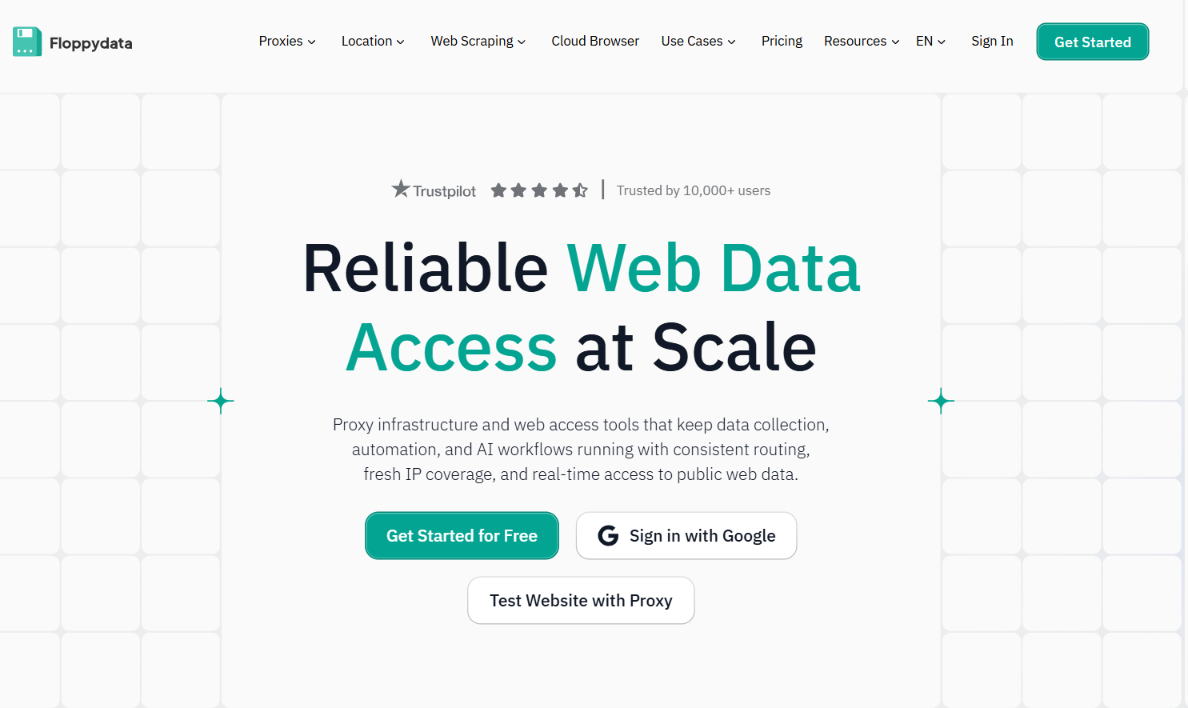
Best for: people who want residential, mobile and datacenter proxies in one place and don’t want to pay enterprise prices.
Why it stands out: residential, mobile and datacenter traffic share one GB balance at a flat $1/GB, so you switch between the three types without opening a second account or paying extra. ISP (static) proxies are bought separately, and you can buy a single static IP for a 4-month term. The network lists 65 million IPs across all proxy types in 195 countries, with country, state, city and ASN targeting, HTTP, HTTPS, SOCKS5 and UDP (beta), a wallet with auto top-up and auto-renewal, and claimed uptime of 99.99%. Floppydata states that its network is consent-based.
Pricing: $1/GB rotating, minimum purchase 19 GB ($19). Static (ISP) IPs from $1.79 each in the 100-IP bundle, with unlimited bandwidth, and a single static IP for 4 months costs $19. Payment by card, PayPal, bank transfer or 70+ cryptocurrencies.
Main limitation: there is no free trial, and the minimum purchase is 19 GB ($19), so a proper first test costs about $19.
Pros
- Residential, mobile, and datacenter traffic on one shared GB balance
- Unlimited bandwidth on static (ISP) IPs, including a single IP for 4 months
- Country, state, city, and ASN targeting in the dashboard
- HTTP, HTTPS, SOCKS5, and UDP (beta)
- Card, PayPal, bank transfer, and crypto accepted
Cons
- No free trial, minimum purchase is 19 GB ($19)
- Younger than the enterprise giants
- Residential pool is smaller than Oxylabs or Bright Data
Verdict: my pick for most people in 2026: a flat $1/GB on one balance for three proxy types, plus cheap static IPs, keeps things simple and low-cost. If raw pool size or enterprise compliance matter most, look at Oxylabs or Bright Data.
2. 1Browser
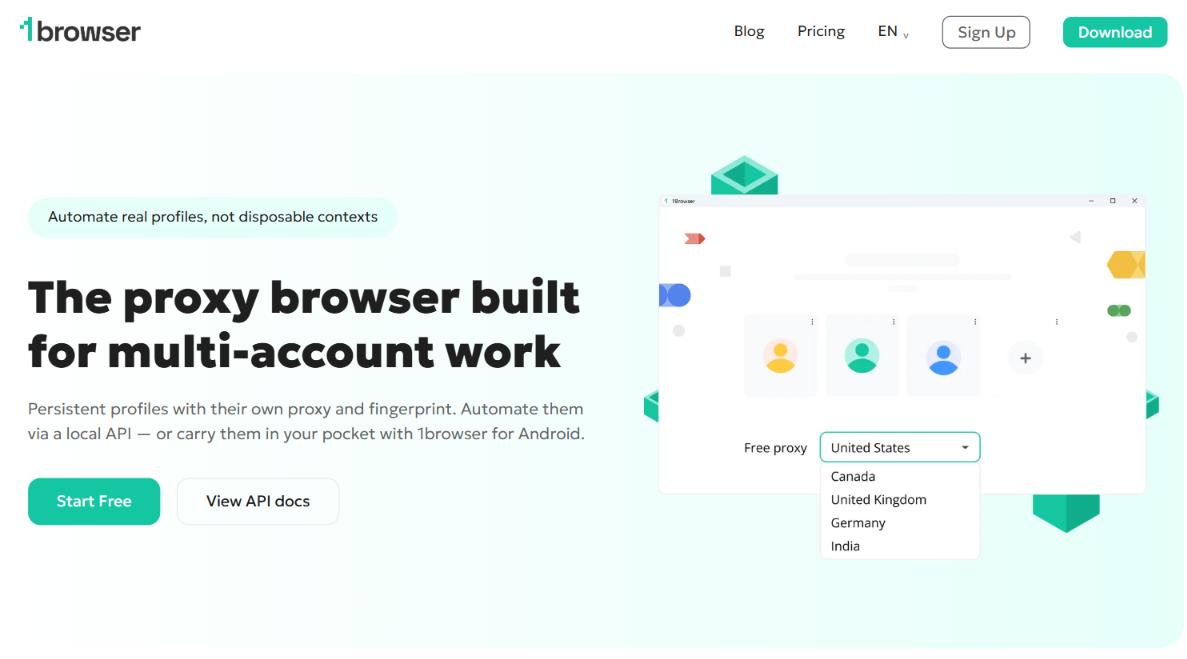
Best for: individuals who manage a number of accounts and want both proxies and an anti-detect browser.
Why it stands out: it is an anti-detect browser with the proxies built directly into it. Each profile has its own IP address, fingerprint, and cookies, which is precisely what you need for multi-account work. Residential, mobile, and datacenter proxies are included, together with a local API and an Android app. I looked into it more in my review of 1Browser.
Pricing: free tier, proxies from $1.
Main limitation: it is not a standalone proxy network, so it only makes sense if you also want the browser.
Pros
- Proxies and fingerprint protection in one place
- Free tier, cheap to get going
- Persistent profiles made for multi-account work
Cons
- Newer, short track record
- Not a big standalone proxy network
Verdict: a strong second pick if multi-accounting is your use case. If you need proxies for scraping at scale, choose a dedicated provider instead.
3. Oxylabs
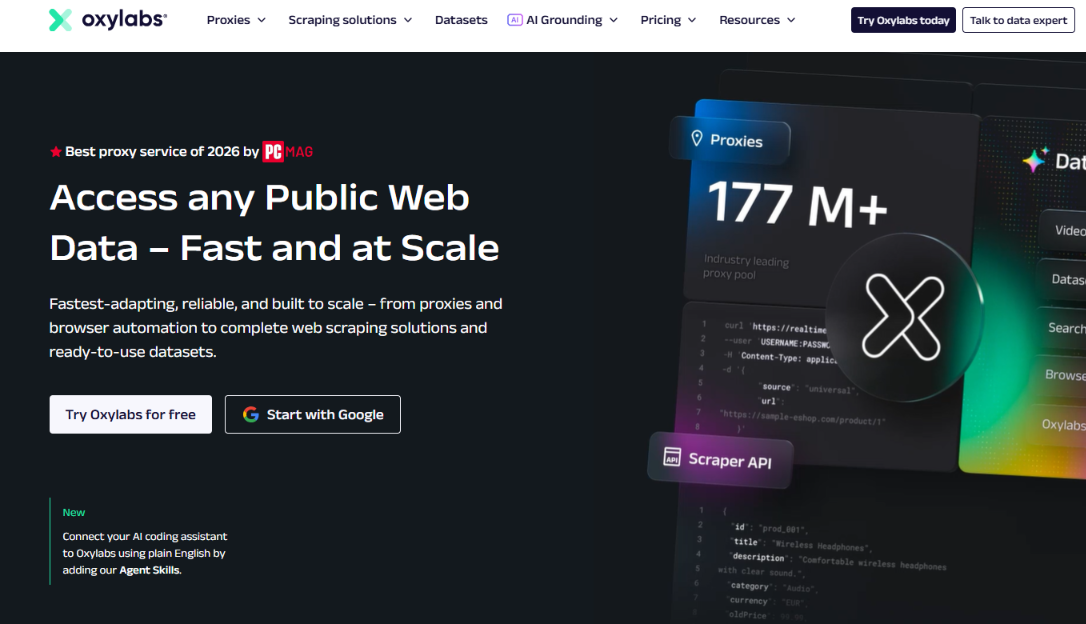
Best for: large teams that need scale and can afford the associated costs.
Why it stands out: premium residential proxies with a pool of more than 175 million IPs covering 195 or more countries. Targeting goes down to the city, the ZIP code, and the ASN, sticky sessions are available, and response times are stated to be under 0.6 seconds.
Pricing: from $6/GB, dropping to $2.50/GB at 1TB. The trial goes through sales.
Main limitation: pricey for small jobs, and no self-serve trial.
Pros
- Enormous pool (175M+, vendor-stated)
- Targeting down to city, ZIP code, and ASN
- Sticky sessions available
Cons
- Pricey for small jobs
- Trial through sales only
Verdict: the default enterprise choice when budget isn’t the constraint, and overkill for small tests.
4. Bright Data
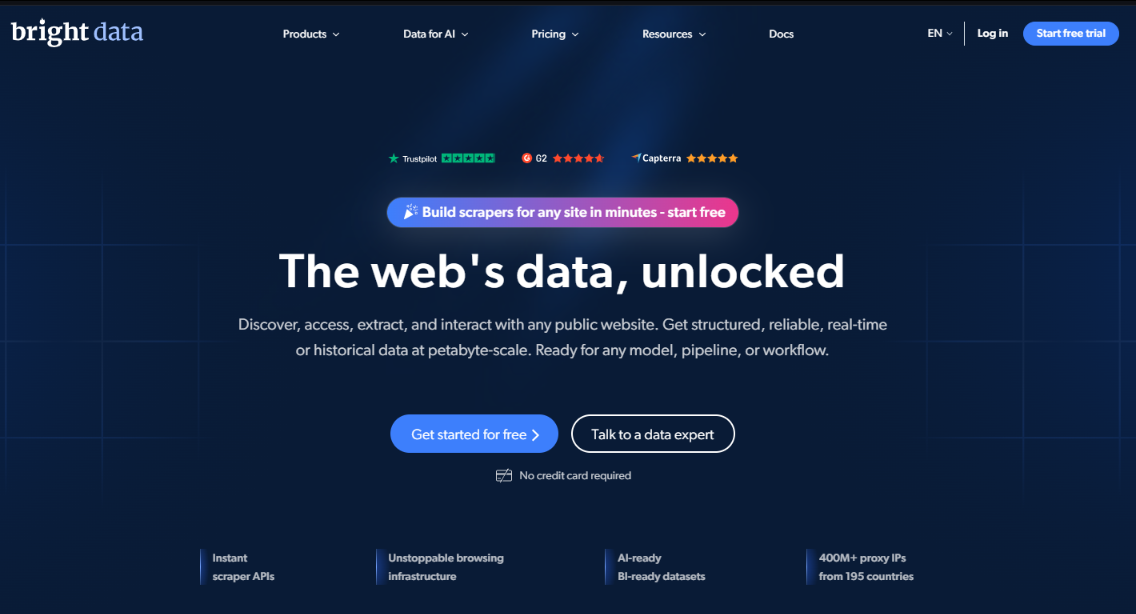
Best for: businesses that carry out a lot of scraping and have strict compliance rules.
Why it stands out: it operates one of the largest networks and has one of the most extensive sets of compliance documents you’ll come across. The service is available in 195 countries and stacks scraping APIs on top of the proxies.
Pricing: $4/GB pay-as-you-go while the promotion lasts, plus a free sign-up credit.
Main limitation: residential access requires business verification before you can start.
Pros
- One of the biggest IP networks anywhere
- Deep tooling, serious compliance
Cons
- Premium once the promos lapse
- Verification gate before you start
Verdict: strong for compliance-heavy teams and a poor fit for a quick project.
5. Decodo
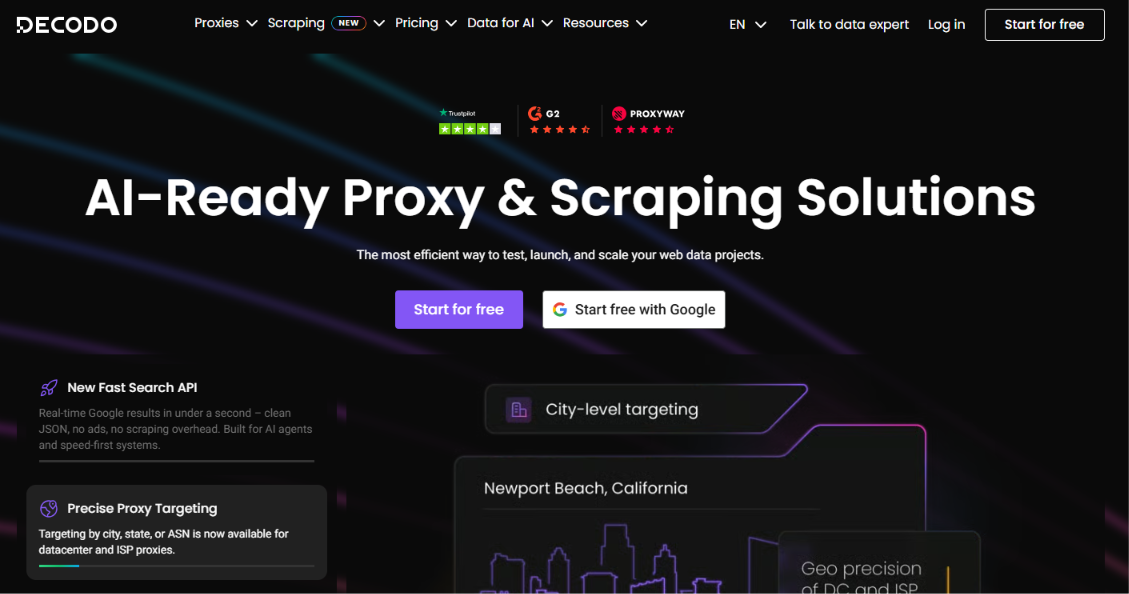
Best for: developers and small teams who want quality without paying the enterprise price.
Why it stands out: the best value overall among the mid-range options, with more than 115 million IPs, coverage in over 195 locations, and a dashboard that doesn’t get in your way.
Pricing: $3.75/GB, falling to $2.75/GB after 100GB, and $4/GB pay-as-you-go. You can take a 3-day trial or the 14-day money-back guarantee, but not both: activating the trial cancels the refund.
Main limitation: it is not the cheapest, and the trial and the refund can’t be combined.
Pros
- Strong price for what you get
- Easy dashboard
- Free trial or money-back option
Cons
- Not the cheapest out there
- Smaller pool than Oxylabs, SOAX, and Bright Data
Verdict: the best all-round value in this guide.
6. SOAX
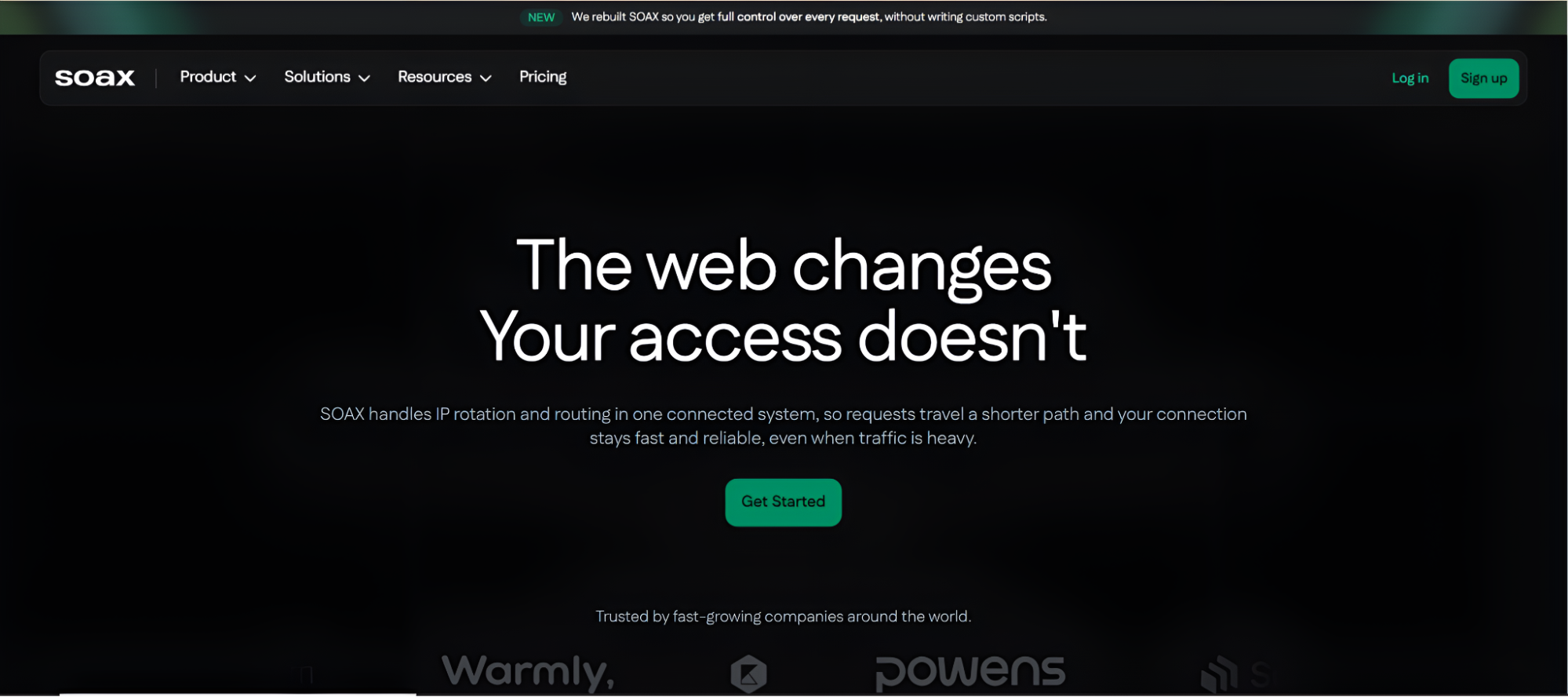
Best for: ad verification and all situations that are location-sensitive.
Why it stands out: it is built for targeting. The system covers more than 155 million IPs in over 195 countries and has a vendor-reported success rate of 99.95%. You can filter by country, region, city, and ISP, and there is no limit on concurrent connections.
Pricing: sandbox pricing is about $3.60/GB, and a 3-day, 400MB trial costs $1.99.
Main limitation: entry plans start above the budget crowd, and the best rates need a big commitment.
Pros
- Excellent granular geo-targeting
- High reported success rate, unlimited connections
Cons
- Entry plans start above the budget crowd
- Best rates want a big commitment
Verdict: the first pick when precise targeting matters more than price.
7. Proxynet
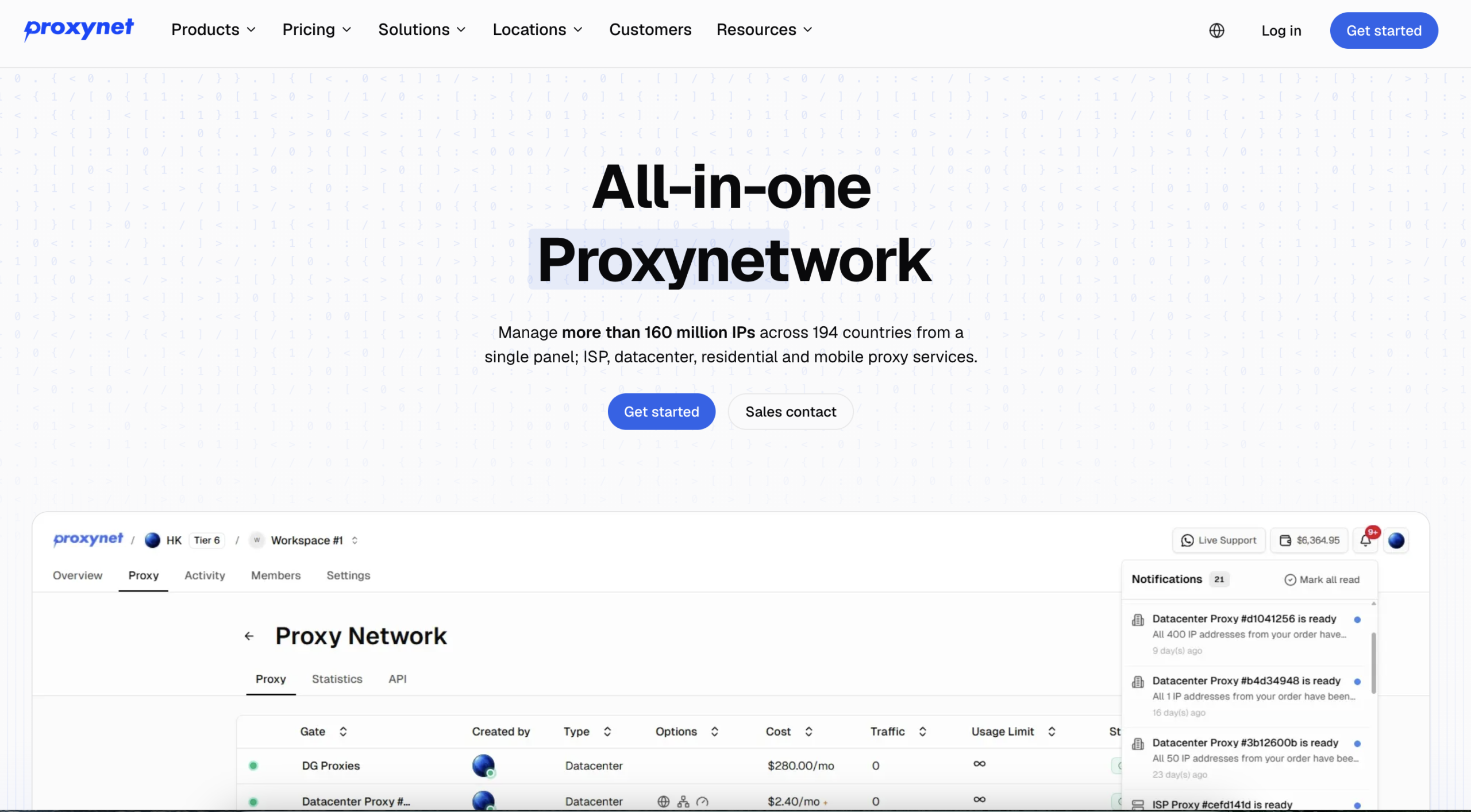
Best for: teams that scrape, monitor prices or verify ads across many countries and want residential traffic that does not reset every month.
Why it stands out: a prepaid wallet instead of monthly plans. The residential pool has more than 140 million IPs in 194 countries (160 million with mobile), described by the vendor as ethically sourced. Country, region, city and ASN targeting are included at no extra cost, and each connection can rotate on every request or keep the same IP for 1 to 60 minutes. The same wallet also pays for mobile, ISP and datacenter proxies. Proxies work over HTTP, HTTPS and SOCKS5 (TCP and UDP), sub-users and gateways are unlimited, uptime is 99.9%, and support runs 24/7.
Pricing: no subscription. The price per GB falls as the balance grows, from $3.30 to $1.50, and the balance never expires.
Main limitation: the $1.50/GB rate needs a top-up of $3,000 or more.
Pros
- Pool of 140M+ residential IPs in 194 countries (vendor-stated)
- Free country, region, city and ASN targeting
- No subscription; balance and traffic never expire
- One wallet for residential, mobile, ISP and datacenter proxies
- HTTP, HTTPS and SOCKS5 with UDP, unlimited sub-users
Cons
- Smaller pool than Oxylabs or Bright Data
- The $1.50/GB rate needs a top-up of $3,000 or more
Verdict: a good fit for multi-country work with a balance that never expires. The best price needs a large top-up.
8. IPRoyal
Best for: people who want flexible traffic and don’t want to face a monthly reset.
Why it stands out: it is the one that doesn’t expire. No matter how much traffic you purchase, it stays there until you use it. The pool provides more than 64 million IPs in over 195 countries, and the IPs are described as ethically obtained with the users’ consent.
Pricing: $5.25/GB on the 10GB plan, and it only becomes cheap when the volume is serious (the best rate needs 10TB). No standard free trial.
Main limitation: the entry price runs high.
Pros
- Traffic that never expires
- Stated ethical sourcing, wide reach
Cons
- Entry price runs high
- Best rate needs 10TB
Verdict: good if you buy traffic in bursts, and expensive for small tests.
9. Rayobyte
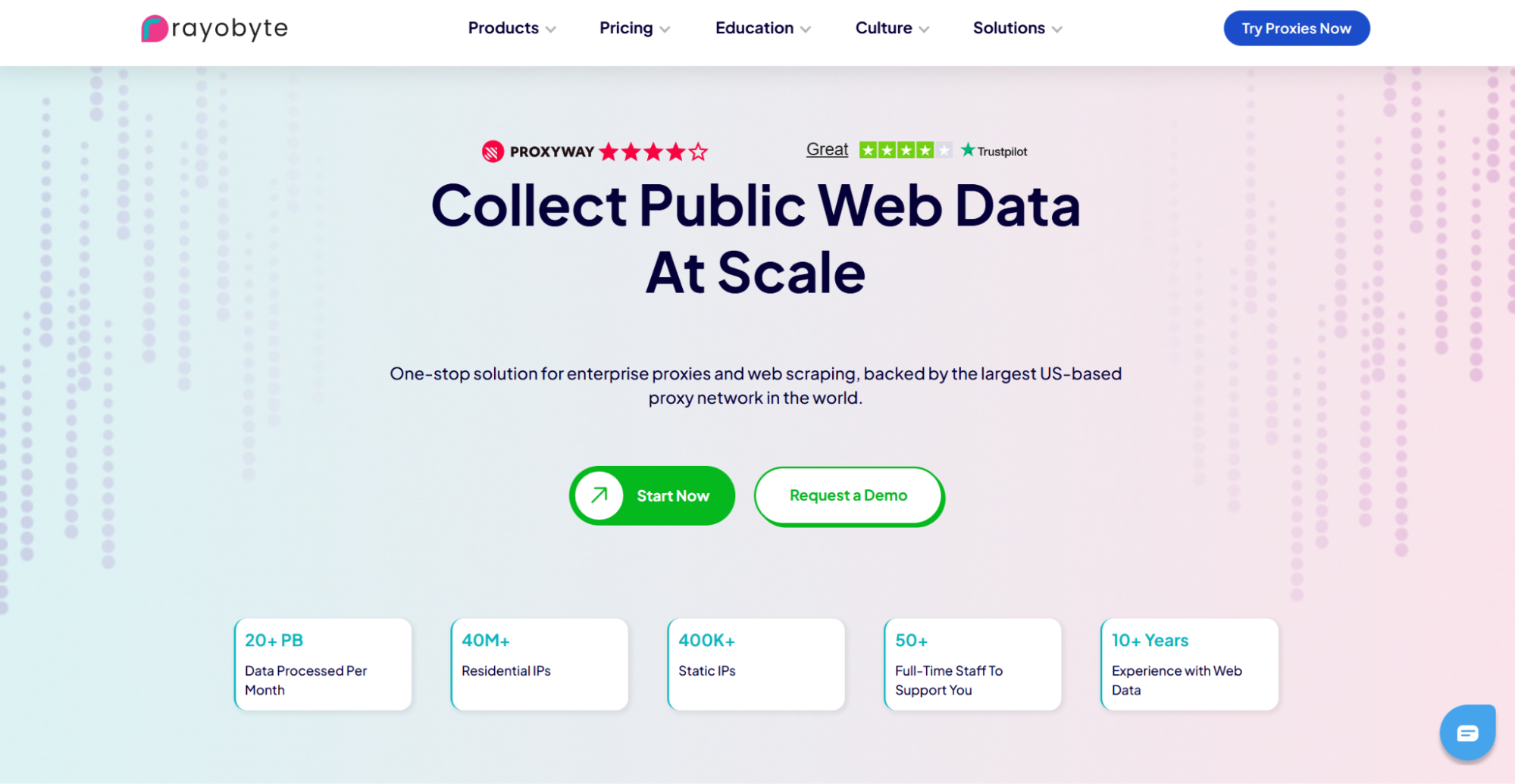
Best for: high-volume work or a heavy presence of US-based clients where you need a steady invoice.
Why it stands out: a strong emphasis on ethical sourcing and support, and pricing that is very easy to understand. The service includes more than 40 million IPs in over 163 locations.
Pricing: $3.50/GB for the first 49GB, then dropping in clear stages to $0.50/GB at 5TB and above. 2-day money-back.
Main limitation: it isn’t the fastest I’ve used, and residential is HTTP(S) only, with no SOCKS5.
Pros
- Transparent volume pricing
- Ethical sourcing, strong support
Cons
- Slower than the leaders
- Residential is HTTP(S), no SOCKS5
Verdict: predictable pricing for large volumes. Success rates remained satisfactory in my use, but it won’t win on speed.
10. Webshare
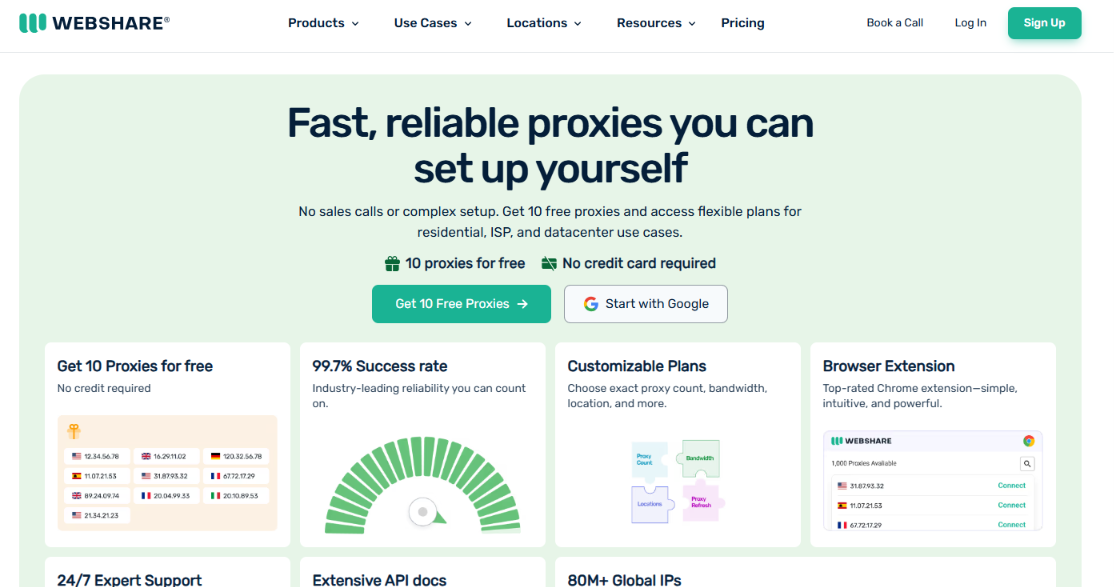
Best for: beginners who want a genuine free option (datacenter only) before spending a single cent.
Why it stands out: the cheapest way to start: ten datacenter proxies free of charge, forever, without the need for a card. On the residential side there are more than 80 million IPs, ethically sourced from 195 countries.
Pricing: residential from $3.50/GB, down to $1.40/GB at 3TB. The free proxies are datacenter, not residential.
Main limitation: the free proxies are datacenter IPs, so they won’t help much on heavily protected sites.
Pros
- Free start without a card
- Wide residential pool (80M+, vendor-stated) in 195 countries
- Residential price falls to $1.40/GB at 3TB
Cons
- Free proxies are datacenter, not residential
- The lowest residential rate needs 3TB
Verdict: use the free proxies to practice, then move to a residential plan for protected sites.
11. Infatica
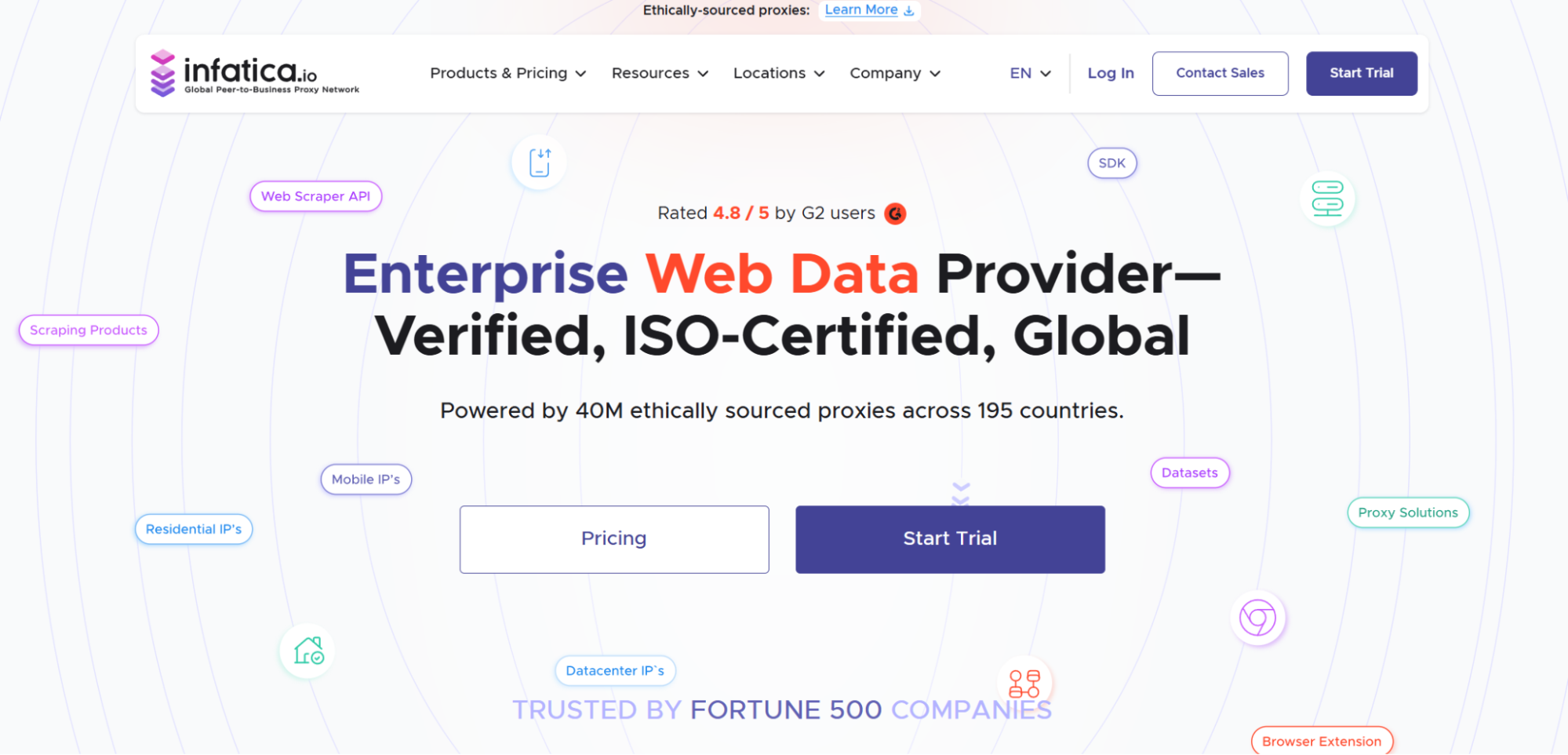
Best for: teams who want speed and compliance that is audited in writing.
Why it stands out: an ISO-certified network that markets itself on speed and written compliance. The pool has more than 40 million IPs, described as ethically sourced, in over 195 countries.
Pricing: from $4/GB down to $2.60/GB at 1TB, with a free trial.
Main limitation: a smaller pool than the biggest networks.
Pros
- ISO certification
- Free trial
- Price falls to $2.60/GB at 1TB
Cons
- Smaller pool than the biggest networks
- Entry price of $4/GB
Verdict: a good choice when written compliance matters, and not a budget pick.
12. Evomi
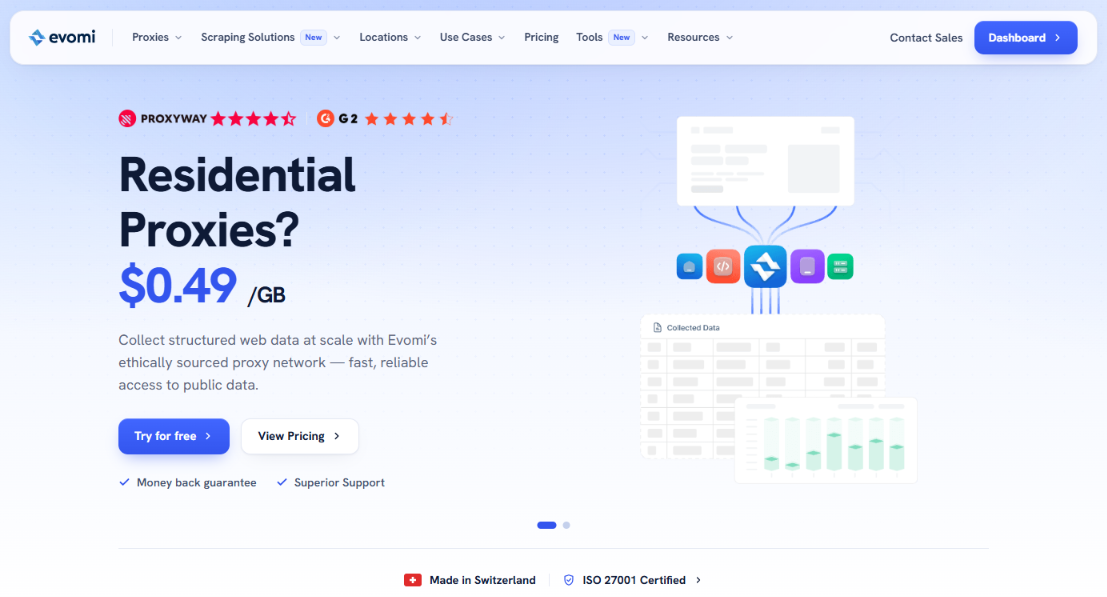
Best for: small teams and developers who want ethical IPs at the lowest possible price.
Why it stands out: it’s the cheapest clean GB I came across, with core residential rates at $0.49/GB and a pool of 54 million-plus ethically sourced IPs. It’s Swiss and EWDCI-certified, and Proxyway awarded it Best Value of 2026.
Pricing: from $0.49/GB (Core), with a 1-day trial.
Main limitation: a smaller pool than the largest networks, and only a 1-day trial.
Pros
- Lowest price per GB in this guide
- EWDCI certification
- 1-day trial to test your own targets
Cons
- Smaller pool than the biggest networks
- Short 1-day trial
Verdict: the one to try first if price is what matters most.
13. DataImpulse
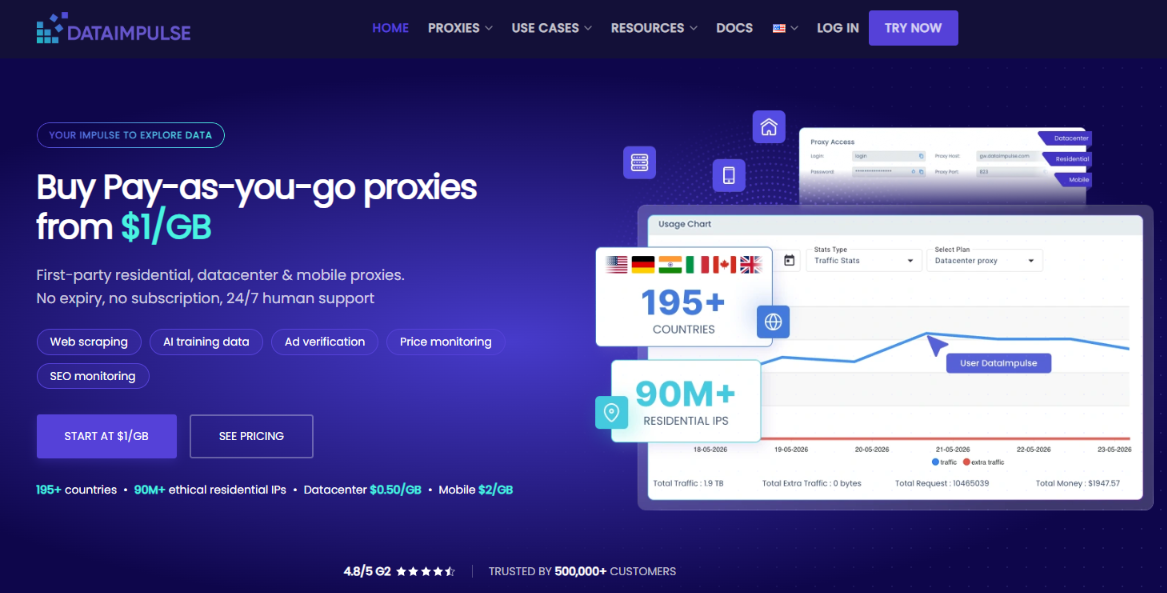
Best for: people on a budget who want low-cost traffic without a subscription.
Why it stands out: the classic pay-as-you-go option, with data that never expires. More than 90 million IPs, described as ethically obtained, are available in 195 countries.
Pricing: $1/GB. A one-time $5 intro gives you 5GB, and later top-ups have a $50 minimum.
Main limitation: the $50 minimum for top-ups after the intro.
Pros
- $1/GB rate
- Data never expires
- No subscription
Cons
- $50 minimum top-up after the one-time $5 intro
- No free trial
Verdict: good for budget scraping where you want to pay only for what you use.
14. Proxidize
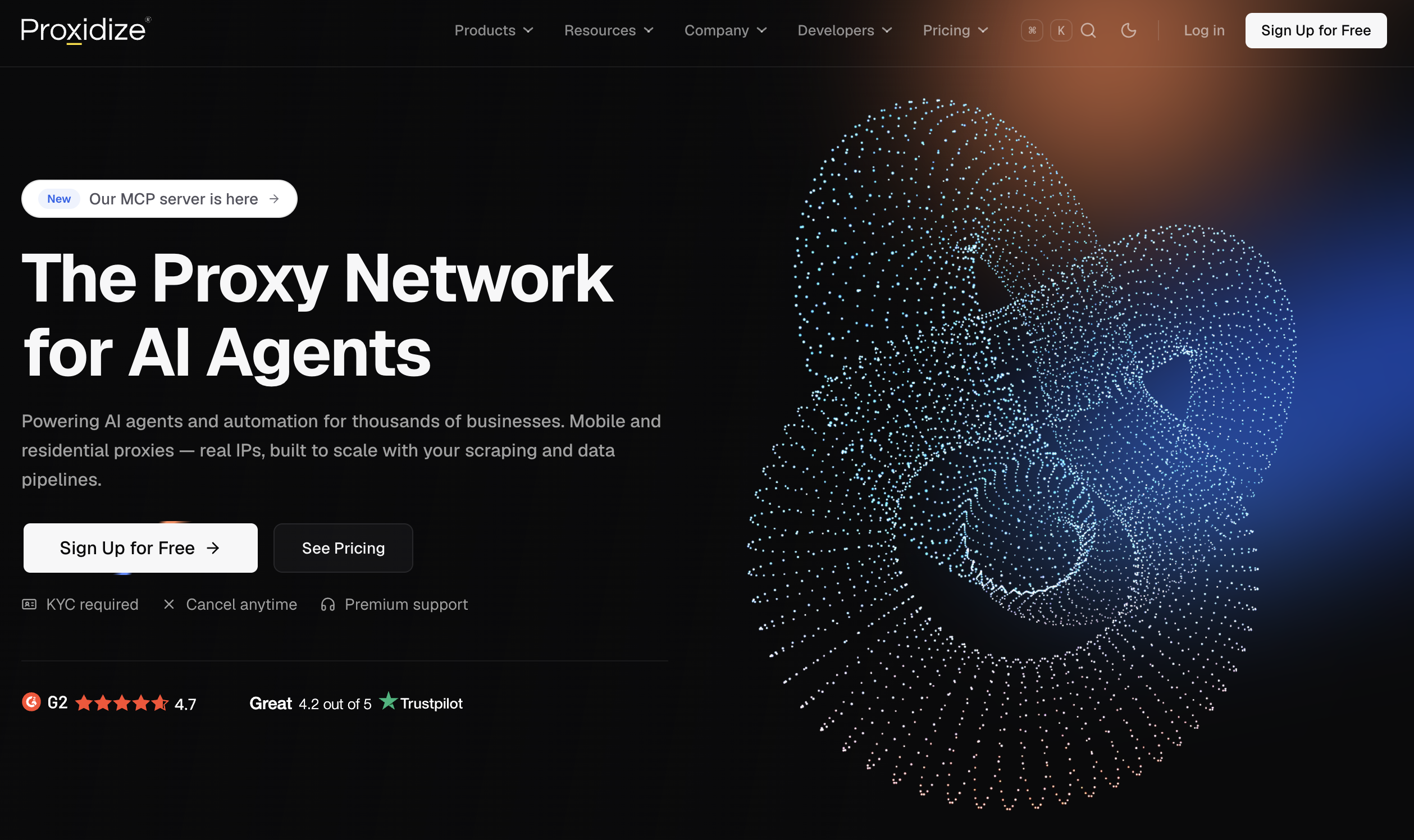
Best for: people who want managed Proxidize residential proxies and mobile proxies without the extra setup work some providers still require.
Why it stands out: managed residential and mobile proxies from a single account, with no hardware or setup required on your end. Coverage spans 195+ countries with country, city, and ISP-level targeting, and you can pick rotating IPs on every request or stick with the same one for longer sessions. Identity verification is clearly documented through the Trust Center rather than being a surprise halfway through onboarding.
Pricing: from $25 a month for 25GB, which works out to $1/GB. Unused bandwidth rolls over rather than disappearing at the end of the month.
Main limitation: identity verification (KYC) is required before you get access.
Pros
- Residential and mobile proxies in one account, no hardware needed
- 195+ countries with country, city, and ISP targeting
- Unused bandwidth rolls over, even after cancellation
Cons
- KYC required; KYB for certain categories and higher usage
- No free trial
Verdict: an easy managed option at $1/GB, as long as you are happy to pass verification.
15. MarsProxies
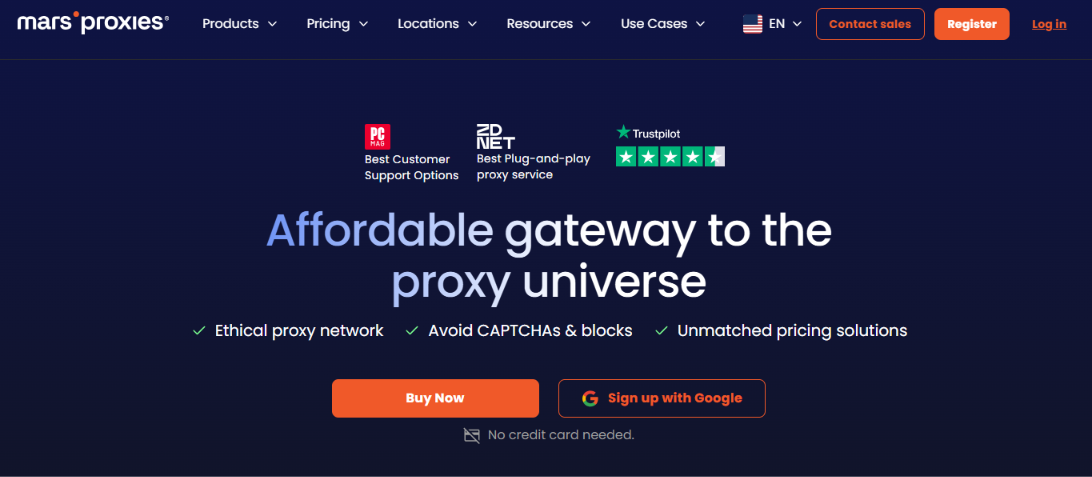
Best for: buyers who want the tiers to stay predictable as they scale.
Why it stands out: a straightforward, tiered pricing structure that becomes more advantageous as your usage increases. The dashboard is simple and the plans go smoothly.
Pricing: from $4.99/GB, dropping to $1.65/GB at 10TB.
Main limitation: there is less information on sourcing than with the leading companies, so proceed with a clear understanding.
Pros
- Tiered pricing that improves with usage
- Simple dashboard
Cons
- Less sourcing information than the leaders
- The lowest price needs 10TB
- No free trial
Verdict: fine if you value predictable tiers, but ask about sourcing before you scale.
16. PacketStream
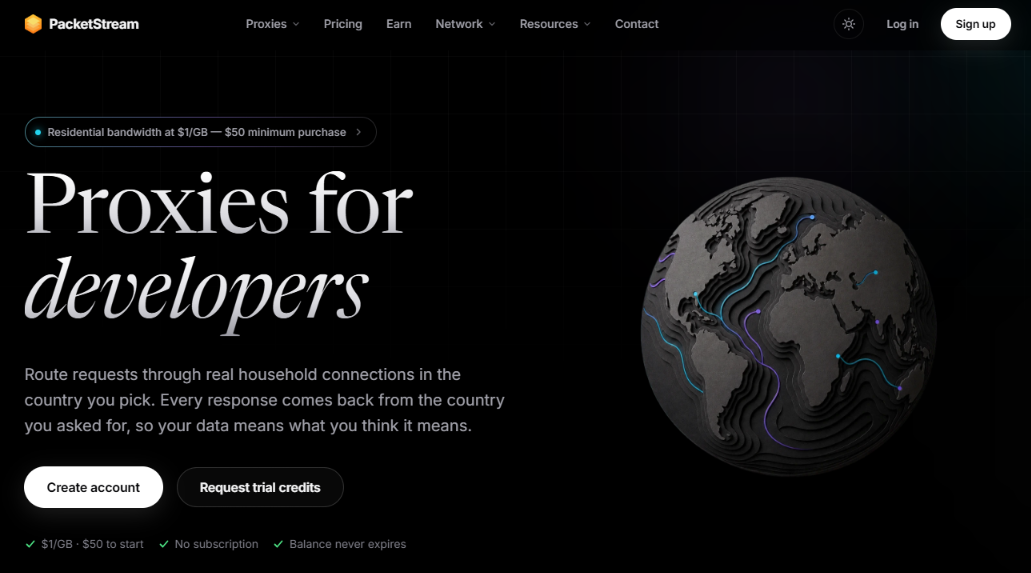
Best for: simple, low-cost jobs that only need country-level IP addresses.
Why it stands out: a cheap flat rate with a balance that never expires, on a peer network based on consent.
Pricing: $1/GB flat, with a $50 minimum charge.
Main limitation: targeting applies only to countries, not to cities, ZIP codes or ASNs.
Pros
- Flat $1/GB
- Balance never expires
- Consent-based peer network
Cons
- Country-level targeting only
- $50 minimum charge
- No free trial
Verdict: cheap and simple, but too basic if you need city or ASN targeting.
17. Massive
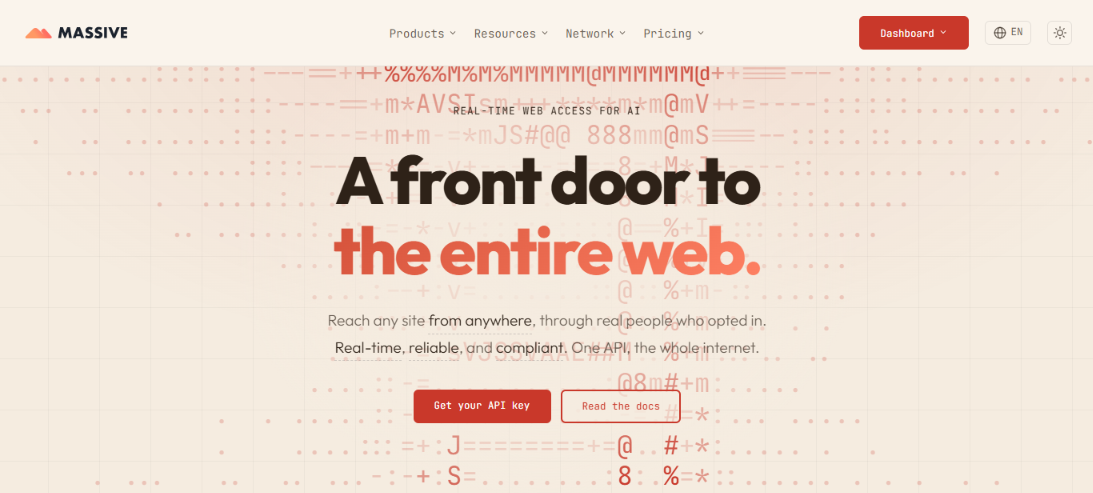
Best for: projects that have to adhere to compliance requirements and need a neatly documented network.
Why it stands out: designed with compliance in mind and based on consent-driven IP rights in more than 195 countries. It is suitable for regulated environments and for AI training data.
Pricing: $8/GB at the entry level, dropping to $4.90/GB at 100GB. Free signup, and unused bandwidth carries over rather than being lost.
Main limitation: a high entry price.
Pros
- Compliance-focused network
- Unused bandwidth carries over
- Free signup
Cons
- High entry price of $8/GB
- Pool size undisclosed
Verdict: a pick for compliance-driven teams, not for budget scraping.
Which residential proxy should you choose?
Start with the use-case table near the top of this guide: it matches a provider to each job in one line. In short, pick Floppydata if you want every proxy type on one budget balance, Decodo for mid-market value, Oxylabs or Bright Data for enterprise scale and compliance, Evomi for the lowest price per GB and SOAX for granular geo targeting.
If all you need are country-level IP addresses, go for the flat-rate option and you’ll save money. If you need to appear as a phone user, then choose mobile proxies instead.
Success rates and speeds vary with the site you’re targeting, so it’s important to carry out your own tests before relying on the figures.
Frequently asked questions
What is the best residential proxy in 2026?
There is no single best one, it depends on what you need. In this guide Floppydata comes first overall for price and flexibility (a flat $1/GB on one balance for residential, mobile and datacenter traffic), Oxylabs is the enterprise pick, Bright Data suits compliance-heavy teams, Decodo is the best mid-market value, Evomi is the cheapest ethical residential traffic and SOAX is the best for geo targeting. This guide is published on Floppydata’s blog, so weigh that when reading the ranking.
How do I check where a residential proxy’s IPs come from?
Ask the provider the six questions in the checklist above: whether it owns the network or resells another one, how devices are enrolled, what consent the user sees, whether users are paid, how they opt out, and whether customer KYC is enforced. A provider that answers with specifics is a safer bet than one that only says “ethically sourced”.
What is the cheapest residential proxy?
Evomi starts at $0.49/GB (Core). DataImpulse and Floppydata start at $1/GB, but mind the minimums: DataImpulse has a $5 intro and then a $50 minimum top-up, and Floppydata has a 19 GB ($19) minimum purchase. Proxynet drops to $1.50/GB, but only with a balance of $3,000 or more.
Should I use residential, mobile or datacenter proxies?
Datacenter proxies are the cheapest and fastest, but protected sites block them more often. Residential proxies use home IPs and get through most protected targets. Mobile proxies use carrier IPs and are the right choice when you need to look like a phone user.
Does residential proxy traffic expire?
It depends on the provider. IPRoyal, DataImpulse, Proxynet and PacketStream balances don’t expire, and Massive carries unused bandwidth over. Floppydata sells both expiring GBs at a discount and non-expiring GBs, so check which one is in your cart at checkout. Some plans reset every month, so read the terms before you pay.
Conclusion
When it comes to dealing with sites that resist, residential proxies are the best option, and in 2026 the most important factor is where those IPs come from.
Of the 17 I looked at, Floppydata is my pick for the average person: it states consent-based sourcing, offers rotating residential, mobile and datacenter traffic on a single balance, and starts at $1 per GB (minimum purchase 19 GB). Whichever provider you choose, ask where its IPs come from.
A first test starts at $19. Just get a plan from the pricing page and carry out your own job using it.