I have been using residential proxies for many years, but it was in 2026 that things changed.
In July the FBI seized what turned out to be one of the largest residential proxy networks. It had been operating through a botnet made up of home devices that had been hijacked. People’s smart TVs were thus quietly letting their internet connection be used without their knowledge.
That was the moment I realized it.
The question I am asking at the moment isn’t about ‘how cheap the GB is’; it’s ‘where this IP actually originates from’. That’s a significant difference. Therefore, I first tested 15 residential proxy providers using that criterion and then ranked them. I’m going to show you the best residential proxies available in 2026, explain what they’re really useful for, and tell you how I rated each one.
Let’s get into it.
TL;DR
If you don’t have time then here’s the brief version:
• Residential proxies make use of actual home IP addresses, which means that websites will see a real person rather than a bot. They are the gold standard when it comes to dealing with difficult targets.
• This year, after one of the major networks was taken over, I now check the sources first, rather than last.
• Number one is Floppydata and number two is 1Browser.
• The following table, which includes all 15 providers, has my ratings.
• The cheapest and fastest clean option is Evomi, and the best all-round choice is Decodo.
What residential proxies are, and what they’re for?
A residential proxy has your traffic pass through an IP address that an internet service provider has given to a real household. Therefore, the website you’re accessing treats you as just some individual using that home’s Wi-Fi network.
That’s what makes it special – when you get IP addresses from a residential proxy provider, they are much more difficult to detect than ordinary server IPs.
Well, what do I actually direct their attention to? Mainly this:
- Web scraping on sites with nasty anti-bot walls
- Ad verification from real places
- Price monitoring across different regions
- SEO and SERP tracking, at scale
- Market research, and juggling multiple accounts
Here’s the catch: residential is more expensive than datacenter and a bit slower, but that’s the agreement you reach. On a protected site, datacenter will have you blocked while residential gets you in. That’s as simple as it gets.
The 2026 reality: sourcing is the whole game
Most guides leave this part out. Don’t.
In July the FBI took over one of the largest residential proxy networks known. It had been linked to a botnet, and involved about two million smart TVs and streaming boxes that had been hijacked, all of these devices being used to provide proxy traffic for somebody else.
Here’s the direct answer. When a company puts software on people’s devices without their knowledge, you’re running your business using stolen access. That presents both a legal and a reputation risk, and the cost savings aren’t worth it.
The future of residential proxy services depends completely on the quality of their proxy sources since all the providers I list below use a consent-based and ethically sourced network. It’s no longer an extra feature; it’s the essential requirement. If you fail to meet this criterion, you won’t end up on the list.
How I ranked them (my methodology)
Once sourcing checks out, here’s what I actually weighed:
- Ethical, consent-based sourcing (the gate everything else sits behind)
- Pool size, plus how deep the country and city coverage goes
- Success rate and speed
- Rotation and sticky-session control
- Protocols (HTTP, HTTPS, SOCKS5)
- The price model, and where the real number lands once you scale
- Free trial or money-back
A quick warning: proxy prices are liable to fluctuate and do change with volume. Therefore, treat all the figures given below as just a starting point and check with the provider yourself before making a payment.
The comparison table
The following are the residential proxies that I tested, arranged according to what is important.
| Provider | Pool | Price (from) | Locations | Free trial | Best for |
|---|---|---|---|---|---|
| Floppydata | 65M+ (res / mobile / DC / ISP) | $1/GB rotating; static $1.79/IP | 195+ | Low-cost start ($1/GB) | All-in-one on a budget |
| 1Browser | Built-in residential + Tor | Free start; proxies from $1 | 150+ | Yes (free tier) | Proxies + anti-detect browser |
| Oxylabs | 175M+ | $6/GB → $2.50/GB (1TB) | 195+ | Via sales | Premium / enterprise |
| Bright Data | 150M+ | $4/GB PAYG (promo) | 195 | Yes | Largest + compliance |
| Decodo | 115M+ | $3.75/GB → $2.75/GB (100GB) | 195+ | 3-day + 14-day money-back | Best value |
| SOAX | 155M+ | ~$3.60/GB (Sandbox) | 195+ | $1.99 / 3-day | Granular geo, ad verification |
| IPRoyal | 64M+ | $5.25/GB (10GB) | 195+ | Via sales | Non-expiring traffic |
| Rayobyte | 40M+ | $3.50/GB → $0.50/GB (5TB+) | 163+ | 2-day money-back | Volume, US-heavy work |
| Webshare | 80M+ | $3.50/GB → $1.40/GB (3TB) | 195 | Free 10 proxies | Cheapest entry |
| Infatica | 40M+ | $4/GB → $2.6/GB (1TB) | 195+ | Free trial | Speed + ISO compliance |
| Evomi | 54M+ | $0.49/GB (Core) | 150+ | 1-day trial | Cheapest ethical GB |
| DataImpulse | 90M+ | $1/GB (never expires) | 195 | $5 / 5GB intro | True pay-as-you-go |
| MarsProxies | Vendor-stated | $4.99/GB → $1.65/GB (10TB) | 60+ | No | Tiered volume plans |
| PacketStream | P2P (consent) | $1/GB flat ($50 min) | Country-level | No | Cheap flat rate |
| Massive | 195+ countries | $4.9/GB → $8/GB | 195+ | Free signup | Compliance, AI training |
Well, let me go through them one by one.
1. Floppydata
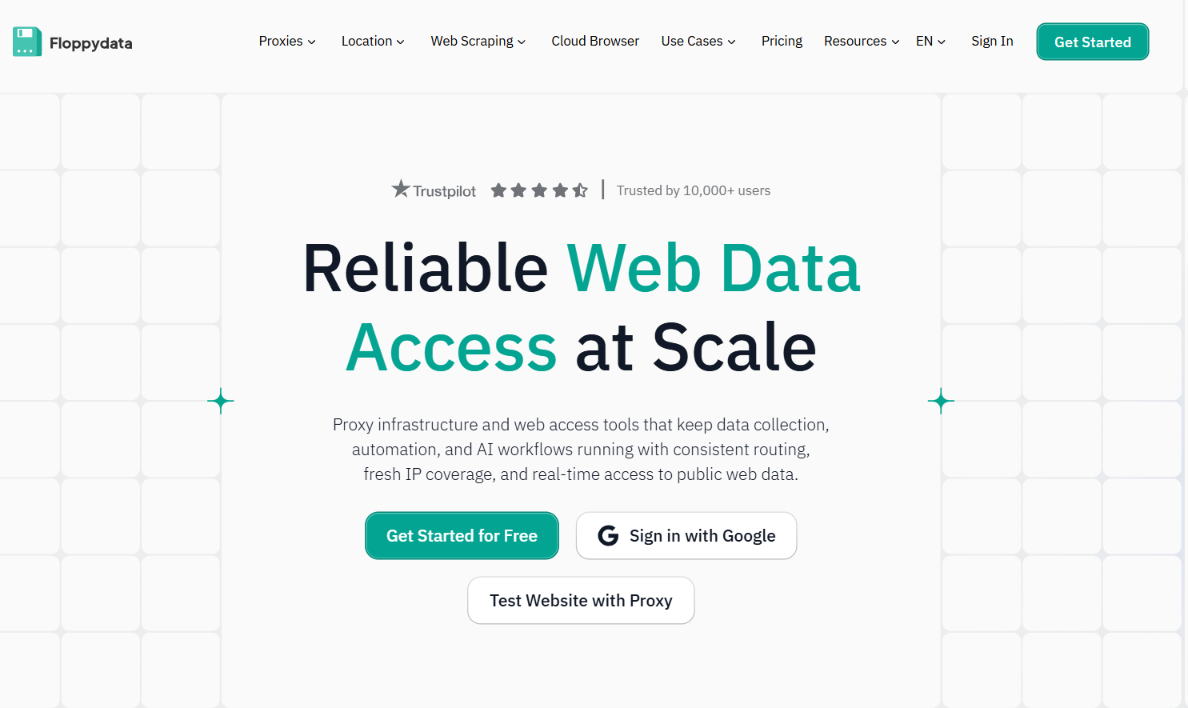
I keep returning to Floppydata and it is my preferred residential proxy service for 2026, something that is certain.
Here is the reason: you can get residential, mobile, and datacenter addresses at a rate of $1 per GB, together with ISP services, all through a single account. There are 65 million IPs and coverage in 195 countries.
That flexibility is what I care about – it lets you buy your GBs once and then switch between types any time you want without having to pay extra or open a second account.
If you’d like fixed IP addresses instead, static residential ones start at $1.79 per IP with unlimited bandwidth. You’d effectively have an unlimited residential proxy without any data limit hovering over you. A price like that is something I don’t usually come across.
The protocols available are HTTP, HTTPS, SOCKS5 and also UDP; uptime is 99.99 per cent; the network is ethically sourced; there is no free trial, but actually, with the pay-as-you-go rate of $1 per GB your first proper test will cost around a dollar, so it doesn’t matter.
Pros
- Residential, mobile, datacenter, and ISP on one balance
- Unlimited bandwidth on the static residential IPs
- More than 65 million IPs, over 195 countries, 99.99% uptime
- HTTP, HTTPS, SOCKS5, and UDP
- $1/GB to get in, no setup fees
Cons
- Younger than the enterprise giants
- Residential pool is smaller than Oxylabs or Bright Data
Ideal for: people who want all the types of proxy available in a single location and who want them obtained in a clean way without having to pay enterprise fees.
2. 1Browser
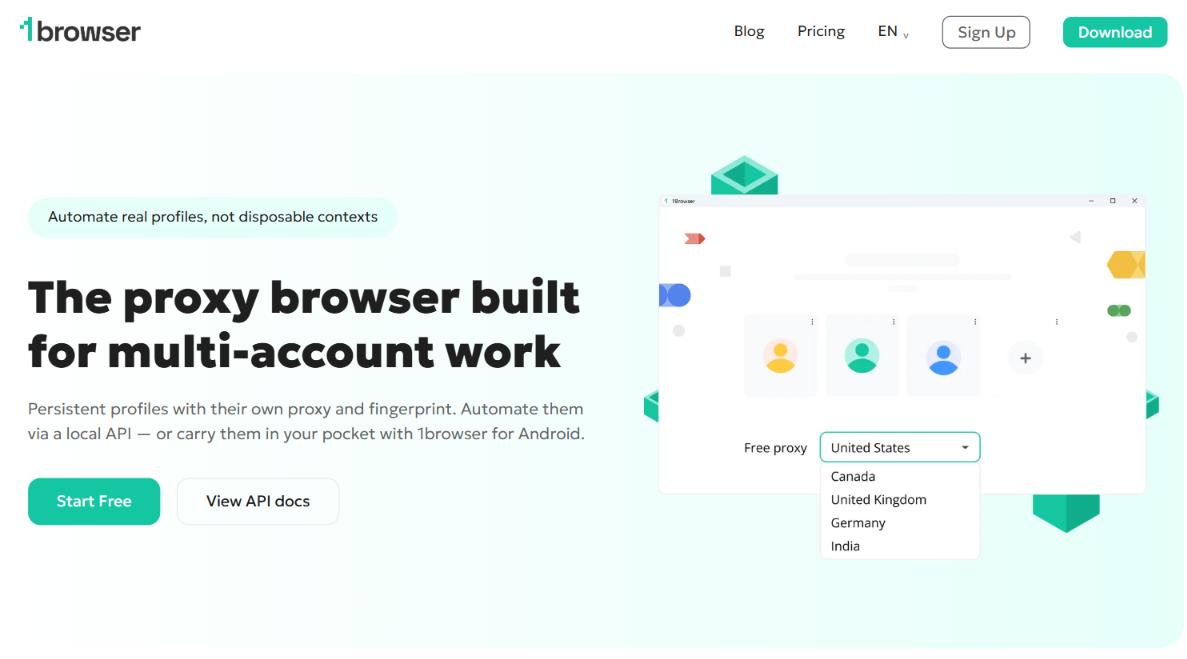
The browser is my second choice and is a different kind of thing; it’s an anti-detect browser with the proxies built directly into it.
Each profile has its own IP address, fingerprint, and cookies – precisely what you need when working with multiple accounts. All three types – residential, mobile, and datacenter – are included, together with a local API and an Android app should you wish to carry out tasks while on the go.
I’ll start with a free trial, offering proxies from $1; I looked into it more in my review of 1Browser.
Pros
- Proxies and fingerprint protection in one place
- Free tier, cheap to get going
- Persistent profiles made for multi-account work
Cons
- Newer, short track record
- Not a big standalone proxy network
Ideal for: individuals who are managing a number of accounts and want both proxies and an anti-detect browser.
3. Oxylabs
Oxylabs is the top choice in the business sector. There’s no doubt that one of its premium residential proxies is indeed available. The pool consists of more than 175 million IPs covering 195 or more countries.
The targeting extends down to the city, the ZIP code, and the ASN. There are sticky sessions with response times of under 0.6 seconds. Prices begin at $6 per GB and drop to $2.50 per GB when you are purchasing a terabyte.
Pros
- Enormous, high-quality pool
- Deep targeting, genuinely fast
Cons
- Pricey for small jobs
- Trial’s through sales only
Ideal for: large teams that require scale and can afford the associated costs.
4. Bright Data
Bright Data is also a giant company. It operates one of the largest networks and has the most extensive set of compliance documents that you’ll come across.
The service is available to 195 countries and involves stacking scraping APIs onto the proxies. The pay-as-you-go rate is $4 per gigabyte, and the promotion is currently underway, although there is indeed a free trial. However, you’ll have to complete business verification before you can begin, which is a nuisance if you’re working on a quick project.
Pros
- One of the biggest IP networks anywhere
- Deep tooling, serious compliance
Cons
- Premium once the promos lapse
- Verification gate before you start
Most suitable for: businesses that carry out a lot of scraping and have strict compliance rules.
5. Decodo
Decodo offers the best value overall among the mid-range options, with more than 115 million IPs, coverage in over 195 locations, and a dashboard that doesn’t oppose you.
Residential starts at $3.75 per GB and falls to $2.75 per GB after you’ve used 100GB, while the pay-as-you-go option is priced at $4; this trial offers the most generous deal on the entire list with three days free and an additional 14-day money-back period.
Pros
- Strong price for what you get
- Easy dashboard, generous trial
Cons
- Not the cheapest out there
- Smaller pool than the top two
Ideal for: developers and small teams who want quality without having to pay the enterprise price.
6. SOAX
SOAX is designed for those who are highly concerned with targeting, since the system covers more than 155 million IPs in over 195 countries and has a reported success rate of 99.95%.
It is possible to filter by country, region, city, and ISP, and there is no limit on the number of concurrent connections. This combination is why it is commonly used for ad verification. The sandbox pricing is about $3.60 per GB, and a 3-day, 400MB trial costs $1.99.
Pros
- Excellent granular geo-targeting
- High success rate, unlimited connections
Cons
- Entry plans start above the budget crowd
- Best rates want a big commitment
Ideal for: ad verification and all situations that are location-sensitive.
7. IPRoyal
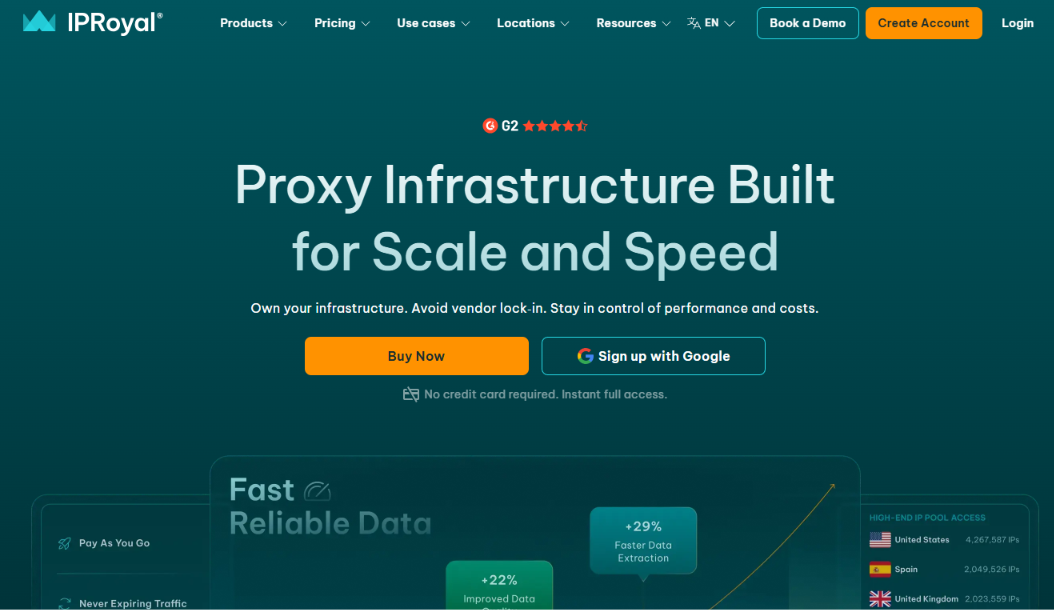
IPRoyal is the one that doesn’t expire. No matter how much traffic you purchase, it just stays there until you decide to use it. Pool provides more than 64 million IPs in over 195 countries.
The residential rate is $5.25 per gigabyte on the 10GB plan and it only becomes cheap when the volume is serious. The IP addresses are ethically obtained with the users’ consent.
Pros
- Traffic that never expires
- Ethical sourcing, wide reach
Cons
- Entry price runs high
- Best rate needs 10TB
Ideal for people who want flexible traffic and don’t want to face a monthly reset.
8. Rayobyte
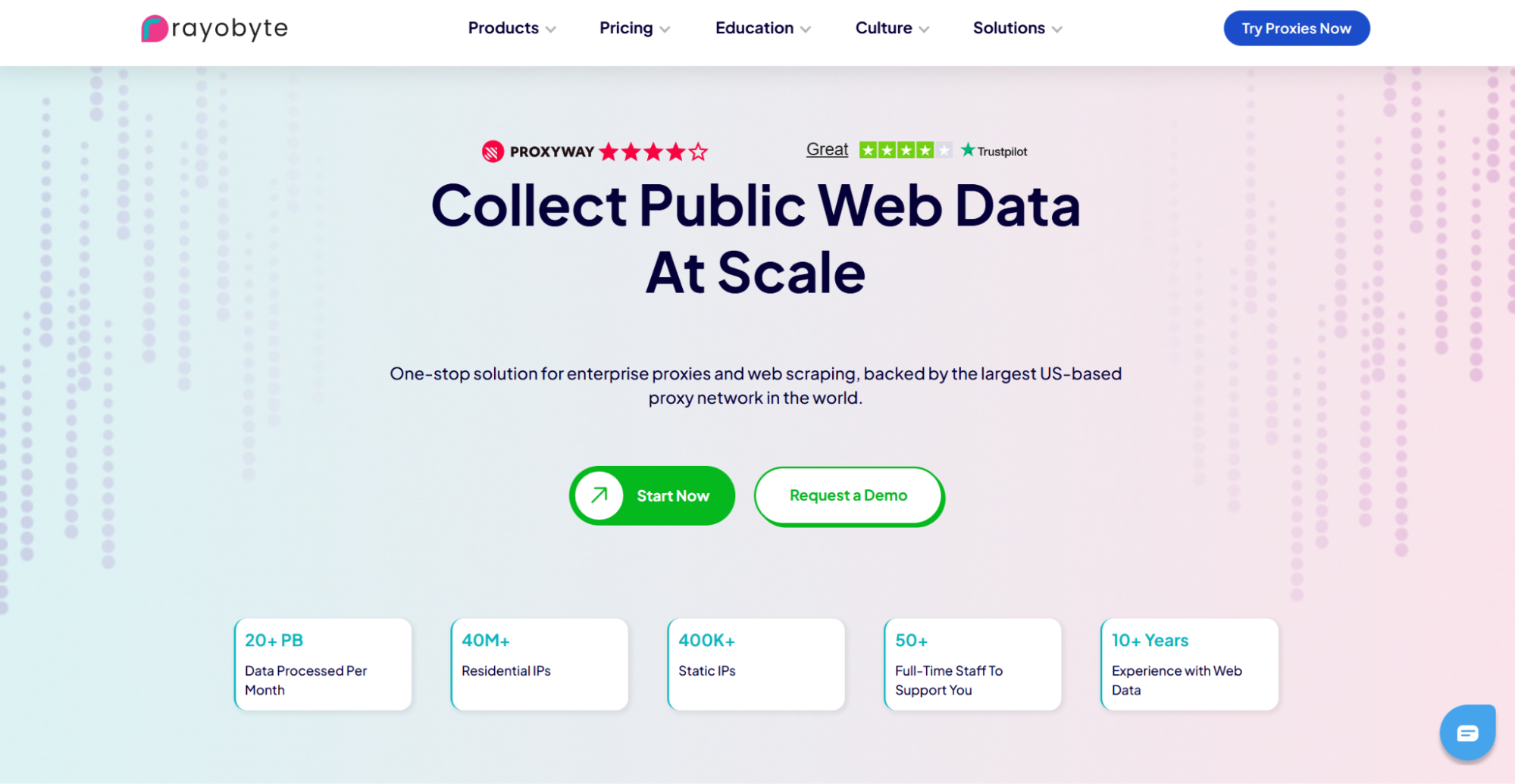
Rayobyte places a strong emphasis on ethical sourcing and its support services, and I prefer that its pricing is very easy to understand.
The price is $3.50 per gigabyte for the first 49 gigabytes, after which it drops in clear stages to $0.50 per gigabyte when you reach 5 terabytes and above. The service includes more than 40 million IPs available in over 163 locations. Although it isn’t the fastest I’ve ever used, the success rates remained satisfactory.
Pros
- Transparent volume pricing
- Ethical sourcing, strong support
Cons
- Slower than the leaders
- Residential is HTTP(S), no SOCKS5
Most suitable for: situations involving high volume or a heavy presence of US-based clients where you need a steady invoice.
9. Webshare
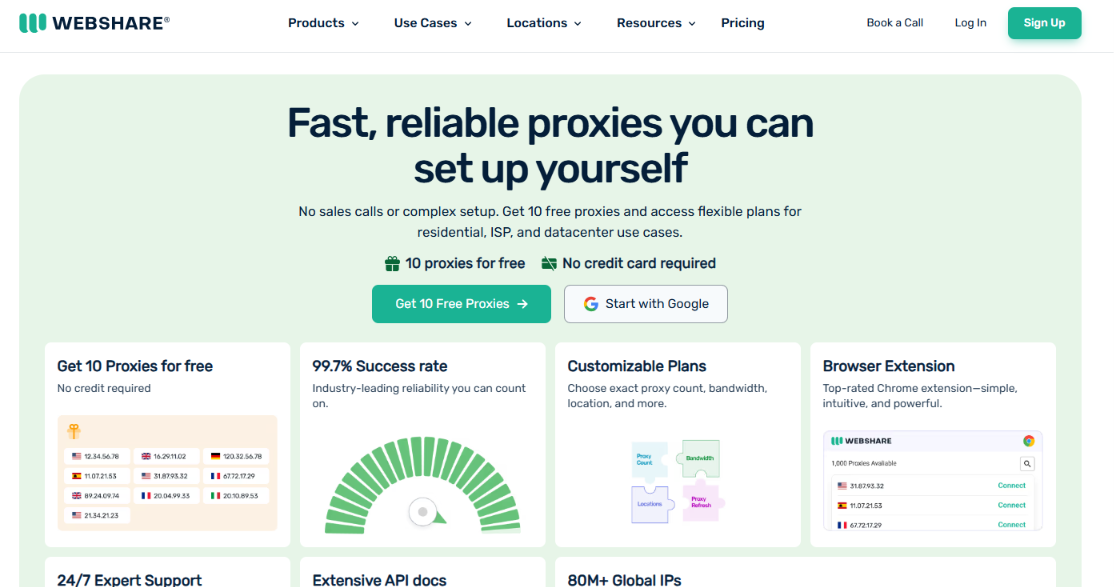
Webshare is by far the cheapest option, offering ten proxies free of charge and forever without the need for a card.
On the residential side there are more than 80 million IPs that are ethically sourced from 195 countries, with prices ranging from $3.50 per GB down to $1.40 per GB when at 3TB.
Ideal for: those who are starting out and would like to have a genuine free option before spending a single cent.
10. Infatica
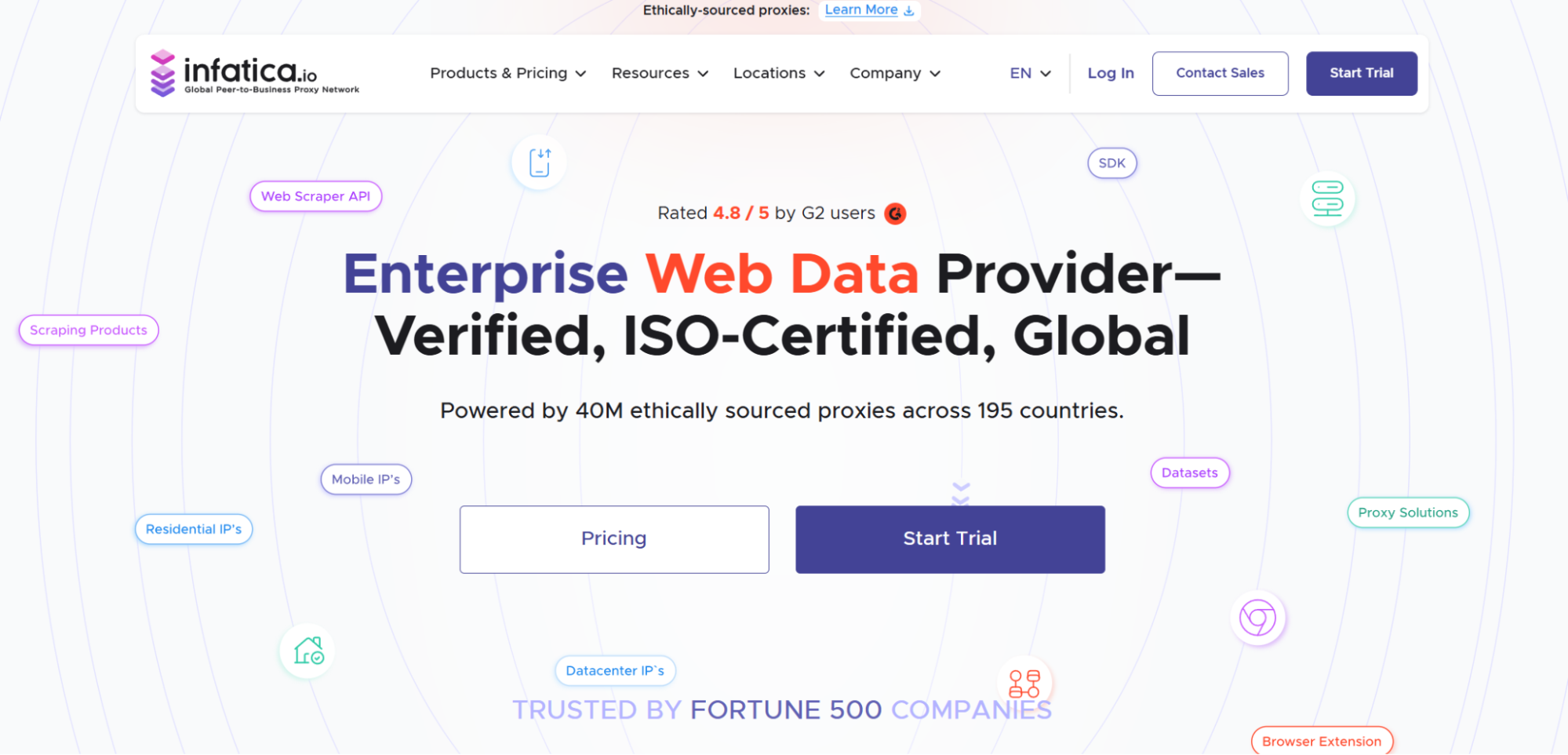
Infatica is a fast, ISO-certified network that has held up well in independent benchmarks.
There is a pool comprising more than 40 million IPs that has been ethically sourced from over 195 countries, priced starting at $4 per GB and going as low as $2.60 per GB for a terabyte, together with a free trial.
Ideal for: teams who want to achieve speed and have compliance audited in writing.
11. Evomi
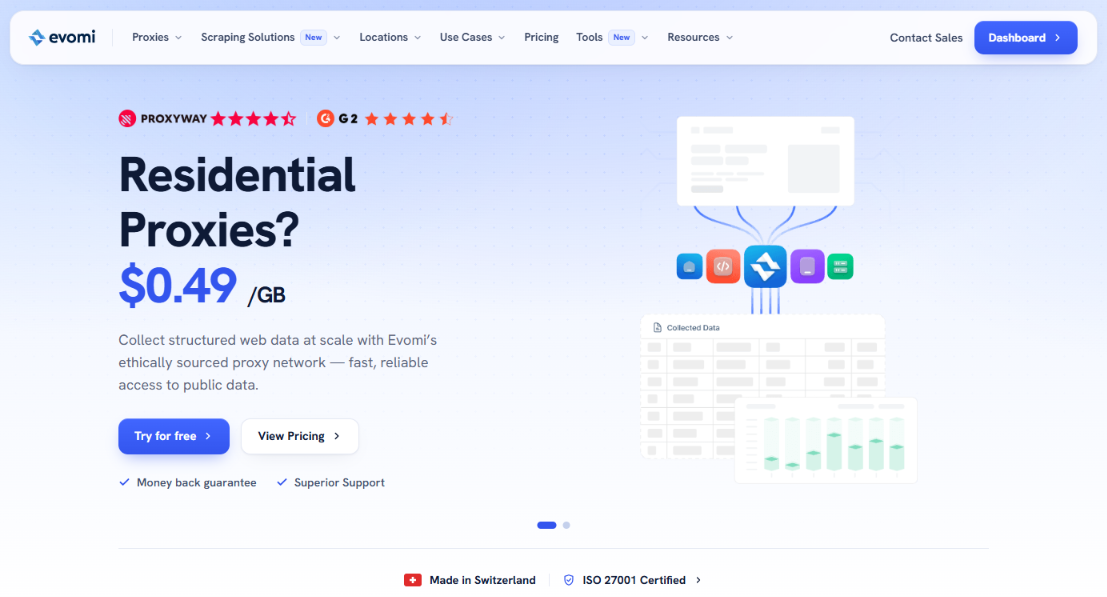
Evomi is merely a cheap option; in fact, it’s the cheapest clean GB I came across, with core residential rates at $0.49 per GB and the pool containing 54 million-plus IPs that have been ethically sourced.
It’s Swiss and EWDCI-certified, and Proxyway awarded it Best Value of 2026, and it offers a 1-day trial so that you can test it out on your own targets before making a decision.
Ideal for: small teams and developers who want ethical IPs at the lowest possible prices.
12. DataImpulse
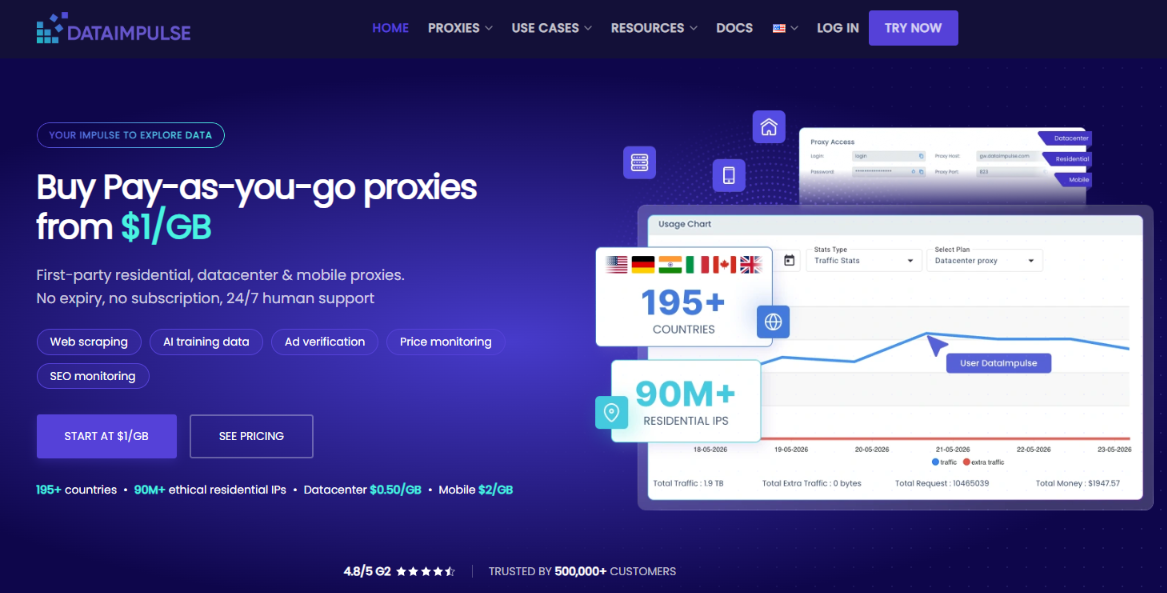
DataImpulse is the real pay-as-you-go option for budget-conscious users, with a rate of $1 per GB and the data never expiring.
More than 90 million ethically obtained IP addresses, available in 195 countries, with a $5 offer for 5GB, and no subscription to worry about.
Ideal for: people on a budget who want low-cost traffic and don’t have to make any commitments.
13. MarsProxies
MarsProxies offers a straightforward, tiered pricing structure that becomes more advantageous as your usage increases, beginning at $4.99 per GB and dropping to $1.65 per GB when you reach 10TB.
The dashboard is simple and the plans go smoothly, though the amount of information on sourcing is less than with the leading companies, so you should proceed with a clear understanding.
Most suitable for: those buyers who want the tiers to remain predictable as they increase.
14. PacketStream
PacketStream is the cheap flat-rate option; it costs a dollar per gigabyte with a minimum charge of $50 and your balance never expires.
The problem lies in the targeting aspect: it applies only to countries, not to cities, not to ZIP codes, not to ASNs. It is a peer network based on consent.
Most suitable for: jobs that are simple and have low costs, requiring only country-level IP addresses.
15. Massive
Massive is designed with compliance in mind and is based on consent-driven IP rights in more than 195 countries. It is suitable for use in regulated environments and for AI training data.
The price is $4.9 per GB when you buy 100GB, rising to $8 per GB at the entry level, and any unused bandwidth carries over rather than being lost.
Most suitable for: projects that have to adhere to compliance requirements and need a neatly documented network.
What residential proxy should you choose?
Quick guide:
- Budget’s not the real issue? Then it’s Oxylabs or Bright Data.
- Best all-round value? Decodo.
- What’s the most inexpensive ethical GB? Evomi, followed by DataImpulse.
- Forever-lasting traffic? Choose IPRoyal or DataImpulse.
- Geo data at a granular level for ad verification? Soax.
- Floppydata for every proxy type on one budget balance?
If all you need are country-level IP addresses, go for the flat-rate option and you’ll save money. If you need to appear as a phone user, then choose mobile proxies instead.
the site you’re targeting, so it’s important to carry out your own tests before relying on the figures.
Conclusion
When it comes to dealing with sites that resist, residential proxies are the best option, and in 2026 the most important factor is the origin of those IPs.
Of the 15 available, Floppydata is the best residential proxy for the average person since the proxies are ethically sourced, all types are offered on a single balance, and the price starts at $1 per GB.
It costs about a dollar to test it. Just get a plan from the pricing page and carry out your own job using it.