
Search Engine Optimization, or SEO, is a widely used practice among businesses of all shapes and sizes. At its core, SEO is a process of building or optimizing digital content in a way that pushes popular search engines to rank your website higher than the rest – and let’s be frank, in today’s day and age, if your business doesn’t come up on the first page of Google, it basically doesn’t exist.
In this context, SEO proxies are necessary for bypassing strict anti-bot systems employed by many, if not all, large platforms. When Google, or a similar search engine, sees hundreds of requests hammering its servers from one IP, it will promptly flag the address as an automated bot. A well-configured SEO proxy prevents this from happening by routing your connection through an intermediary server and assigning a different IP to each singular request, making it seem as if hundreds of regular users are browsing simultaneously.
Who Needs SEO Proxies?
SEO proxies have a wide applicability among professionals working with digital content, products, or data, as search algorithms change rapidly and the market grows oversaturated with competitors. Apart from SEO specialists, businesses and solopreneurs also frequently employ proxy solutions to remain relevant and competitive in a fast-paced world of social media trends and fly-by-night brands. SEO proxies are popular among:
- Digital marketing agencies
- SEO agencies
- E-commerce brands
- Market researchers
- Local SEO specialists
- SEO software developers
- Affiliate marketers
- Data engineers
- Brand managers
- Search Engine Marketing (SEM) specialists
SEO Proxies – Use Cases
SEO is most commonly used as an umbrella term which encompasses a variety of subdisciplines ranging from rank tracking and SERP scraping to competitor analysis and ad verification. Although they all make up what we usually call SEO, these practices differ significantly in their technical requirements; in turn, each task calls for its own proxy configuration. In this section, we’ll go over the most popular SEO components and establish best proxy practices for each one.
Proxies for Rank Tracking
The results you get in your browsing are highly personalized – search engines customize what they show based on the user’s exact location, browser history, and even device. Rank tracking is the process of monitoring where your website appears on Search Engine Results Page (SERP) over time based on specific keywords, to keep you in the know about how easy or hard it is for different users to find your URL.
Tools like SEMrush, Ahrefs, or Mangools are most commonly used to send requests to the search engine and log the position of your page. However, without a well-configured rank tracker proxy, search engines will see those requests as automated, ultimately rate-limiting and blocking them, as well as flagging your IP as malicious.
Proxy type: Residential
Rotation: Sticky sessions with rotation every 5-10 minutes or every 3-5 requests
Geo-targeting: City-level or deeper depending on your target
Proxy quantity: 1 unique IP per 10-20 checks. Recommended minimum – 5,000 IPs
Proxies for SERP Scraping
Similar to rank tracking, SERP scraping deals with the data of result pages, but if rank tracking is used to understand where one specific website appears on the search engine’s pages, SERP scraping is used to extract all results of the entire page – titles, URLs, meta descriptions, maps, ads, People Also Ask boxes, Google AI overviews, and more. It’s the backbone of competitive keyword research, content gap analysis, and SERP feature tracking at scale.
In 2026, SERP scraping is becoming increasingly difficult, as Google employs the most aggressive anti-bot systems to block scrapers specifically. This is why reliable proxies are a necessity here.
Proxy type: Premium residential or mobile IPs
Rotation: Per-request with a 30-60 minute cooldown window for each IP
Geo-targeting: City-level or deeper depending on your target
Proxy quantity: 1 unique IP per individual search request. Recommended minimum – 50,000 IPs
Proxies for Crawling
Crawling, sometimes called spidering or website auditing, is a process of reviewing one specific website, all its data and structure, in order to find broken links, technical errors, missing or slow-loading content. SEO professionals often use it to audit their own or their company’s website, although it can also be used to crawl competitor sites in order to scrape or analyze them.
Proxy type: Datacenter or static residential (ISP) depending on the website
Rotation: Long sticky sessions, one IP per domain, rotate between domains
Geo-targeting: Country- or state-level, the pool corresponding to the site’s region
Proxy quantity: 1 IP per domain with 2 to 5 concurrent threads, for heavy sites up the proxy count. Recommended minimum – 10 to 100 dedicated IPs
Proxies for Backlink Monitoring and Auditing
Backlink monitoring is also performed by automated crawlers, although the process is a bit different – here, the crawler searches through thousands of external websites (blogs, forums, news sites, etc.) to find the ones that link to you, then analyzes those sites. Search engines use backlinks to analyze how trustworthy or relevant your site is to users, so if your link frequently pops up on hacked, spammy, or adult websites, Google might trigger a penalty and lower your website on results pages.
Proxy type: Static residential (ISP) and datacenter with a backup pool of rotating residential (for occasional sites with strict anti-bot systems)
Rotation: Long sticky sessions, one IP per domain, rotate between domains
Geo-targeting: Global geo-targeting with a highly diverse pool of countries
Proxy quantity: 20 to 50 IPs with 2GB to 5GB residential backup pool. Recommended minimum – 20 to 50 dedicated IPs
Proxies for Ad Verification
This process is pretty self-explanatory; SEO specialists use ad verification to check if their digital ads are being displayed correctly, in the right geographic location, on safe websites, and to real users. Dishonest publishers use bots to generate fake ad impressions or clicks, while your ad might not be displayed on the intended website at all.
Proxy type: Premium residential or mobile IPs
Rotation: Sticky sessions, rotation every 10-15 minutes, keep one IP for the whole cycle of verification
Geo-targeting: Deep ASN/ISP-level targeting
Proxy quantity: 1 unique IP per individual test. Recommended minimum – 1,000 IPs
Proxies for Brand and Reputation Monitoring
SEO is often used to gain brand awareness; here, automated tools are used to track company or product reviews across the internet. Brand and reputation monitoring involves scanning social media, forums, review platforms, news sites, and even the dark web. The goal is to catch negative reviews, copyright infringement, counterfeit products, phishing scams, or corporate data leaks before they can cause any damage.
Proxy type: Residential proxies with a backup pool of mobile IPs
Rotation: Long sticky sessions, one IP per domain, rotate between domains
Geo-targeting: Global geo-targeting with a highly diverse pool of countries
Proxy quantity: Based on the scope. Recommended minimum – 2,000 IPs or 10GB to 20GB of monthly bandwidth
Proxies for Price and Market Intelligence
Automated tools and proxies are an absolute must when it comes to e-commerce. Price and market intelligence involves tracking of competitors’ pricing, monitoring suppliers’ stock levels, and searching for product variations across the web. E-commerce is an extremely fast-paced market, where prices change constantly. Additionally, many large platforms employ dynamic pricing algorithms that adjust costs based on user’s location, competitor data, time of day, and inventory levels.
Proxy type: Residential IPs
Rotation: Per-request rotation
Geo-targeting: City-level or ZIP code-level targeting
Proxy quantity: 1 unique IP per 5-10 products scraped. Recommended minimum – 10,000 IPs
Best SEO Proxy Providers
Now that you probably know exactly what you’re looking for, let’s get to the best proxy providers for SEO workflows.
TL;DR
| Provider | Proxy types available | Pool Size | Rotation abilities | Geo-targeting level | Price |
| Floppydata | Datacenter, Residential, Mobile, ISP | 65+ Million | Per-request, 5-60 minutes, Sticky sessions/Keep-Alive | Country, City, State, ASN | Rotating proxies – $1/GB, Static datacenter – $1/IP, ISP – $5/IP |
| IPBurger | Residential, Mobile, ISP | 100+ Million | Per-request, up to 30 minutes, Custom sticky sessions | Country, City, State, ISP | Residential – $49/mo, Mobile – $99/mo, ISP – $14.41/mo |
| Shifter | Residential, ISP | 205+ Million | Per-request, per-session, up to 60 minutes, Custom sticky sessions | Country, City, State, ASN | Residential – $0.75/GB, ISP – $1.68/IP |
| Dataimpulse | Datacenter, Residential, Mobile | 90+ Million | Per-request, 1-120 minutes | Country, City, State, ASN, ZIP code | Residential – $1/GB, Datacenter – $0.5/GB, Mobile – $2/GB |
| Decodo | Datacenter, Residential, Mobile, ISP | 125+ Million | Per-request, 1-60 minutes, Custom intervals up to 24 hours | Country, City, State, ASN | Residential – $3.75/GB, Datacenter – $0.6/GB, Mobile – $3.75/GB, ISP – $3.33/IP |
| Infatica | Datacenter, Residential, Mobile, ISP | 60+ Million | Per-request, 10-60 minutes | Country, City, State, ASN | Residential – $4/GB, Datacenter – $0.6/GB, Mobile – $8/GB, ISP – from $3 |
| SOAX | Residential, Mobile | 100+ Million | Per-request, 5-30 minutes, Custom sticky sessions up to 24 hours | Country, City, State, ASN, ZIP code | Residential – $5/GB, Mobile – $5/GB |
| Live Proxies | Residential | 10+ Million | Per-request, up to 60 minutes | Country, City, State, ASN, ISP | Residential – $70/mo |
| ProxyEmpire | Datacenter, Residential, Mobile, ISP | 34+ Million | Per-request, up to 60 minutes, Custom sticky sessions | Country, City, State, ISP
(Only Country for ISP IPs) |
Residential – $3.50/GB, Datacenter – $0.625/GB, Mobile – $4.50/GB, ISP – $2/IP or $2.86/GB |
| Oxylabs | Datacenter, Residential, Mobile, ISP | 195+ Million | Per-request, up to 24 hours, Custom sticky sessions | Continent, Country, City, State, ASN, ZIP code | Residential – $6/GB, Datacenter – $1.20/IP, Mobile – $7.50/GB, ISP – $1.60/IP |
| Webshare | Datacenter, Residential, ISP | 80+ Million | Permanent sticky sessions until rotated manually, automatic rotation schedule available every 5, 60 minutes, 24 hours, or once a month | Country, City, ASN, ISP | Residential – $3.50/GB, Datacenter – $0.0299/IP, ISP – $0.3/IP |
1. Floppydata
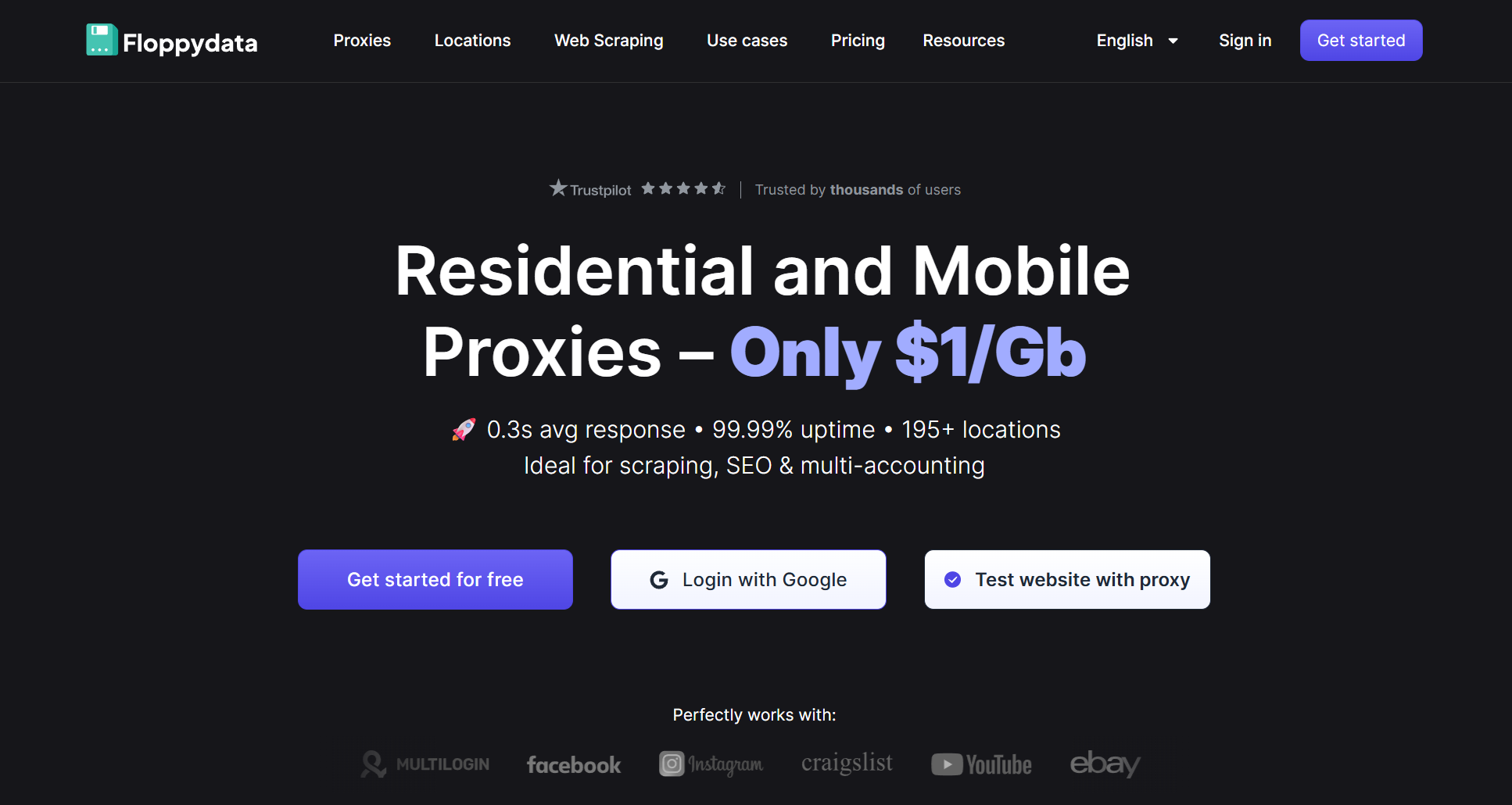
Floppydata is my go-to provider for SEO proxies; the service offers one of the best market prices combined with top-notch performance and connection stability. Floppydata provides a broad toolset for any SEO need, which is crucial for teams and agencies looking for a one-stop-shop proxy service.
Key Features:
- All-encompassing data plan for rotating proxies includes datacenter, residential, and mobile IPs, which you can use at your own discretion, paying only for GBs
- Dedicated scraper APIs for popular use-cases and platforms
- Flexible rotation: per-request, 5 to 60 minute intervals, and sticky/Keep-Alive support
- Great granular geo-targeting
- UDP protocol support
- AI integrations
- Live customer support
- No setup fees, easy plan upgrades/downgrades
Pros:
- Great performance speed
- 95% IP clean rate provides high trust scores for all proxy types
- Full proxy stack available, covering every SEO need in one provider
- Very affordable
- Flexible billing and rollover-friendly plans
- Unlimited concurrent requests
- Wide compatibility with other tools
Cons:
- No free trial
Pricing:
- Rotating proxies (Datacenter, Residential, Mobile) – $1/GB
- Static Datacenter – $1/IP
- Static Residential (ISP) – $5/IP
Best For: SEO agencies, rank trackers, SERP scrapers, and data engineers looking for maximum value without sacrificing pool size or targeting depth.
2. IPBurger
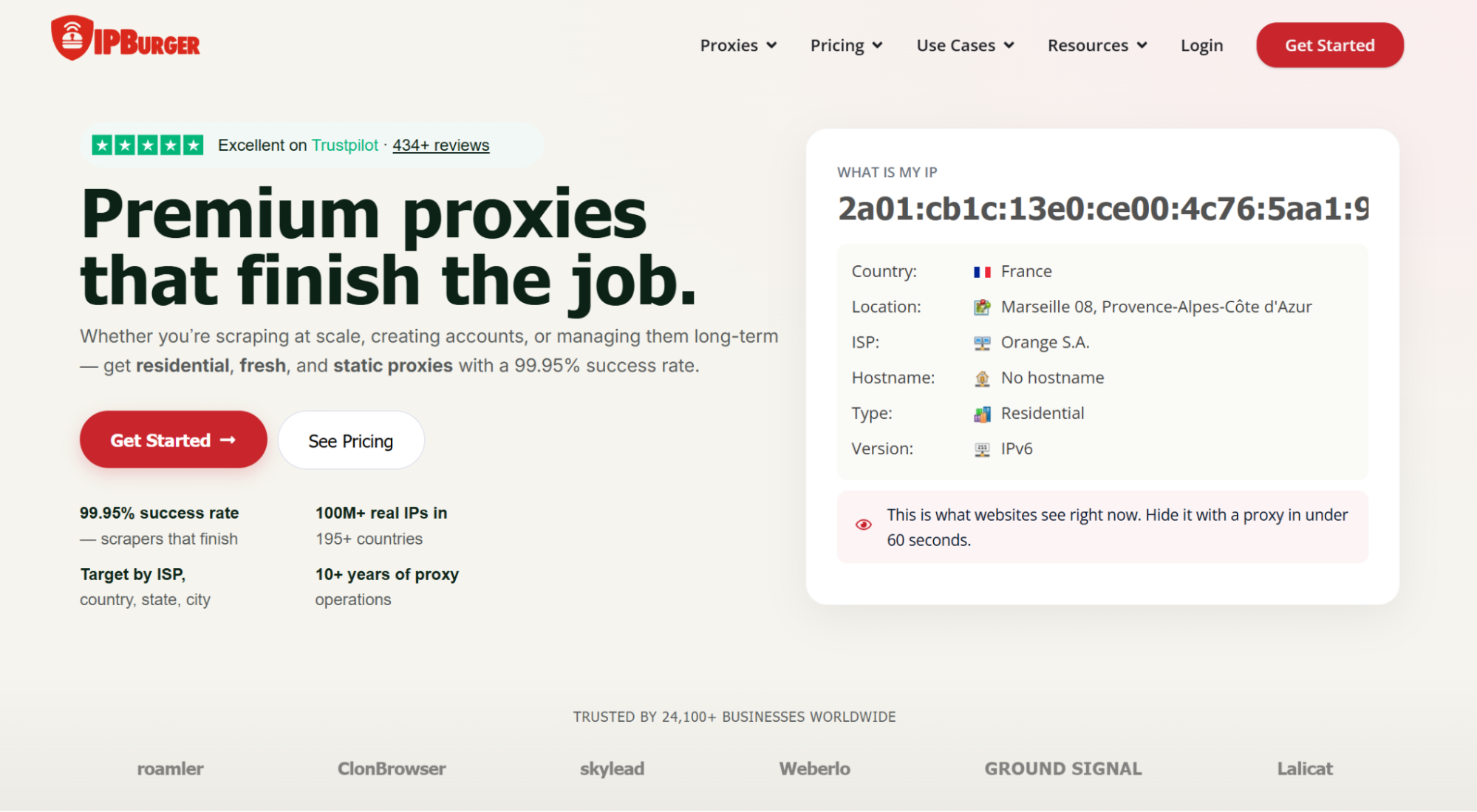
IPBurger is a well-established provider with more than a decade of experience on the market. The provider focuses on SEO workload and caters to business clients. IPBurger’s user-friendly dashboard and complimentary proxy and VPN extensions significantly simplify proxy setup and management.
Key Features:
- In-house VPN priced at $5.41/mo
- Chrome and Firefox browser extensions
- Leak protection and kill switch
- Unlimited bandwidth on residential plans
- Private dedicated and fresh (never before used) dedicated IPs available
Pros:
- Stable connection and high clean rate
- Large residential IP pool
- Stable ISP proxies suited for account management tasks
- Easy-to-use and setup
Cons:
- No datacenter proxies
- Limited session control for residential proxies, maxing out at 30 minutes
- Pricing far above market rate
- Limited pricing flexibility
Pricing:
- Residential: from $49/mo
- Mobile: from $99/mo
- ISP: from $14.41/mo
Best For: Businesses focused on account management and ad testing.
3. Shifter
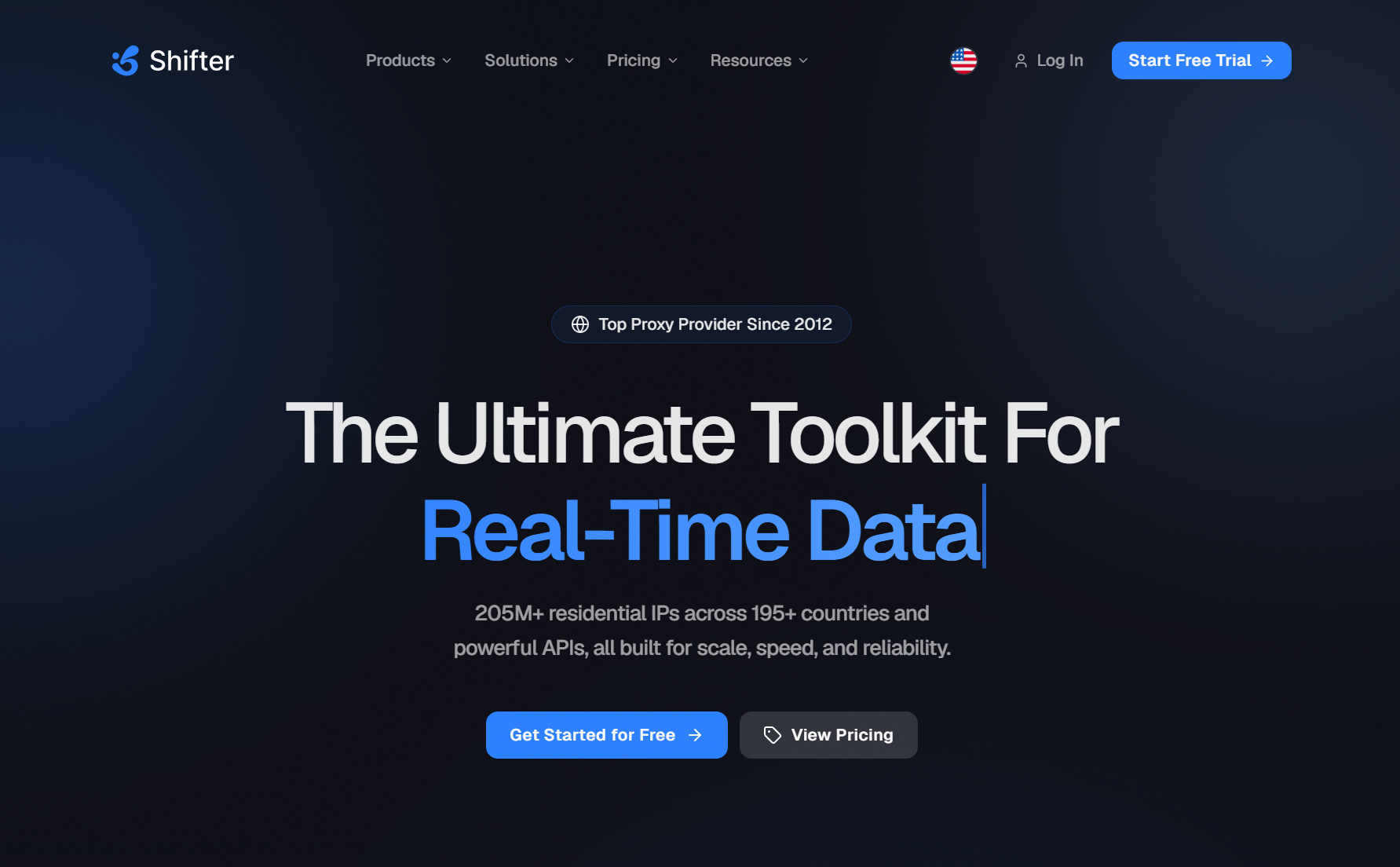
Shifter (formerly Microleaves) comes with a massive pool of 205+ million IPs and a port-based pricing model. It is another viable option for users in need of residential or ISP proxies specifically.
Key Features:
- 205+ million IPs sourced directly from device owners and ISPs
- Works with standard proxy configuration – single gateway endpoint (p.shifter.io:443), session stickiness via session ID or TTL extension
- Unlimited concurrent connections
- Additional APIs for scraping and SERP
- Free trial available
Pros:
- Large IP pool
- Cost-effective for extremely high-volume, high-concurrency use cases
- Unlimited concurrent connections
- Flexible rotation control
Cons:
- No datacenter and mobile proxies
- Minimum plan starts at $99/mo for just 5 ports
- Bad fit for low-to-mid volume users
Pricing:
- Residential: from $0.75/GB
- ISP: from $1.68/IP
- Subscription plans start at ~$99/mo for 5 ports
Best For: High-concurrency, high-volume bulk operations.
4. Dataimpulse
Dataimpulse is a run-of-the-mill provider that might win you over with affordable prices, user-friendly dashboard, and non-expiring traffic. It’s a good option for sporadic proxy users with low-volume tasks operating on a budget, but be aware that Dataimpulse’s performance leaves much to be desired and deep levels of geo-targeting costs extra.
Key Features:
- Authorization by username/password or IP whitelisting
- API access with detailed documentation available
- Premium residential proxies available for $5/GB
- Traffic doesn’t expire
Pros:
- Competitive base pricing ($1/GB for residential)
- Non-expiring traffic
- Good geo-targeting options including ZIP code
- User-friendly dashboard
Cons:
- City and ASN targeting costs aren’t included in the base plans
- Variable performance
- Monthly plans lack flexibility
- No ISP proxies
Pricing:
- Residential: $1/GB
- Datacenter: $0.5/GB
- Mobile: $2/GB
Best For: Sporadic, low-volume scraping needs without deep geo-targeting.
5. Decodo
Decodo (formerly Smartproxy) is a recognizable mid-market provider with a solid reputation and a reasonable feature set. Decodo offers great flexibility in its pricing plans, which will ensure you’re only paying for what your operation actually needs.
Key Features:
- No-code integration support (n8n and similar)
- Multi-account management support
- Additional APIs for scraping and SERP, AI parser, prebuilt templates
- CAPTCHA handling built into the infrastructure
- 14-day free trial for residential proxies
- Browser fingerprint protection
Pros:
- Well-established reputable provider
- Broad proxy type selection
- Deep targeting including ZIP code and ASN
- User-friendly dashboard
Cons:
- Limitations on sticky sessions
- Above average pricing point
Pricing:
- Residential: $3.75/GB
- Datacenter: $0.60/GB
- Mobile: $3.75/GB
- ISP: $3.33/IP
Best For: SEO teams and agencies looking for a reliable, full-stack provider with granular targeting.
6. Infatica
Infatica is another mid-tier provider that is widely known for having one of the best clean rates on the market. Although its prices are higher in comparison with other mid-tier competitors, Infatica’s pay-as-you-go plans might come in handy for personal use, too.
Key Features:
- Ethically sourced IPs with transparent consent protocols
- Authorization by username/password or IP whitelisting
- Unlimited concurrent sessions
- AJAX rendering support
- Built-in Infatica Data Platform – one UI for SERP, scrapers, and AI search engines
- CSV/XLSX/JSON data export from the dashboard
- Additional tools for scraping, SERP, AI, and YouTube data
- $1.99 trial for residential/mobile (3 days)
- Pay-as-you-go availability
Pros:
- Great performance and high trust score
- User-friendly dashboard
- Wide compatibility with other tools
Cons:
- Smaller IP pool among the major providers
- Mobile proxies are among the most expensive on the market
- API functionality is limited compared to competitors
Pricing:
- Residential: $4/GB
- Datacenter: $0.6/GB
- Mobile: $8/GB
- ISP: From $3
Best For: Mid-volume SEO tasks, SERP scraping or rank tracking at a moderate scale.
7. SOAX
SOAX is a provider focused on ethical IP sourcing and protocol versatility. Flexible sticky sessions up to 24 hours and solid uptime make it a dependable pick for teams running sensitive, long-session workflows; however, the lack of datacenter and ISP proxies doesn’t make it a good fit for broader SEO operations.
Key Features:
- Additional tools for scraping, SERP, AI, video and e-commerce data as well as free tools
- Automatic IP rotation
- Custom headers support
- Unlimited concurrent connections
- Supports HTTP(S), SOCKS5, UDP, and QUIC protocols
- $1.99 trial (3 days, 400MB)
Pros:
- Great variety of protocol support
- Ethically sourced IPs with privacy regulation compliance
- Good uptime and response time
- Flexible pricing plans
Cons:
- High pricing
- No datacenter and ISP proxies
- Smaller IP pool compared to competitors of similar price range
Pricing:
- Residential: $5/GB
- Mobile: $5/GB
Best For: Compliance-sensitive enterprise teams that need ethically verified IPs with protocol flexibility.
8. Live Proxies
Live Proxies is a niche provider with a small network and a narrow geographic focus covering the US, UK, and CA regions. Instead of inflating its IP pool, Live Proxies centers the quality of provided proxies and employs private IP allocation where you’re not sharing addresses with other users, in turn significantly reducing the risk of inheriting a blacklisted IP.
Key Features:
- IPs sourced exclusively from Tier-1 ISPs — AT&T, Comcast, Verizon, etc.
- IP health monitoring
- Unlimited concurrent connections
- Bandwidth rollover
- 100% Private IP allocation
Pros:
- Private IP allocation reduces the chance of inheriting a blacklisted IP
- Good granular targeting options for available regions
- Unlimited traffic plans available
- Unlimited concurrent connections
Cons:
- The smallest IP pool on this list
- Limited global use
- High pricing, entry-level plan starts at $70/mo
- Residential proxies only
Pricing:
Residential: from $70/mo
Best For: US/UK-focused operations where private IP allocation is a priority.
9. ProxyEmpire
ProxyEmpire is a good mid-tier provider popular for its flexibility and never-expiring bandwidth policy. The service upholds its reputation by providing great performance and success rate. ProxyEmpire is a good choice for professionals searching for affordable datacenter proxies or sporadic proxy users looking for PAYG model instead of strict monthly plans.
Key Features:
- Mobile carrier-level targeting
- HTTP(S), SOCKS5, and UDP protocol support
- Pay-as-you-go availability
- Non-expiring traffic / unused bandwidth rollover
- Unlimited concurrent connections
Pros:
- Traffic rollover availability
- Great success rate
- Broad proxy type selection including dedicated mobile
- Reasonable pricing compared to competitors
Cons:
- Smaller IP pool compared to most competitors
- Newer provider with less enterprise track record
- ISP proxies only support country-level targeting
Pricing:
- Residential: $3.50/GB
- Datacenter: $0.625/GB
- Mobile: $4.50/GB (subscription) / up to $20/GB (PAYG)
- ISP: $2/IP
Best For: Teams with unpredictable scraping schedules.
10. Oxylabs
Oxylabs is an enterprise-level proxy provider with a massive pool of IPs and consistent high performance making it a great fit for any large-scale task. The platform offers a number of complementary tools tailored specifically to SEO workloads – web scraping and SERP APIs, managed datasets, and AI Studio.
Key Features:
- Residential proxies with fingerprint protection
- Dedicated account managers for enterprise tiers
- Chrome extension, web scraper and SERP APIs, AI Studio, as well as managed datasets
- Automated retry systems
- 99.95% uptime SLA with automated failover
Pros:
- Largest and most diverse IP pool
- Unmatched targeting depth including continent and ZIP code
- Excellent uptime and success rate
- Strong enterprise tooling and integration support
Cons:
- The highest pricing among competitors, entry-level plans start at $99/mo
- Setup and onboarding has a steep learning curve
Pricing:
- Residential: $6/GB
- Datacenter: $1.20/IP
- Mobile: $7.50/GB
- ISP: $1.60/IP
Best For: Large enterprises with complex, high-volume data collection operations.
11. Webshare
Webshare is considered one of the most budget-friendly providers on the market. Although its residential proxy pricing is about average market price, Webshare stands out for its datacenter IPs priced at $0.0299 per IP which will be beneficial for crawling or backlink auditing. Additionally, Webshare keeps its interface pretty straightforward, making it a nice stepping-stone for beginners.
Key Features:
- Chrome extension and API docs
- Permanent sticky sessions with optional automatic rotation schedules (5 min, 60 min, 24 hours, monthly)
- Free permanent plan (10 proxies, 1GB)
- Real-time speed monitoring
- Ethically sourced IPs
Pros:
- Free trial
- Very low datacenter proxy pricing
- Clean, easy-to-use dashboard
- Good for entry-level testing and low-volume use
Cons:
- No mobile proxies
- Limited rotation control compared to competitors
- Variable response times
- Bad fit for high-volume SERP scraping or rank tracking at scale
Pricing:
- Residential: $3.50/GB
- Datacenter: $0.0299/IP
- ISP: $0.3/IP
Best For: Beginners, individual users or developers looking for cheap datacenter IPs for non-scraping use cases.
Conclusion
SEO workload is composed of several individual disciplines, each with its own requirements. That is why it’s necessary to identify your proxy needs precisely beforehand and then choose a provider that meets them entirely. In the case of SEO agencies or multidisciplinary specialists whose demands change and fluctuate over time, as well as across teams, I’d recommend Floppydata, as it provides an all-encompassing approach to SEO proxies while keeping the service budget-friendly.