If your ad account got banned 5 minutes after you created it, don’t immediately blame the ad creative; maybe the principal reason is the country you’re in.
I’ve been there, so I decided to look for some answers. I’ve managed ad accounts across 12+ countries. The question I was trying to answer was: how do advertising platforms decide to trust you from day one?
Here’s what I found out: Meta, TikTok, Google, and LinkedIn actually score your account. Automatically. In the first few seconds after creation. And that score is built on signals that have nothing to do with how good your ads are.
Your country (or more precisely, the country your IP comes from) is one of the heaviest inputs in that score.
I experimented with this, so I set up a business manager account for Meta ads account in a country with historically high policy violation rates, I was faced with a brutal identity verification loop before I even published a campaign.
So, if you want to know whether your country is the reason why you’re getting banned, and if you want to know which countries won’t get you banned, you’re in the right place.
In this guide, I’ll break down which countries platform algorithms trust most in 2026, why they trust them, and what you can do about it if you’re operating from somewhere that doesn’t make that list.
However, one thing this guide is not is a guide on how to spam platforms or run black-hat operations. The tier differences I’m documenting here are based on legitimate trust factors such as banking infrastructure, fraud rates, KYC systems, and IP cleanliness. Following the platform’s Terms of Service is assumed throughout.
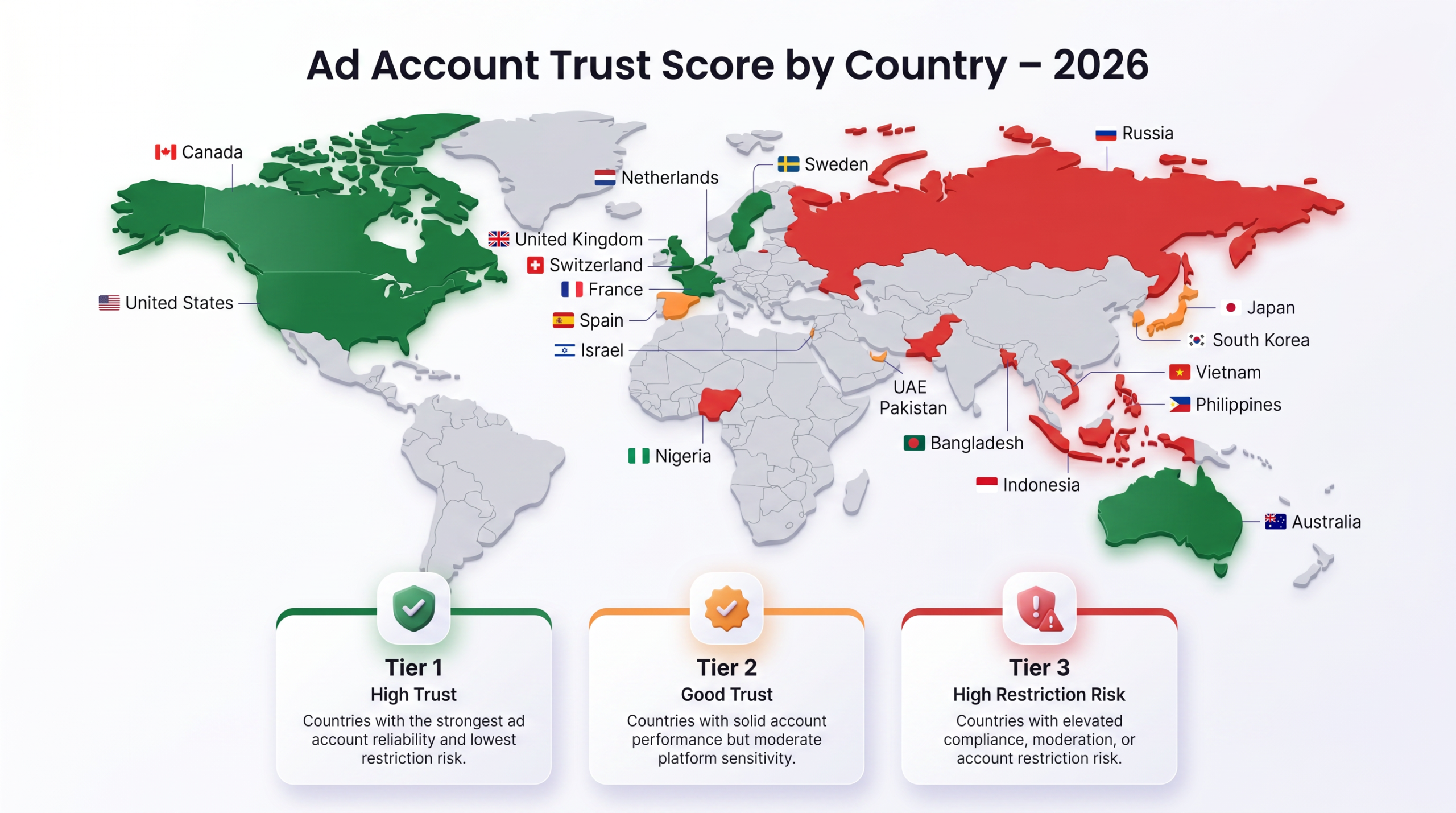
TL;DR: World map showing the different trust tiers
Short on time? You can use this map to visualize global trust tiers so you can identify which regions are safest for your ad accounts and which ones require extra caution in two seconds:
Why Your Country of Registration Matters More Than Your Ad Creative
At first, I thought platforms were just scanning my ad copy or landing page for illegal words. Turns out they also check:
- IP Reputation: to see if my IP address is clean, if it comes from a flagged country, or if it comes from a datacenter.
- Billing Country: to see if the geography of my bank matches where I claim to be
- Phone Number Origin: to see if it is a real local mobile carrier or a cheap VoIP number
- Browser/Device Fingerprint: to see if previous banned accounts have been linked to my exact hardware, OS, or browser profile
To give you a better idea of what this looks like behind the scenes, here is a breakdown of what the platform’s automated system does while you’re waiting for the dashboard to load:
What happens in the first 60 seconds after account creation:
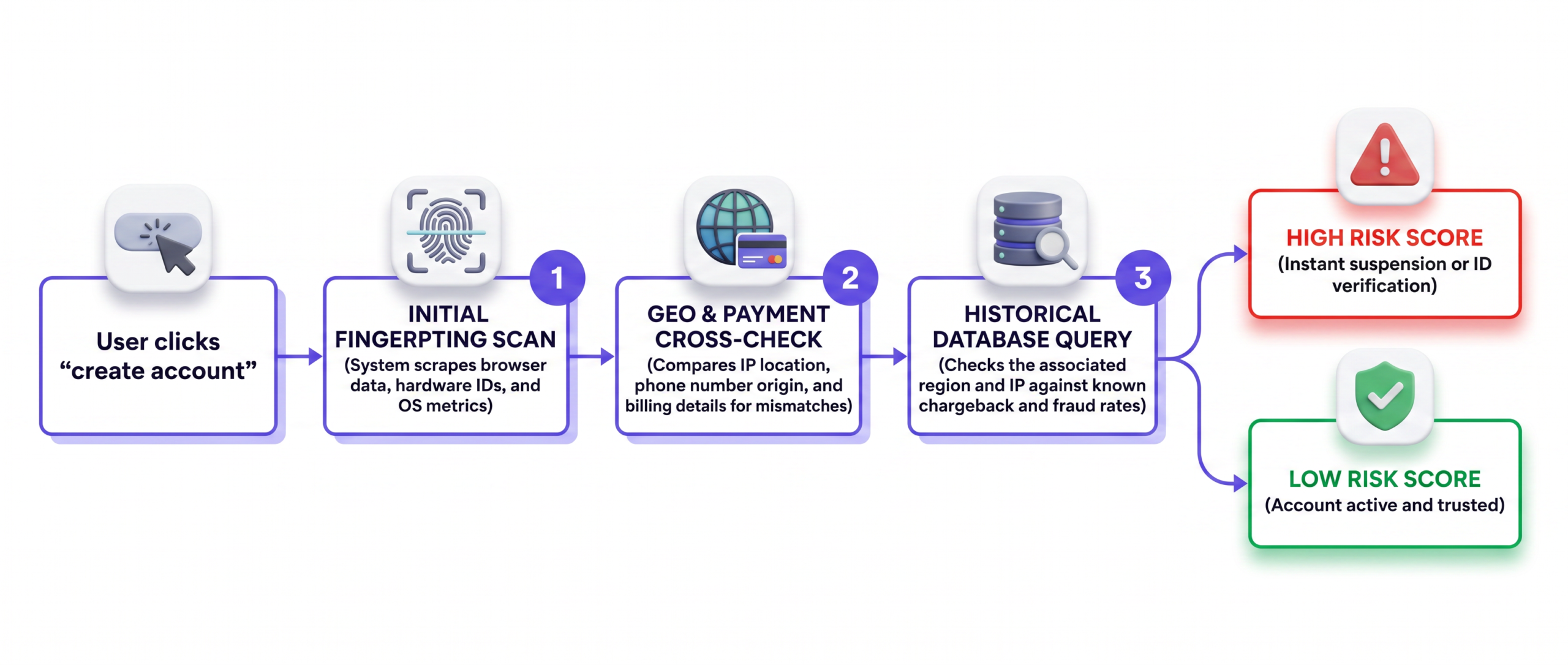
But did you know that ad platforms can (and routinely do) restrict or ban accounts based on your country?
Some countries are explicitly banned and restricted; you will usually find these non-negotiable blacklists buried in a platform’s policy documentation. For example, here are the countries that Google Ads doesn’t support:
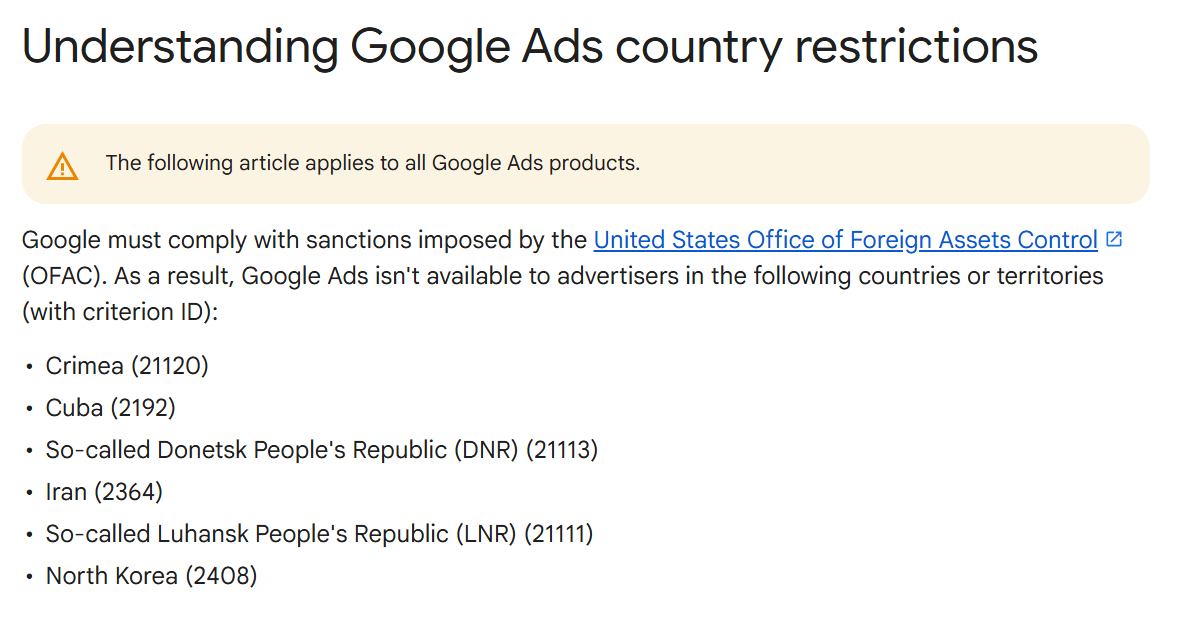
Source: Understanding Google Ads country restrictions
But there are other countries that are not explicitly banned on paper, and still, advertisers from these regions face a lot of account restrictions, identity checks, and many failed payments.
That’s because ad platforms inherently distrust the digital footprints coming from these locations due to high historical fraud rates.
Here are the fraud rates of some of the countries I’ll talk about in this guide:
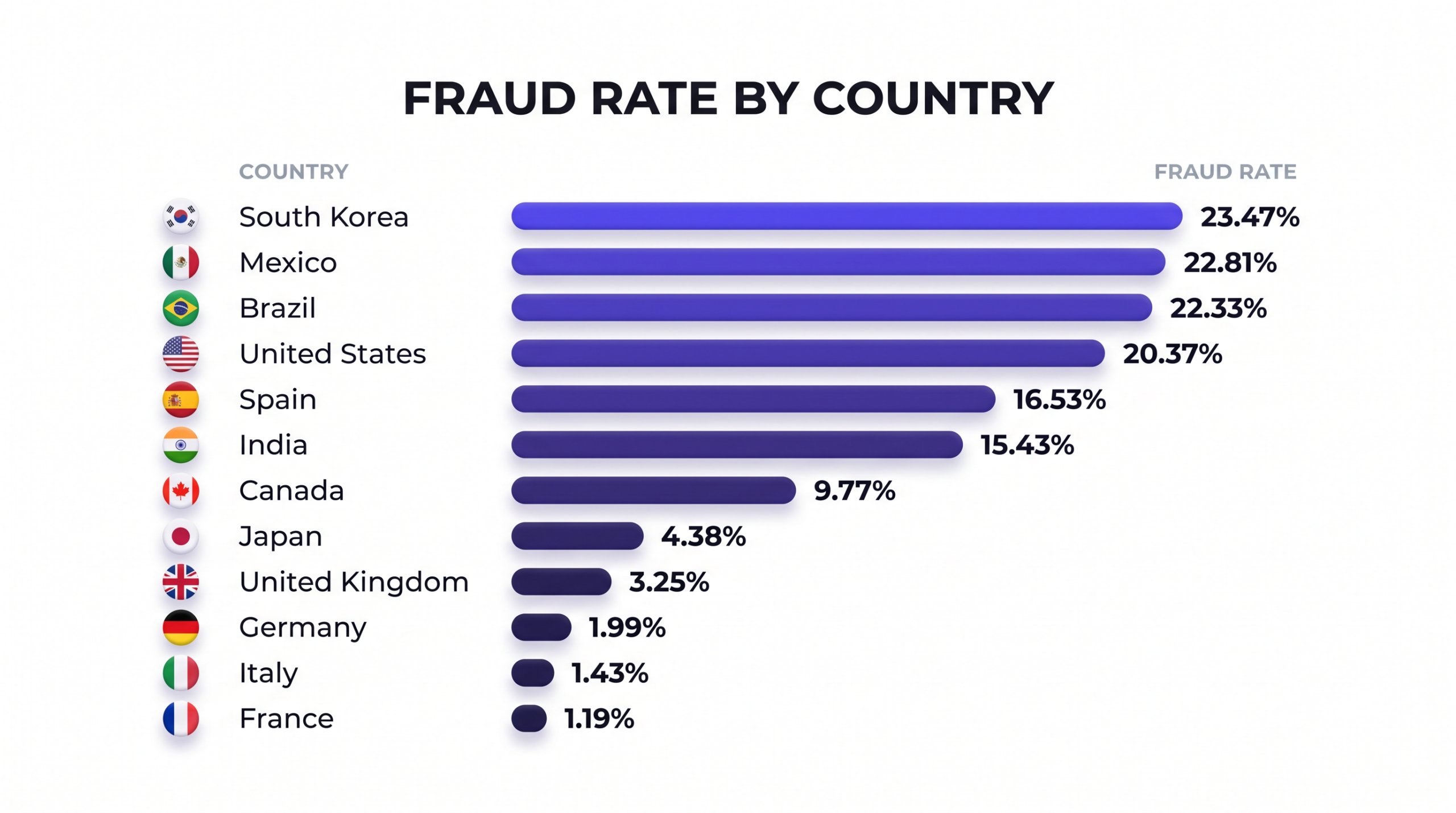
Source: Ad Fraud by Country: Q1 2026 Data
On the flip side, they also have their “favorite” countries, where advertisers are rarely banned unless they really violate the rules.
A lot of these regions have high approval rates because they have low fraud scores, but it’s not always the case. The United States is a great example. Even though the US sees a high volume of fraud, it’s still the most trusted market. Why? Because they have stable, reliable banking systems, and other perks we’ll discuss later in the guide.
What you should understand now is that indeed, ad platforms do judge you according to your country.
And this algorithmic bias is exactly why savvy media buyers bypass these geographical restrictions. By containerizing their setups with premium proxies, they switch their IP address to a high trust region, securing that top-tier trust score to open and scale their ad accounts safely.
Want to do the same, but don’t know which regions you should switch your IP to? I made a list for you below.
Best Countries for Creating Advertising Accounts Without Bans (Tier List 2026)
I put together this breakdown of the global trust matrix for 2026. This is exactly how the platform algorithms weigh different regions during initial account screening:
| Country | IP Reputation | Banking Score | KYC Quality | Policy Violation Rate | Overall Tier |
| 🇺🇸 United States | Pristine / Domestic | Elite | High Trust | Medium-Low | Tier 1 (Highest Trust) |
| 🇬🇧 United Kingdom | Very High | Elite | High Trust | Low | Tier 1 (Highest Trust) |
| 🇨🇦 Canada | Very High | Excellent | High Trust | Low | Tier 1 (Highest Trust) |
| 🇦🇺 Australia | Very High | Excellent | High Trust | Low | Tier 1 (Highest Trust) |
| 🇩🇪 Germany | Flawless | Flawless | Very Strict | Very Low | Tier 1 (Highest Trust) |
| 🇫🇷 France | Flawless | Excellent | Strict | Very Low | Tier 1 (Highest Trust) |
| 🇳🇱 Netherlands | Exceptional | Strong | High Trust | Low | Tier 1 (Highest Trust) |
| 🇸🇪 Sweden | Exceptional | Strong | High Trust | Very Low | Tier 1 (Highest Trust) |
| 🇨🇭 Switzerland | Pristine | Elite | Exceptionally High | Very Low | Tier 1 (Highest Trust) |
| 🇪🇸 Spain | High | Reliable | Good | Low-Medium | Tier 2 (Good Trust) |
| 🇮🇹 Italy | High | Reliable | Good | Low-Medium | Tier 2 (Good Trust) |
| 🇯🇵 Japan | Exceptional | Elite | Strict | Very Low | Tier 2 (Good Trust) |
| 🇸🇬 Singapore | Exceptional | World-Class | High Trust | Low | Tier 2 (Good Trust) |
| 🇦🇪 UAE | Medium-High | Solid | Moderate | Medium | Tier 2 (Good Trust) |
| 🇮🇱 Israel | High | Strong | High Trust | Low | Tier 2 (Good Trust) |
| 🇰🇷 South Korea | High | Strong | Strict | Low | Tier 2 (Good Trust) |
| 🇳🇬 Nigeria | Poor / Flagged | Low | Volatile | Extremely High | Tier 3 (High Risk) |
| 🇵🇰 Pakistan | Poor / Flagged | Low | Unstable | High | Tier 3 (High Risk) |
| 🇧🇩 Bangladesh | Poor | Low | Unstable | High | Tier 3 (High Risk) |
| 🇻🇳 Vietnam | Heavily Flagged | Moderate-Low | Volatile | Extremely High | Tier 3 (High Risk) |
| 🇮🇩 Indonesia | Poor | Moderate | Moderate | High | Tier 3 (High Risk) |
| 🇵🇭 Philippines | Poor | Moderate | Moderate | High | Tier 3 (High Risk) |
| 🇮🇳 India (Certain Regions) | Mixed | Strong | Good | High | Tier 3 (High Risk) |
| 🇷🇺 Russia | Blocked | Sanctioned | Restricted | Critical | Tier 3 (High Risk, sanctioned) |
So in total, there are 3 tiers: Tier 1, Tier 2, and Tier 3.
Let’s unpack the actual mechanics behind them:
Tier 1: Highest Trust Countries
The 9 countries on this tier list aren’t “high trust countries” just because they have money; it’s that their financial and digital ecosystems are built on massive institutional accountability.
So when an ad platform sees an account anchored here, it assumes compliance until proven otherwise.
Why do these Tier 1 countries have a high trust score?
- The Fintech and Headquarters (🇺🇸 US, 🇬🇧 UK): We all know that the headquarters for Meta and Google are in the US, so acceptance becomes the default for countries anchored there. Plus, Stripe and PayPal are near-universal payment methods used in the US that are highly accepted. As for the UK, it’s on the Tier 1 because they have world-class, heavily regulated digital banks (most popular ones I know are Revolut and Wise) and incredibly strict corporate registries (like Companies House).
- The Financial Fortresses (🇩🇪 Germany, 🇨🇭 Switzerland, 🇸🇪 Sweden, 🇫🇷 France): Ad platforms absolutely love these regions because they represent the gold standard for banking compliance.
- The Trusted IPs (🇨🇦 Canada, 🇦🇺 Australia, 🇳🇱 Netherlands): these countries’ digital footprints are so clean that accounts coming from their IPs are rarely flagged.
Tier 2: Good trust, but with a catch
I’ve used some of these regions without many issues, but they usually have one specific con that prevents them from getting that “automatic pass” Tier 1 enjoys.
Why do these Tier 2 countries have a good trust score?
If you wish to use one of these countries for your ads, you must know what the nuance is that makes it fall under Tier 2 instead of Tier 1.
- The Middle East (🇦🇪 UAE, 🇮🇱 Israel: The UAE, for example, has a phenomenal banking system, but platforms tend to treat it with a little bit of moderate caution because there’s a massive volume of international money moving through the region and a heavily expat-driven population.
- Asia (🇸🇬 Singapore, 🇯🇵 Japan, 🇰🇷 South Korea): Japan’s local payment systems don’t always play nice with Western ad networks because they’re very localized. As for South Korea, identity mismatches are rare, and KYC is straightforward. But in my opinion, Singapore is the best pick among the three because it has low violation rates and clean commercial IPs.
- Southern Europe (🇪🇸 Spain, 🇮🇹 Italy): Spain sees slightly more chargebacks than its northern neighbors, and Italian banks sometimes flag international payments.
The takeaway here is that you can definitely scale huge in Tier 2, but your technical setup has to be completely flawless.
Tier 3: High-Risk Countries, avoid at all costs
Wrapping up our series today with the high-risk countries.
Before we get into it, let me clear something: the problem isn’t the businesses in these countries; most are completely legitimate. The algorithms that only judge the data. And unfortunately, the regional risk data for these countries is very high, which is why they have very low trust scores.
Why should these Tier 3 countries be avoided?
- 🇷🇺 Russia: Western platforms have blocked the region due to sanctions. More related to laws and legalities than trust.
- 🇳🇬 Nigeria & 🇮🇩 Indonesia: High chargeback rates and spotty identity verification make it hard for platforms to confirm who they’re dealing with. They both face constant payment friction.
- 🇧🇩 Bangladesh & 🇵🇭 Philippines: These areas suffer from “bad neighbors.” The regional IP pools are contaminated with high volumes of click-farm activity, so if you sign up here, your digital fingerprint often overlaps with known bot infrastructure.
- 🇻🇳 Vietnam, 🇵🇰 Pakistan, & 🇮🇳 India: Historical data shows these regions are hotspots for policy abuse and aggressive affiliate marketing.
Platform-by-Platform Breakdown: Meta, TikTok, Google, and LinkedIn approval conditions
I want to speak now about how this actually plays out across the different platforms because the country effect isn’t uniform: each platform has its own way of measuring risk. Here is the breakdown:
Meta ads approval
- Most Trusted Countries & Warmup: A Tier 1 account can often scale budgets within 3 to 5 days of clean spending, while in a Tier 2 or high-risk region, expect to spend 14+ days warming up your account before Meta lifts your daily spending limits.
- Common Ban Triggers & KYC: Meta has a red flag: it changes its behavior in a very sudden manner. If you set up a Business Manager and then log in from a different country’s IP, you’ll likely get locked out. They’ll immediately ask for a national ID or business docs that perfectly match the country you claimed to be in.
- Payment Preferences: Meta wants to see credit card BINs (the first few digits of your card) that match local, established banks. If you try to use a virtual card from a country that doesn’t match your Business Manager’s location, Meta will flag your account for “unusual activity” before you even publish an ad.
TikTok ads approval
- Regional Approval Differences: Because TikTok is a newer ad platform, they’re working to stop spam so their automated moderation is incredibly aggressive. In US and UK, their ad systems are mature and linked to reliable payment networks, so onboarding gets smoother there.
- Common Restrictions (SIM & Phone): TikTok’s fraud detection is focuses a lot on your hardware. A common cause for instant bans is a mismatch between your country and your SIM card.
Google ads approval
- Billing Address Importance: Once you picka billing country on Google, it’s locked in forever. If your billing address, the credit card’s issuing country, and your IP address don’t all match perfectly, you’ll trigger an automatic “Suspicious Payments” ban.
- Verification & Historical Performance: Google gives so much importance to Advertiser Verification. If a specific region experiences a spike in fraud, Google applies a blanket historical penalty to that entire cluster. This means new accounts created in that same geographical or digital footprint start with a terrible trust score.
LinkedIn ads approval
- B2B Trust Factors: LinkedIn is actually far more lenient on geography because they expect international B2B companies to have remote media buyers or global teams.
- Company Verification: Instead of banning you over a proxy location, LinkedIn will restrict your ad account if it isn’t seamlessly tied to a fully verified, active Company Page. The algorithm evaluates the page’s employee count, domain registration age, and organic posting history. If your business profile looks like a ghost town, your ad account will be locked regardless of whether you’re routing from a Tier 1 or Tier 2 country.
Knowing these platform specificities allows us to adjust our infrastructure depending on exactly where we are running traffic for clients.
So changing your IP isn’t enough sometimes, you have to create a whole ecosystem around what your ad platform requires. Here’s how to handle each one of them:
- Virtual credit cards: Ad platforms will check the Bank Identification Number (BIN) of your card, so it should match your IP location. Some fintech suggestions I use are Wise Business, Revolut Business, and Stripe. All are highly favored in most Tier 1 countries. Just make sue the billing address you register in the ad account dashboard is the exact same address provided by your fintech provider when you generated the card. Mismatches here are the number one cause of “Suspicious Payments” flags.
- Phone numbers: Just avoid VoIP (Voice over IP) lines and cheap apps that give virtual numbers. You should either acquire a physical SIM card from a major carrier in your target country, and if that’s not possible, use premium business-grade VoIP services that don’t appear on “disposable number” blacklists.
- Identity & KYC: If you’re willing to scale your business seriously, you can form a lightweight corporate entity in the US like an LLC or an LTD for the UK. This gives you official documentation to provide if an automated system demands identity verification.
- The Digital Fingerprint: use anti-detect browsers like 1Browser and Gologin instead of the standard Chrome or Firefox browsers. That way you can be free to create as many accounts as you want without getting flagged, and also to completely hide your real personal & device info and fingerprint and replace it with something that actually matches your “virtual” location.
With these pillars aligned, you stop “tricking” the algorithm and start mimicking the data signature of a real, local business owner. And I repeat: Following the platform’s Terms of Service is assumed throughout.
So once you’ve chosen the country you want to open your ad account from and got everything you need to have a solid ecosystem to back it up, you need to actually change your location (the virtual one, not the real one).
How to actually change your location into Tier 1 or Tier 2 countries to launch ads without bans?
There are two popular approaches to this: using a VPN, or using a Proxy.
My opinion will be to always choose a proxy and here’s why:
- A VPN routes all your internet traffic through a single server. If you are running multiple accounts, you cannot easily separate your traffic, not only that’s suspicious for the platform, but a ban on one account can “bleed” into the others because they are all using the same VPN exit node. If you use proxies instead, you can assign one proxy IP address to each account, so they become isolated from one another and there won’t be any “ban contagion”.
- VPN providers often use datacenter IPs. Because these IP ranges are public and shared by thousands of users, they are essentially “toxic” assets in the eyes of platforms like Meta or Google. If a single user on that VPN performs spammy behavior, the platform flags the entire IP range, and you get caught in the collateral damage.
- Premium residential proxies like those offered by Floppydata provide you with an IP address that looks like a legitimate home connection.
Basically, use a VPN if you just want to watch Netflix from another country. Use a residential proxy if you are managing professional ad assets where a single IP mismatch could lead to a permanent, unrecoverable account ban.
Now, this is where we get into the actual execution. Knowing the theory is great, but how do we actually bridge the gap and access those high-trust Tier 1 regions safely?
Let me show you step by step:
How to Use Floppydata Proxies to Access High-Trust Regions
Floppydata maintains a massive network of over 65 million IPs spanning 195+ countries, which allows you to establish a solid local footprint anywhere. But you can’t just use one type of proxy for everything; different ad platform algorithms require specific hardware signals.
Here is my go-to setup depending on the network:
| Ad Platform | Recommended Proxy Type |
| Meta Ads | ISP static or Residential |
| TikTok Ads | Mobile proxies |
| Google Ads | Static Residential |
| LinkedIn Ads | Residential |
Once the choice is made, let’s now go over to Floppydata.com and get started.
- Create your account if you haven’t already
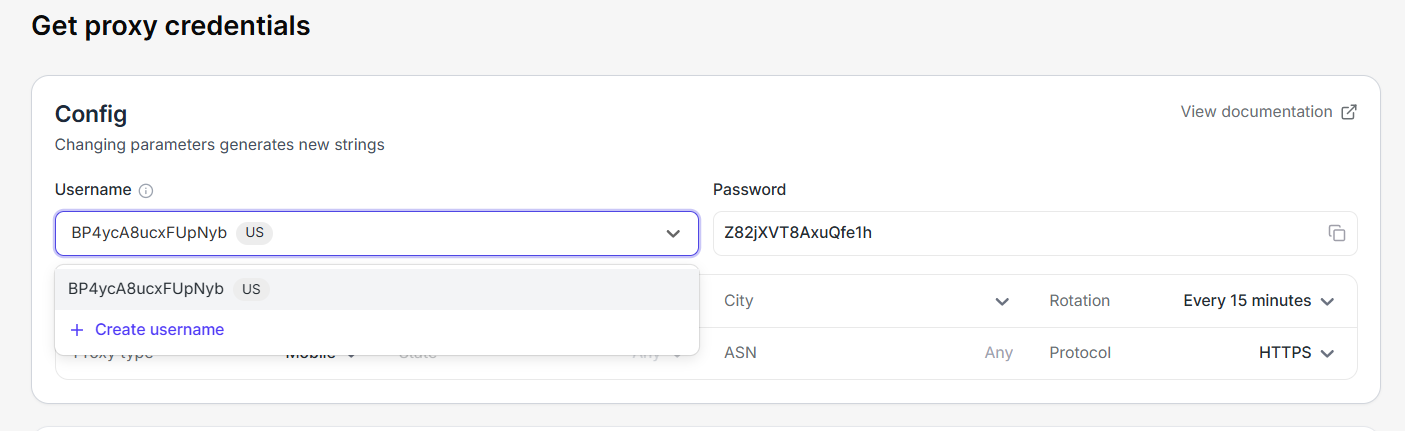
- On the dashboard, look at the panel on the left and click the “Get proxy credentials”.
- Then, create a proxy user to generate your proxy strings under it. I’ll call mine US because that’s the country I’ll be targeting for this example:
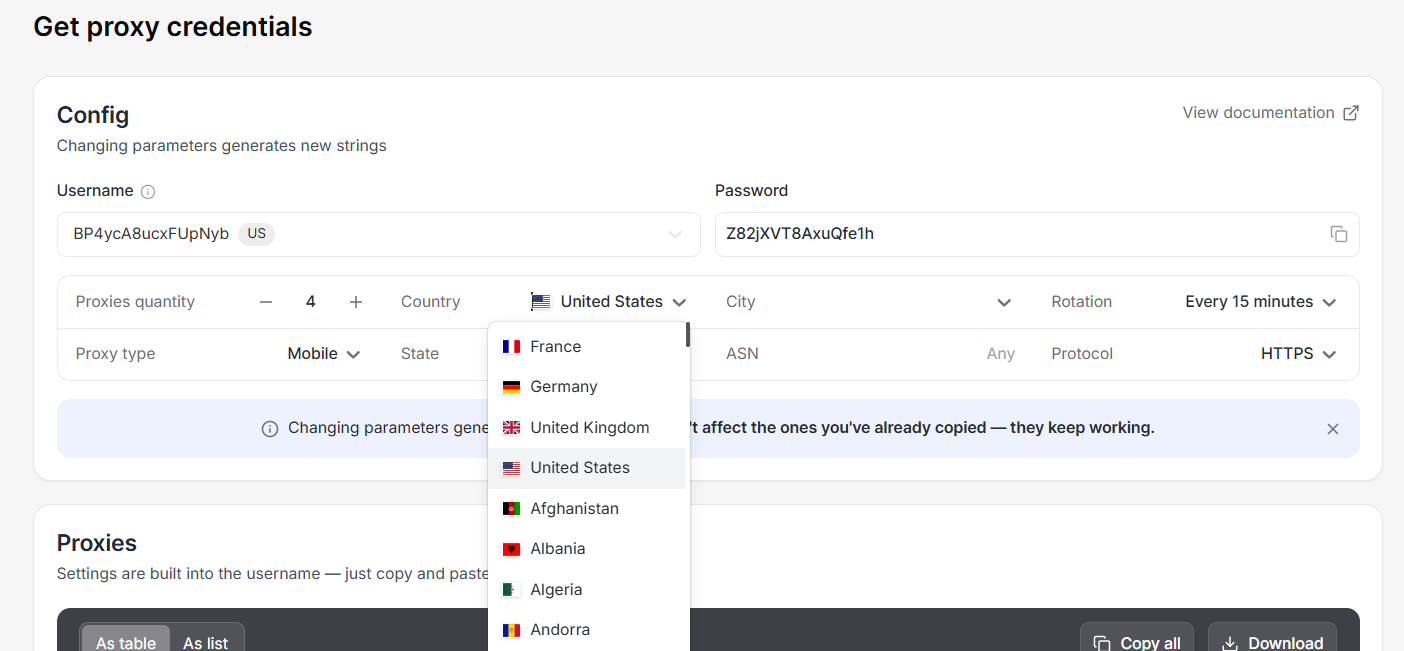
- Select the country you want to change to, I choose the US.
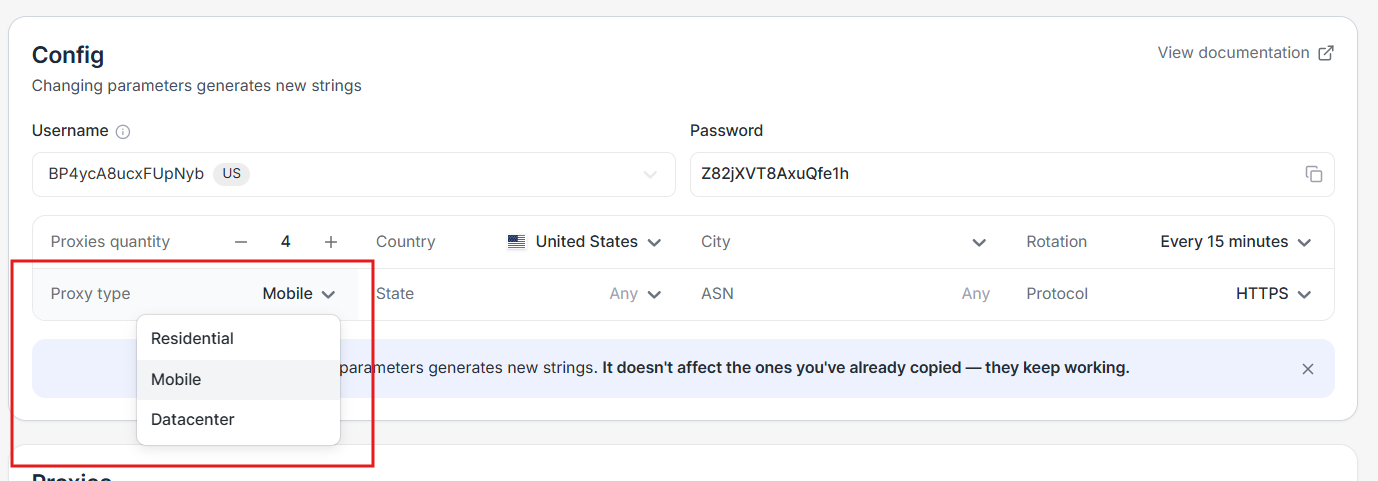
- Choose your proxy type according to your application or according to the platform you’ll be doing ads from:
- Set the other parameters according to your needs, such as the rotation, the proxy quantity, the protocol, etc.
- Scroll down to Proxies and you’ll find your proxies in a table, ready to be copied and used on any browser you want.
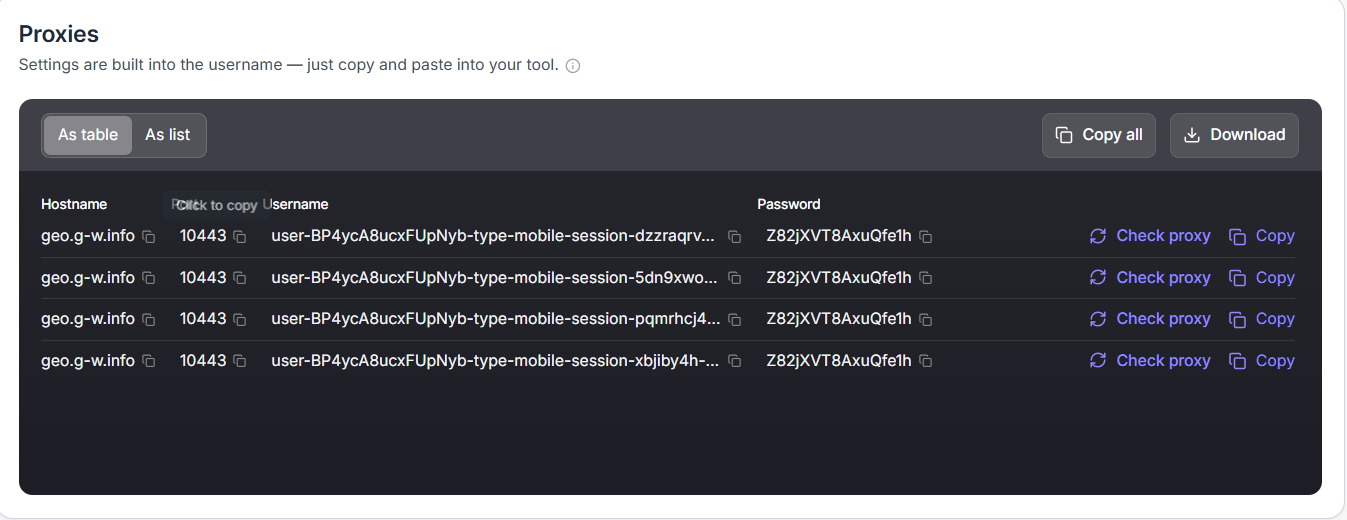
More details on how to integrate your proxy into your browser are in the Floppydata integrations page.
Conclusion
In this guide, we learned that you cannot hack your way into high-trust ad accounts by simply masking your location. Instead, you must build a cohesive, legitimate ecosystem where every signal, from your IP to your banking and identity documentation, tells the exact same story.
We’ve also seen how regions are categorized into tiers based on their historical risk profiles, with countries in Tier 1 being the best ones to change your location to for their high-trust reputations.
It’s then followed by Tier 2, which requires a little tweaks to make it as strong as the first tier, and then comes Tier 3, which includes the regions that are treated as high-risk by default due to historical data on fraud and policy abuse, which you should avoid.
I’ve then taught you how to get your own IP address from the country of your choice using Floppydata, along with some tips on how to build your ecosystem around that location and have a solid base like any successful business.