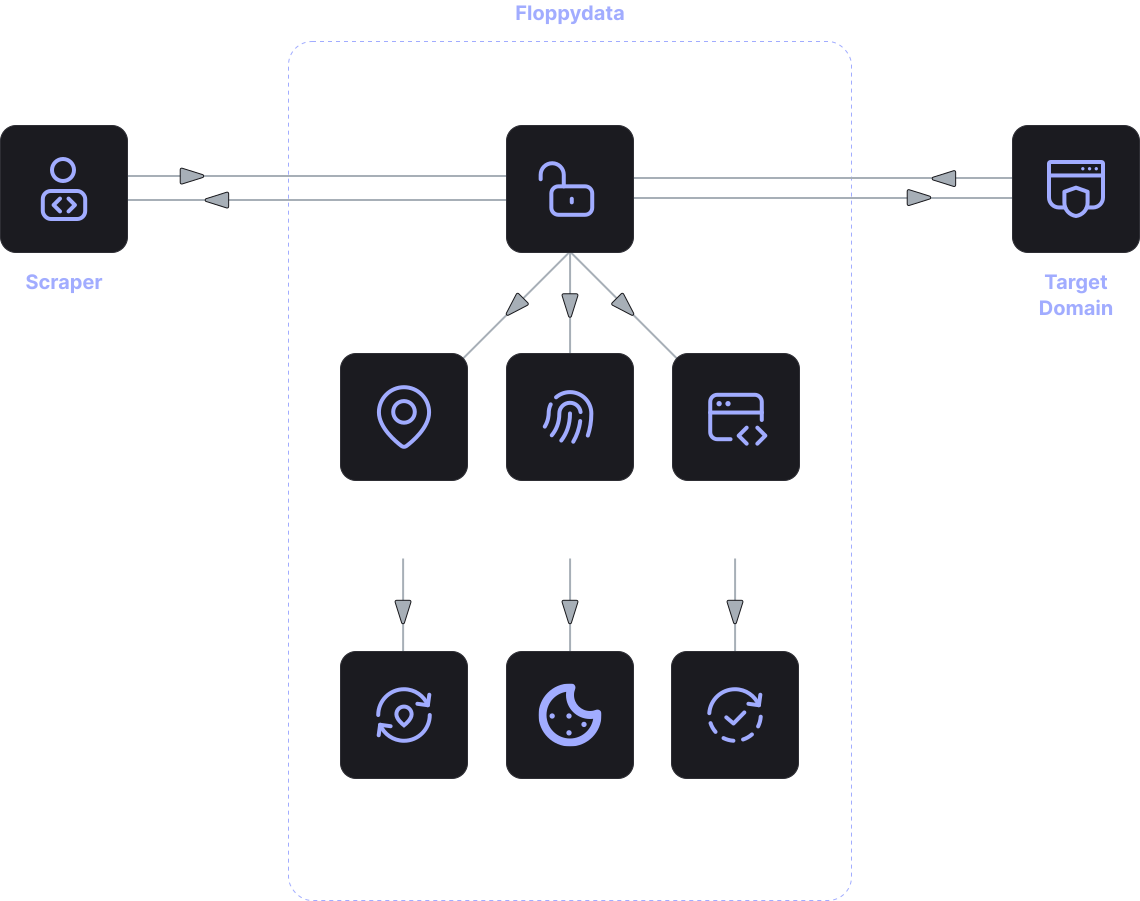
Social media scraper is a tool for automated collection of public data from social networks. Unlike manual monitoring of profiles, posts, and comments, social media scraping allows you to systematically extract information and save it in a structured form for further analysis.
Review and discussion data on social media platforms is posted by users and is analyzed by social media scrapers. Media scrapers collect the reviews, comments, discussions, and real-time reactions of users. Social media scrapers make streamlining the reviews, discussions, and real-time reactions of users easy for the analyst.
Social media scraping does not involve private data. Social media scrapers work with publicly available information.
How does social media scraping work?
The process starts by selecting the source.These sources can be things like public profiles, brand pages, hashtags, keywords, or topics. The social media scraper gathers the posts, comments, reactions, and related metadata.
To develop an understanding of how to scrap social media data, the first step is understanding the purpose of the process. For instance, the purpose of the data will determine the focus of the collection process. For brand monitoring, it will focus on mentions and the dynamics of discussion. For the analysis of competition, it will focus on publication and engagement metrics. For research, it will focus on the texts and the sentiment of the comments.
After data collection, data processing is required. This involves the removal of duplicate entries, uniformity in data presentation, and organization of data in tables and databases. The available data can later be incorporated into BI (business intelligence) systems or utilized in analytical reports.
Consequently, media scrapers are defined as components within a system that interacts with digital data.
What is social media scraper used for?
Social media scraping is justified when data is available in large volumes and is required to be analyzed on an ongoing basis. In these instances, manual analysis becomes futile and automation becomes imperative.
Social media scraping is more popular in situations where there is a need for volume and consistency. If there is a specific case to analyze manually once, that is fine, but if there is a need to analyze more than a few sources, automation is the way to go.
Basic usage scenarios:
- Monitoring brand mentions and evaluating audience reactions
- Content analysis and competitor strategies
- Tracking trends and popular topics
- Research on user reviews
- Preparation of data for marketing and analytical reports
Companies that are active in the digital environment often look for the best social media scraping tools to reduce manual workload and improve the accuracy of analysis.
Advantages of using media scraper
The main advantage is consistency. Social media scraper allows you to receive data regularly and in large volume. This is especially important if the company is working with multiple platforms at the same time.
Automated collection saves the team time. Instead of manually viewing the feed, employees receive a structured array of data. This speeds up the preparation of reports and simplifies decision-making.
In addition, social media scraping allows you to integrate data into your existing analytical infrastructure. Information can be automatically sent to report panels and used to build dynamic graphs and indicators.
Another advantage is objectivity. Instead of a subjective impression of a few posts, the company analyzes real data at scale.
Who is suitable for social media scrapping?
- Social media scraping tools are in demand in various fields.
- Marketers use them to evaluate the effectiveness of campaigns and analyze the audience.
- PR specialists are used to monitoring reputation and crisis situations.
- Analysts are used to studying the dynamics of discussions and identifying patterns.
- Product teams are used to finding user feedback.
- Research projects are used for building data arrays and trend analysis.
- Even small teams can use social media scrapers to control their digital presence and monitor it regularly.
Important aspects when working with social media scraping
Social media platforms set their own limits for data access and automation for each social platform. That means for a social media scraper to be effective, the user must abide by the terms and conditions and keep a reasonable limit on the number of automated processes he/she runs.
Working with public data only and having a well planned data collection architecture is how to lower the risk of getting restricted. For long-term projects, it is important to choose solutions that will provide control and provide a clear process.