According to the latest Freedom in the World report by Freedom House, 2025 marks the 20th consecutive year of the decline of global freedom, with a total of 54 countries experiencing deterioration in their political rights and civil liberties. The same sentiment is true for internet freedom, as governments impose strict censorship over online activity and freedom of speech.
As of now, the reporting on the current 2026 year is scarce; however, it’s safe to say that, with the current state of affairs and the overall rise of censorship across the world, many countries are steadily moving towards intensifying restrictions.
The desire to keep your online activity private, stay in touch with loved ones, and retain access to the world outside of your politically oppressed bubble is a natural one. That’s why netizens who face restrictions resort to circumvention tools for bypassing censorship.
In this article, I’ll go over the current stance of internet censorship by country, which restrictive practices governments implement to restrict online activity, and show how to bypass internet censorship effectively.
Internet Freedom by Country
In and of itself, freedom is a complex philosophical idea that doesn’t (or perhaps can’t) have a uniform definition across cultures, religions, and political systems. Online freedom, although no less ambiguous, has certain characteristics that can be tracked and measured by researchers.
The common methodology of internet censorship encompasses:
- freedom of speech and expression;
- possible legal and extralegal repercussions for online activity;
- accessibility of the internet as a whole and of specific services;
- infrastructural, economical, and political restraints;
- surveillance and privacy infringement;
- temporary connection shut-downs;
- monopolistic ownership of internet service providers;
- cyberattacks and hacking present.
Analysis of these metrics allows researchers to evaluate the level of internet freedom in countries across the globe by providing numerical scores and ranking the subjects accordingly. The scores range from 0 (ultimately inaccessible) to 100 (most freedom).
Before we dive into the rank of internet censorship by country, it’s important to note that, technically, no country can score a perfect 100 points. Web security is just another component of government control of the internet – alike, but parallel to censorship.
In this article I will be using the 2026 data from Freedom House’s Freedom on the Net research, Reporters Without Borders (RSF) Global 2026 analysis, and Cloudwards latest report.
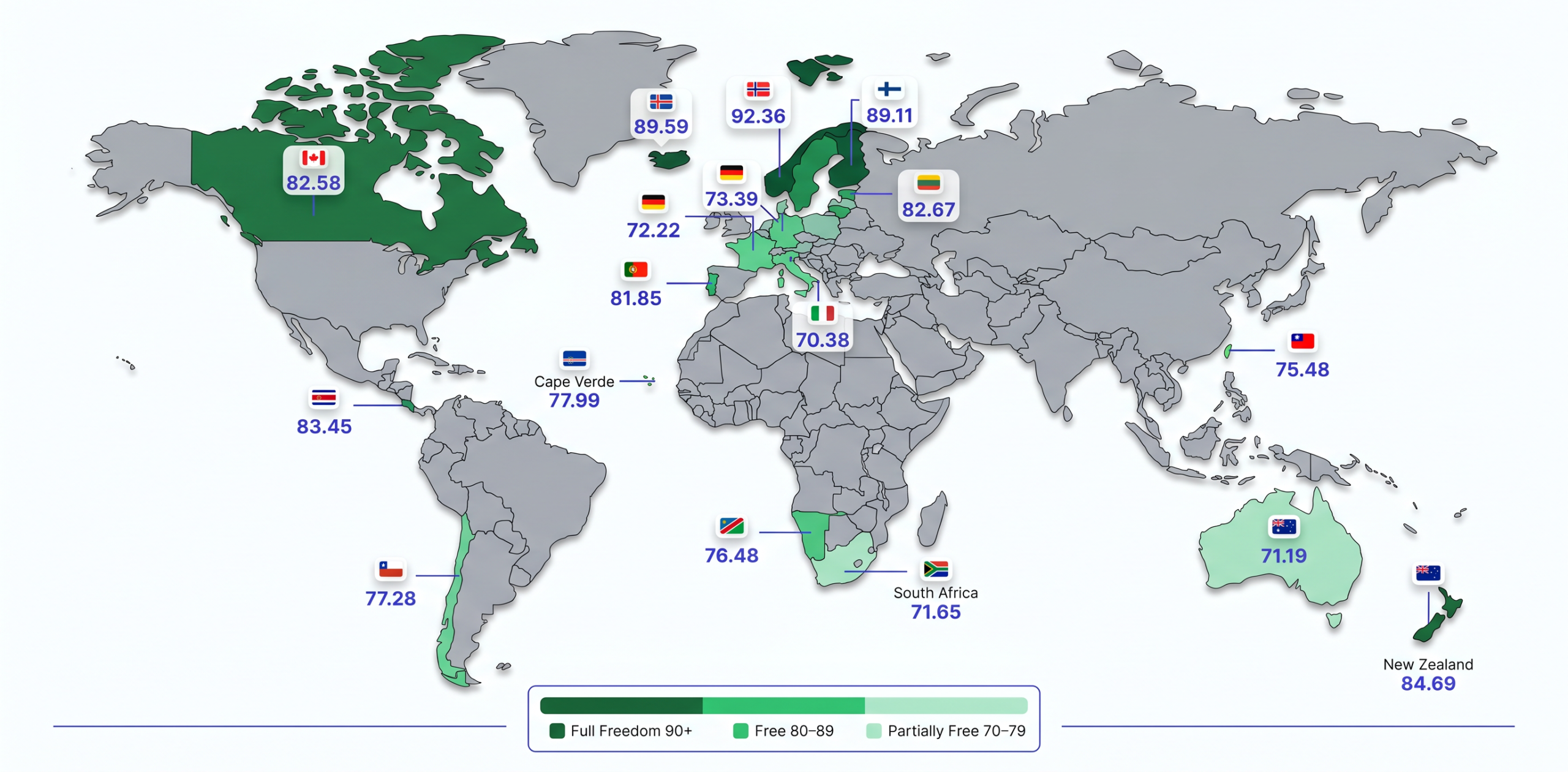
Countries with Full Internet Freedom (100-70)
Many countries, ranking high on the list, block violent, graphic, and illegal content that ends up on the web, restrict access to torrenting sites due to copyright infringement, and impose age restrictions on adult platforms. Because of the broad terminology of utilized metrics, those regulations also form the final score.
| Country | Freedom House | Reporters Without Borders | Cloudwards | Avg. |
| Norway | – | 92.72 | 92 | 92.36 |
| Denmark | – | 88.47 | 92 | 90.23 |
| Iceland | 94 | 82.77 | 92 | 89.59 |
| Finland | – | 86.22 | 92 | 89.11 |
| Liechtenstein | – | 82.62 | 92 | 87.31 |
| Belgium | – | 81.17 | 92 | 86.58 |
| New Zealand | – | 77.38 | 92 | 84.69 |
| Switzerland | – | 84.83 | 84 | 84.41 |
| Luxembourg | – | 84.14 | 84 | 84.07 |
| Estonia | 91 | 88.54 | 72 | 83.84 |
| Sweden | – | 87.61 | 80 | 83.8 |
| Costa Rica | 86 | 72.35 | 92 | 83.45 |
| Ireland | – | 85.93 | 80 | 82.96 |
| Lithuania | – | 81.34 | 84 | 82.67 |
| Suriname | – | 73.20 | 92 | 82.6 |
| Canada | 85 | 78.76 | 84 | 82.58 |
| Slovakia | – | 72.71 | 92 | 82.35 |
| Portugal | – | 83.71 | 80 | 81.85 |
| Austria | – | 79.43 | 84 | 81.71 |
| Netherlands | 84 | 88.92 | 72 | 81.64 |
| Latvia | – | 81.00 | 80 | 80.5 |
| Jamaica | – | 75.87 | 84 | 79.93 |
| Poland | – | 75.52 | 84 | 79.76 |
| Moldova | – | 74.77 | 84 | 79.38 |
| Trinidad and Tobago | – | 74.70 | 84 | 79.35 |
| Seychelles | – | 73.04 | 84 | 78.52 |
| Slovenia | – | 72.88 | 84 | 78.44 |
| Cape Verde | – | 71.98 | 84 | 77.99 |
| Montenegro | – | 71.80 | 84 | 77.9 |
| Chile | 87 | 60.84 | 84 | 77.28 |
| Namibia | – | 76.97 | 76 | 76.48 |
| Fiji | – | 76.76 | 76 | 76.38 |
| Taiwan | 79 | 75.44 | 72 | 75.48 |
| Spain | – | 75.42 | 72 | 73.71 |
| Germany | 74 | 82.17 | 64 | 73.39 |
| France | 76 | 76.68 | 64 | 72.22 |
| South Africa | 73 | 77.95 | 64 | 71.65 |
| Australia | 75 | 74.58 | 64 | 71.19 |
| Italy | 74 | 65.16 | 72 | 70.38 |
So, if you’re asking yourself, “What countries have no internet censorship?”, the short answer is none of them, but the ones that made the list above are as close as it gets. Reverting back to the ambiguity of the idea – the complete and total freedom of the internet might be unachievable but, perhaps, that’s not a complete and total negative.
Countries with Partial Internet Freedom (69-40)
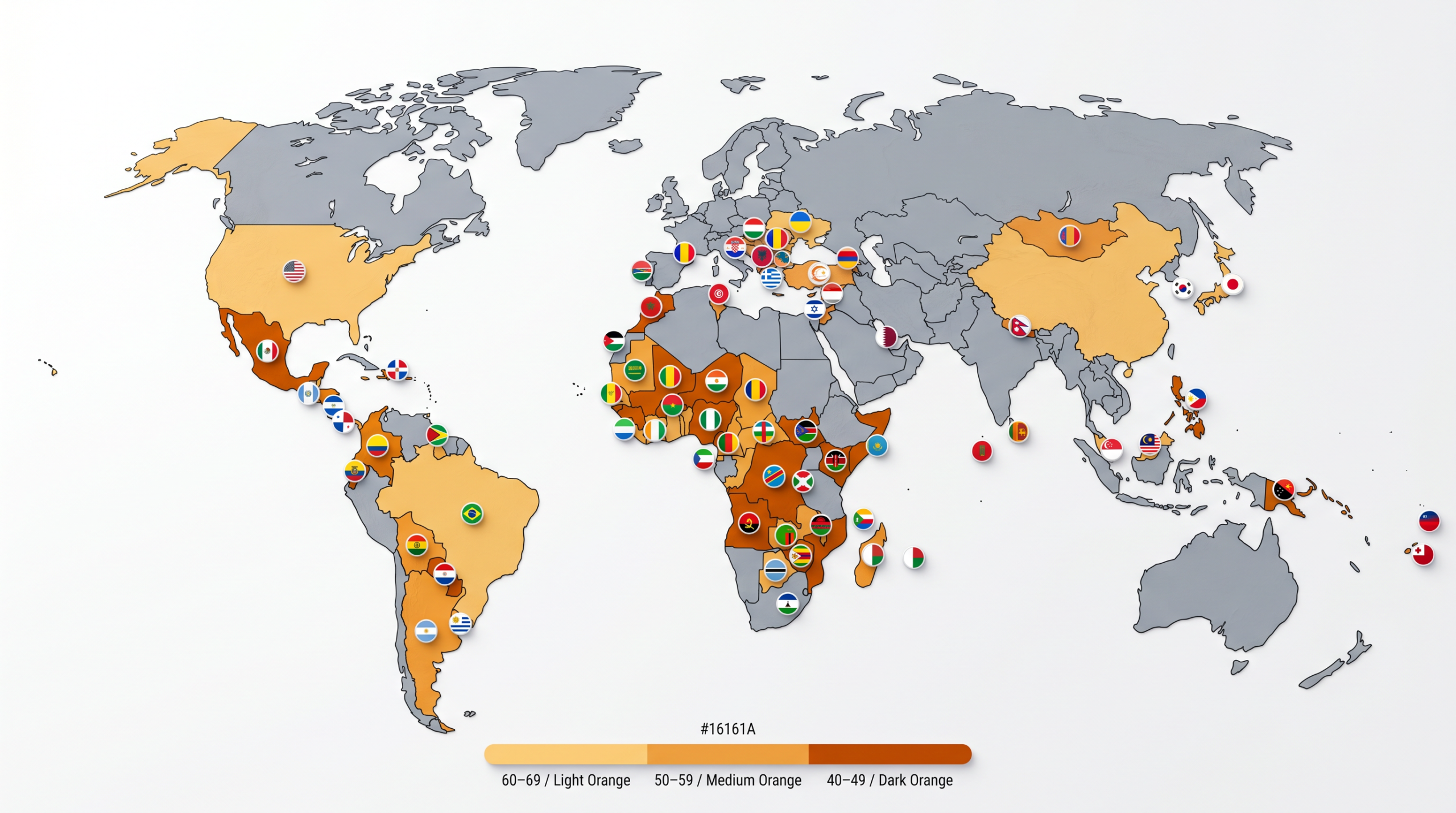
Countries that fall into this category have higher levels of online censorship. The notion is backed by proven records of content, protected by international human rights standards, being moderated or blocked by political agencies. Cases of users and journalists being threatened, penalized, or prosecuted for their online activity also drop the score significantly.
Additionally, netizens of the “Partly Free” countries often report a noticeable presence of government surveillance, higher frequency of cyberattacks, more widespread hacking attempts, and/or poor internet connection due to infrastructural limitations like low fiber optic coverage.
Among other countries, this category includes the United States and United Kingdom, Japan, South Korea, Mexico, Argentina, Brazil, Philippines, Colombia, Ukraine, and Israel.
Countries with No Internet Freedom (39-0)
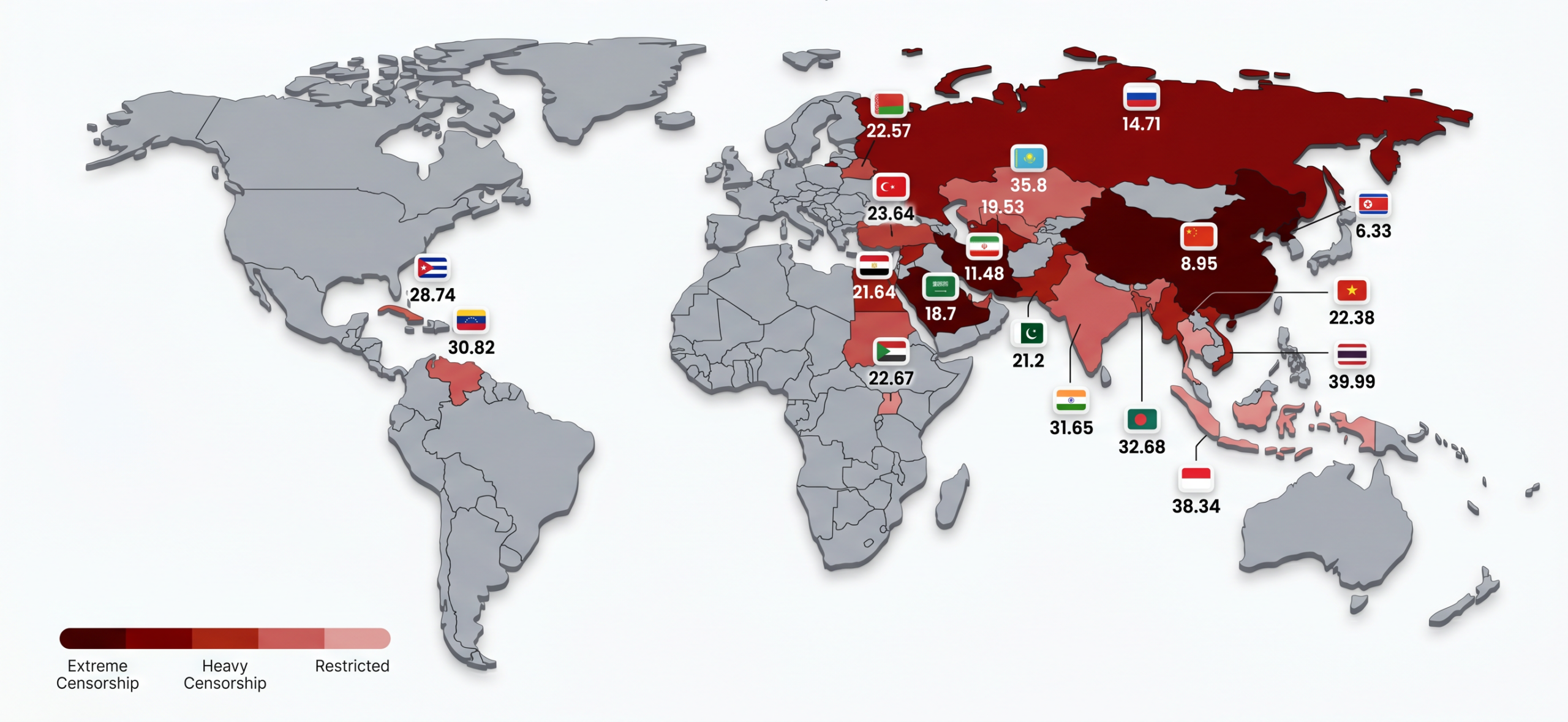
Regions where internet censorship is prevalent – on top of close and privacy-infringing governmental monitoring of users’ online activity, reports from these countries show frequent penalties and fabricated criminal charges for as little as social media comments. In the most extreme cases, forced disappearances and murders of prolific activists are used for silencing opposing forces.
| Country | Freedom House | Reporters Without Borders | Cloudwards | Avg. |
| 🇹🇭 Thailand | 37 | 50.97 | 32 | 39.99 |
| Cambodia | 42 | 33.28 | 44 | 39.76 |
| Uganda | 52 | 41.98 | 24 | 39.32 |
| Indonesia | 48 | 43.02 | 24 | 38.34 |
| Brunei | – | 52.58 | 24 | 38.29 |
| Kuwait | – | 40.44 | 36 | 38.22 |
| Tanzania | – | 46.22 | 28 | 37.11 |
| Libya | 43 | 40.34 | 28 | 37.11 |
| 🇰🇿 Kazakhstan | 37 | 34.41 | 36 | 35.8 |
| Laos | – | 32.54 | 36 | 34.27 |
| Ethiopia | 30 | 34.66 | 36 | 33.55 |
| Bangladesh | 45 | 33.05 | 20 | 32.68 |
| Oman | – | 43.67 | 20 | 31.83 |
| 🇮🇳 India | 51 | 31.96 | 12 | 31.65 |
| Azerbaijan | 34 | 23.95 | 36 | 31.31 |
| Venezuela | 26 | 30.48 | 36 | 30.82 |
| 🇺🇿 Uzbekistan | 29 | 34.95 | 24 | 29.31 |
| Bahrain | 30 | 24.84 | 32 | 28.94 |
| Cuba | 21 | 29.22 | 36 | 28.74 |
| Syria | – | 39.44 | 12 | 25.72 |
| 🇹🇷 Turkey | 31 | 27.94 | 12 | 23.64 |
| 🇦🇪 United Arab Emirates | 28 | 30.86 | 12 | 23.62 |
| Sudan | 27 | 29.02 | 12 | 22.67 |
| 🇧🇾 Belarus | 20 | 27.72 | 20 | 22.57 |
| Iraq | – | 28.85 | 16 | 22.42 |
| 🇻🇳 Vietnam | 22 | 21.15 | 24 | 22.38 |
| Afghanistan | – | 19.51 | 24 | 21.75 |
| 🇪🇬 Egypt | 28 | 24.92 | 12 | 21.64 |
| 🇵🇰 Pakistan | 27 | 32.61 | 4 | 21.2 |
| Yemen | – | 27.89 | 12 | 19.94 |
| 🇹🇲 Turkmenistan | – | 23.06 | 16 | 19.53 |
| 🇸🇦 Saudi Arabia | 25 | 19.11 | 12 | 18.7 |
| Myanmar | 9 | 26.38 | 16 | 17.12 |
| 🇷🇺 Russia | 17 | 23.15 | 4 | 14.71 |
| 🇮🇷 Iran | 13 | 17.45 | 4 | 11.48 |
| 🇨🇳 China | 9 | 13.85 | 4 | 8.95 |
| 🇰🇵 North Korea | – | 12.67 | 0 | 6.33 |
Another form of violation of internet freedom is monopoly over Internet Service Providers – ownership control of all state ISP by one, usually governmental or government-adjacent, legal body.
The reason it’s considered a violation is not strictly economical. When the government holds every last byte of internet connection in the country, it can pull the plug whenever it desires, which happens frequently in the regions that made the list. When regular online activity becomes dangerous and privacy nonexistent, users resort to circumvention tools and intermediaries.
How to Bypass Internet Censorship
Although circumvention tools’ usage won’t be a complete overkill for anyone, in this article I’ll direct my attention to the regions at the bottom of the list that are suffering from the heaviest online censorship.
In this block, we’ll go over how difficult it is to bypass restrictions in each country, which solutions work best across unique internet landscapes, and what locals use to escape surveillance.
Bypass Difficulty
Let’s take a look at the methods most commonly used for enforcing internet restrictions by region and how technically sophisticated they are.
Extreme Bypass Difficulty
North Korea stands at the top of this ranking, and rightfully so: this is the only country where just the regime’s most trusted officials can access the global internet, while regular citizens must make do with Kwangmyong, the national intranet. Portable devices sold inside the country run on North Korea’s own software called “Red Flag,” that records and stores all data from the device.
Countries like Iran and Turkmenistan are often cited alongside North Korea for their heavy online restrictions. Here, violations of internet freedom range from social media censorship and bans on circumvention tools to nationwide “near-total” connection blackouts, with access allowed only to select domestic platforms (making it more akin to an intranet) as well as extra-legal repercussions for online activity and the use of spyware.
Similar censorship methods are employed by China, famous for its Great Firewall, the largest and most sophisticated online censorship infrastructure. The Great Firewall doesn’t just block restricted content – it creates a separate internet ecosystem open to domestic platforms that operate under strict government oversight only.
Recent journalistic investigations discovered that Chinese firms exported the technology that supports the Great Firewall to facilitate government censorship in other countries, including Myanmar, where internet freedom has been practically nonexistent since the military seized control of the state in a 2021 coup and adopted a Cybersecurity Law in early 2025 that restricted the operation of anticensorship tools in the country and codified the regime’s de facto censorship practices.
In their control of internet freedom, these countries implement:
- Sovereign internet and national intranets;
- AI-driven censorship tools;
- Deep Packet Inspection (DPI) and Traffic Secure Gateways (TSG)
- Domain Name System (DNS) poisoning;
- Protocol throttling and inspection;
- Encrypted and obfuscated protocol blocking;
- White-listing;
- VoIP and messenger throttling;
- Nationwide and targeted shutdowns;
- Surveillance infrastructure.
Popular Bypass Solutions
North Korea: Contraband technology, Offline media sharing, hardware jailbreak, modified software, Obfuscated VPN services and Tor.
Iran: Obfuscated VPN services, Tor with obfs4 and Snowflake bridges, Residential proxies, P2P network architecture, TLS fragmentation.
Turkmenistan: Obfuscated VPN services, Tor network bridges, Residential proxies, Self-hosted Virtual Private Server, TCP segmentation.
China: Shadowsocks, Obfuscated VPN services, Tor with obfs4 bridge, QUIC-Based and Content Delivery Network (CDN), Residential proxies.
Myanmar: Obfuscated VPN services, Residential proxies, Shadowsocks, Tor with Snowflake bridge, Custom Access Point Names (APNs).
High Bypass Difficulty
Although allowing access to the global internet, citizens of Egypt, Ethiopia, Turkey, Syria, Tanzania, and Oman face strict social media censorship like nationwide bans on entire platforms (Instagram, TikTok, YouTube, etc.) while their government prohibits usage of VPN services and circumvention tools, making it harder to bypass blocks.
Regime-controlled regions like Yemen, Saudi Arabia, Afghanistan, and Sudan impose harsh restrictions on online activity, under the pretense of political or ideological reasons, that often result in legal charges as well as extra-legal repercussions.
Netizens of Russia, Iraq, and Pakistan report heavy throttling of messengers, such as Telegram and WhatsApp, especially amidst political events. This is done not only to prevent people from organizing, but, in Russia’s case, to push citizens towards state-controlled and highly monitored messenger Max.
Russia has been at the forefront of internet censorship for decades, the restrictions intensified, and are now surpassing many other countries, since Russia’s invasion of Ukraine in 2022. Similar to, and at times together with, China the country works to advance its censorship toolkit and is happy to export their technology. The same principle is applied to Vietnam and the country’s infamous Bamboo Firewall, bearing close resemblance to the Chinese censorship model.
Countries of this category implement:
- Deep Packet Inspection (DPI)
- Bandwidth throttling and inspection;
- Encrypted protocol blocking;
- White-listing;
- Platform-wide and targeted shutdowns;
- VoIP and messenger throttling;
- Nationwide connection blackouts;
- Surveillance infrastructure.
Popular Bypass Solutions
Egypt: Tor with obfs4 and Snowflake bridges, Shadowsocks-based stealth VPNs, Residential proxies, Custom self-report evasion software.
Ethiopia: Residential SOCKS5 proxies, Obfuscated VPN services with customized stealth protocols, Tor with obfs4 bridge.
Turkey: Obfuscated VPN services with customized stealth protocols, Tor with obfs4 bridge, Encrypted DNS adjustments, DPI bypass tools.
Syria: Obfuscated VPN services, Tor network bridges, Offline media sharing.
Tanzania: Obfuscated VPN services with customized stealth protocols, Residential proxies, Tor with Snowflake bridge, P2P mesh messaging.
Oman: Obfuscated VPN services with customized stealth protocols, Residential proxies, Shadowsocks, Tor with obfs4 and Snowflake bridges.
Yemen: Mobile VPNs with strong encryption and mobile proxies, Orbot (Tor for Android), Secure messaging apps (Signal, Telegram), Custom split-tunneling tool (Alkasir), Maintenance hubs.
Saudi Arabia: Obfuscated VPN services, Tor with obfs4 and Snowflake bridges, Shadowsocks, Residential HTTPS/SOCKS5 proxies.
Afghanistan: VPN services, Proxy Clients, Tor with Snowflake bridge, Offline media sharing and P2P Web Proxy (Lantern).
Sudan: VPN services, Proxy Clients, Tor with Snowflake bridge, Starlink and satellite terminals, P2P mesh networks and Offline media sharing.
Russia: Obfuscated VPN services with stealth protocols as well as Self-hosted VPNs, Residential proxies, DPI bypass tools, Anti-censorship mirrors, Tor with WebTunnel and Snowflake bridges.
Iraq: VPN services, Proxy Clients, Encrypted DNS adjustments, Tor with obfs4 and Snowflake bridges, P2P mesh networks and messengers.
Pakistan: Obfuscated VPN services with stealth protocols, Residential proxies, Tor with obfs4 and Snowflake bridges, Encrypted DNS adjustments.
Vietnam: VPN services, Proxy Clients, Encrypted DNS adjustments, Tor with WebTunnel and Snowflake bridges.
Moderate Bypass Difficulty
Countries from this category also violate internet freedom and netizen’s right of privacy, however, contrary to extreme and high bypass difficulty, they don’t ban circumvention tools outright, making it easier for users to bypass restrictions.
For example, in Belarus, the only European country on Freedom House’s “Not Free” list, VPN services are technically legal, but citizens can face fines or administrative charges for using circumvention tools to access any of over 14,000 web resources blocked by the Belarusian government. The same principle is employed by Kuwait and Kazakhstan. Ultimately, this condition negates the purpose of a VPN.
Bangladesh, India, and Uganda are ranked the highest by Freedom House with scores 45, 51, and 52 respectively, earning them the “Partly Free” label. However, all three countries restrain internet freedom by censoring social media and restricting access to various web services, including independent media covering political and social dissent. Additionally, India and Bangladesh are prolific in internet shutdowns, cutting connection for up to 200 days straight in India’s case, while Uganda utilizes arrests and prison sentences to silence journalists or persecute LGBTQ+ citizens.
Similar to Uganda, journalists, human rights defenders, bloggers, and regular citizens of the United Arab Emirates and Venezuela have reportedly received lengthy prison sentences over their online activity. In both countries, reporters have uncovered cases of mistreatment towards political prisoners, ranging from torture to forced disappearances.
Countries of this category implement:
- DPI-Based Protocol Filtering;
- Bandwidth throttling and inspection;
- IP and DNS blocking;
- VoIP and messenger throttling;
- Nationwide and targeted shutdowns;
- Granular URL filtering;
- DNS Spoofing/Poisoning.
Popular Bypass Solutions
Belarus: VPN services, Proxy Clients, Encrypted DNS adjustments, Tor with WebTunnel and Snowflake bridges, Anti-censorship mirrors.
Kuwait: Obfuscated VPN services, Encrypted DNS adjustments, Encrypted proxies (Cloudflare WARP).
Kazakhstan: Obfuscated VPN services, Proxy Clients, Tor with WebTunnel and Snowflake bridges, DPI bypassing utilities.
Bangladesh: VPN services, Proxy Clients, Tor with obfs4 and Snowflake bridges, P2P mesh networks.
India: VPN services, Proxy Clients, Encrypted DNS adjustments, P2P mesh networks.
Uganda: VPN services, Proxy Clients, Secure messaging apps (Signal, Telegram), Offline media sharing.
United Arab Emirates: Obfuscated VPN services, Encrypted proxies, Encrypted DNS adjustments.
Venezuela: Obfuscated VPN services, Proxy Clients, Encrypted DNS adjustments, Tor with Snowflake bridge, Anti-censorship mirrors.
Low Bypass Difficulty
Countries with low bypass difficulty are the ones, where circumvention tools are completely legal for personal use. Although these regions are still highly restrictive in terms of internet freedom, permission of VPN usage helps netizens bypass restrictions easily without risking legal repercussions.
Thailand, the highest ranked country among those labeled “Not Free”, is far from perfect. Thai netizens often face arrests, surveillance, extralegal harassment, and violent attacks for their online content. The issue is extremely poignant among pro-democracy activists and journalists that continuously receive heavy prison sentences under the pretense of defaming the monarchy.
Similar violations are present in Indonesia, Brunei, Laos, Azerbaijan, Uzbekistan, and Bahrain, where the government goes as far as assembling so-called “Cyber Teams” tasked with carrying out online harassment campaigns and cyberattacks against users and civil society groups. In Cuba the situation is worsened by imposed limits on ordinary data plans as well as higher prices for any additional data that far surpassed the monthly minimum wage.
Cambodia and Libya, despite scoring 42 and 43 on Freedom on the Net report, which put them in the “Partly Free” category, stay severely restrictive to online freedom, employing the same repressive tactics as the countries aforementioned.
These countries implement:
- DPI-Based keyword filtering;
- VoIP and messenger throttling;
- Targeted platform blocks;
- DNS Spoofing/Poisoning;
- White-listing;
- URL and IP blacklisting;
- Centralised gateways.
Popular Bypass Solutions
Thailand, Brunei, Laos, Azerbaijan, Uzbekistan, Bahrain, Cambodia, Libya: VPN services, Proxy Clients, Encrypted DNS adjustments.
Cuba: VPN services, Proxy Clients, Encrypted DNS adjustments, Offline media sharing (El Paquete Semanal).
Bypassing Censorship Best Practices
Out of all aforementioned popular solutions, just three stand out in their prevalence – VPN services, proxies, and Tor are used in every country with heavy online censorship.
Choosing the best bypass solution can become a tiring process – to help you make an educated choice, let’s dig deeper into these options and establish which one would be the most effective for your use case.
VPN
VPN, or a Virtual Private Network, serves as the middle-man between your computer and the global web. VPN connects you to a remote server by routing your traffic through an encrypted tunnel. From said server, you are connected to the destination site, making it seem as if the request came from the VPN provider, not your computer.
Still, modern DPI can easily detect and block VPNs, so it’s important to choose a service that supports obfuscation such as stealth-protocols.
Proxy
Proxy services utilize a similar bypass method by routing your traffic through the provider’s dedicated server with the only exception being the lack of an encrypted tunnel between your computer and the server.
While VPN encrypts all your traffic, proxy simply hides your IP address and the level of data encryption is controlled by the chosen protocol – HTTP provides no encryption, HTTPS is used for basic encryption, and SOCKS5 for maximum encryption. This allows proxies to maintain maximum connection speed and handle high-bandwidth tasks easily.
Tor
Tor, short for The Onion Router, is an open-source decentralised network that’s designed for maximum anonymity. Contrary to VPNs and proxies that rely on one server, Tor routes your traffic through three random nodes.
The first step happens on your computer where Tor Browser gives your data three levels of encryption. Next, Tor sends this data to the Entry Node that decodes the first level allowing it to see only your IP address. Traveling further, your data reaches the Middle Node, which sees the IP address of the previous node and the next one without having any information about you. Unraveling the last layer of encryption, the third Exit Node knows the destination website so it can connect to it and send data back down the chain. Because of this structure no server of the network knows both who you are and where you’re going at the same time, while simultaneously no server is allowed to decode the data routed through them.
Although Tor provides utmost protection, in some heavily restrictive countries the network is blocked at the ISP level. For this instance, Tor offers built-in Pluggable Transports, also known as Bridges (Snowflake, WebTunnel, and obfs4) that further encrypt your data disguising it as standard HTTPS browsing or WebRTC video call.
Effectiveness Comparison
| Proxy | VPN | Tor | |
| Encryption | Traffic of one specific application | All traffic from your device | All traffic from your device |
| Speed | Maximum | Medium | Very low |
| Anonymity | Medium/High (depending on the provider) | Medium/High (depending on the provider) | Maximum |
| Setup Complexity | Low/Medium (requires setup through system/browser) | Low (through desktop client) | Low/Medium |
| Bypassing Simple Blocks (DNS/IP) | Maximum | Maximum | Maximum |
| Bypassing Complicated Blocks (DPI) | Medium (with encrypted protocols) | Maximum (with obfuscation) | Maximum (especially via bridges) |
| Price | ~$1-$5 (monthly) | ~$10-$13 (monthly) | Free |
When it comes to your online privacy, it’s vital to choose a reputable provider. Free VPN providers and proxy services are often caught stealing your data and personal information, which they then resale to bad actors.
Entrusting your entire online persona to a service shouldn’t be taken lightly – some popular paid providers, although offering secure browsing experience and stable encryption, track and collect your data such as IP address, browsing history, connection time, or downloaded files. When pressed by the government or hackers, these services have to give away the data they’re storing. To prevent this from happening, look for VPNs with proper No-Logs Policy and Kill Switch feature in place.
- No-Logs ensures that the provider doesn’t gather your online activity, so in a dire situation it has nothing to hand over. Additionally it’s best to search for providers that undergo independent third-party audits to prove they actually delete data.
- Kill Switch is especially useful when using public networks riddled with bad actors. The feature prevents data leaks if your VPN connection drops unexpectedly by instantly blocking your device from accessing the internet.
Which One to Pick?
Each method comes with its pros and cons. VPN services became largely widespread in recent years, thus drawing more attention from government authorities. The censorship tech is now advanced enough to detect VPNs and cut the connection. While Tor offers maximum security due to its multi-node structure, this is exactly what makes it predictable for sophisticated censorship models which allows authorities to blacklist many known Entry Nodes of Tor.
On the other hand, proxies rarely get on the governmental radar. Censorship models look for distinct signatures of VPN protocols specifically, so a well-configured proxy is invisible to firewalls because it looks identical to regular browsing. That is also the reason why even the strictest of governments are usually more legally lenient towards proxy services. Additionally, unlike VPNs and Tor, proxies do not encrypt traffic. This lack of heavy processing allows them to maintain high internet speeds and handle massive amounts of user traffic simultaneously.
Which Proxies Help Get Full Access
In this section, I’ll go over the best practices for bypassing online censorship using proxies: what proxy type to use for specific countries and web services, how to deal with (prevalent for proxies) CAPTCHAs, and how to set up your own proxy pool.
In my research and testing of proxy services, one proxy provider, Floppydata, stood out not only for its great prices (as low as $0.60/GB for datacenter proxies) but also for amazing uptime and the user-friendliness of its dashboard. In this article, I’ll be using Floppydata as the main example.
Blocked Websites by Country
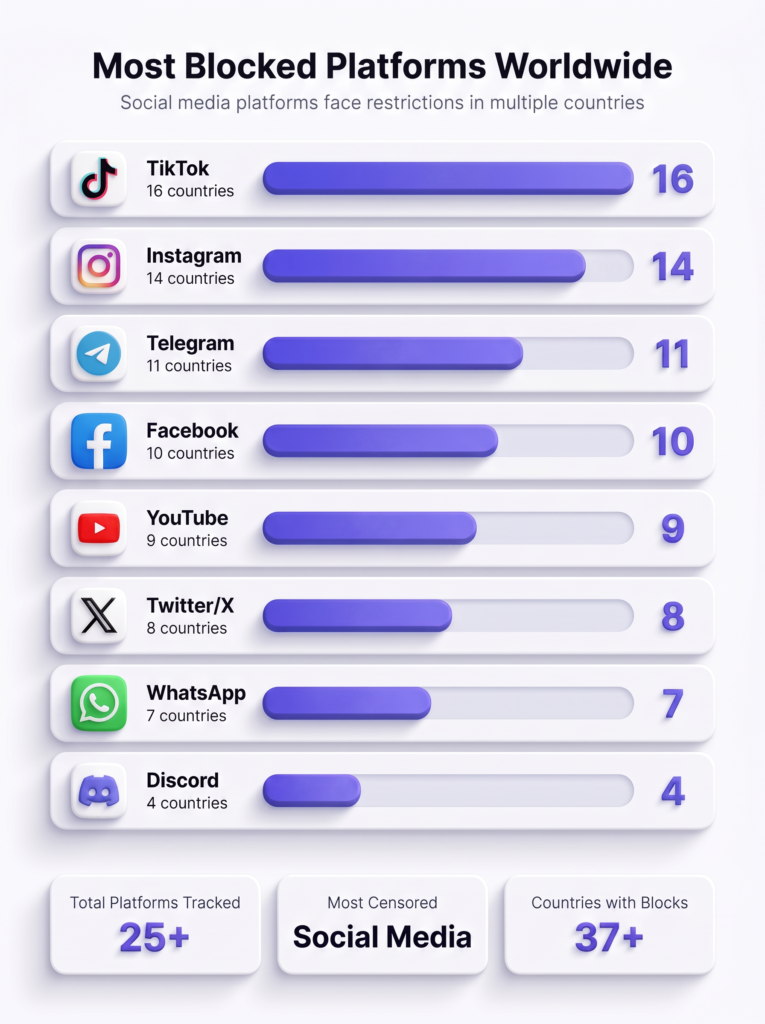
Floppydata has over 195 proxy locations to choose from, if you’re new to proxies and don’t know where to start the sheer amount of available countries might be overwhelming enough. When in doubt, use this table of popular destination websites and how to access them most efficiently. The data in this table is based on OONI Explorer’s independent coverage on internet censorship.
| Service | Countries Where Blocked | Countries Where Restricted | Reason for Blocking | How to Bypass | Best Proxy Type |
| TikTok | India, Afghanistan, Iran, Somalia, North Korea, Kyrgyzstan, Uzbekistan, Jordan, Senegal, Syria, Myanmar, Gabon, China, Hong Kong, Turkmenistan, Eritrea | Russia, Indonesia, Government Device Ban in USA, EU, Canada, Australia, New Zealand, Japan, Taiwan | Data privacy, National security, Children protection, Control over political dissent, Religious and moral reasoning, Fight against explicit content and misinformation, Push towards local alternatives. | Floppydata proxies with locations in Germany, Netherlands, Austria, Poland, USA (specifically Virginia and Oregon states), Kazakhstan, Malaysia, Japan. | Mobile, Residential, Static Residential (ISP) Proxies |
| China, Iran, Myanmar, Russia, Gabon, North Korea, Turkmenistan, Eritrea | Syria, Cuba, Temporary blocks in Bangladesh, Age-restrictions in Australia, Indonesia, France, Turkey | Control over political dissent, Children protection, Religious and moral reasoning, Fight against explicit content and misinformation, Non-compliance with local courts. | Floppydata proxies with locations in Germany, Netherlands, France, Poland, USA (specifically Virginia, Ohio, Texas, and Oregon states), Kazakhstan, Georgia, UAE. | Mobile, Residential, ISP Proxies | |
| Telegram | China, Iran, North Korea, Turkmenistan, Somalia, Vietnam, Nepal, Pakistan, Gabon, Eritrea | Russia, Indonesia, Thailand, Latvia, Brazil, France, Germany, Temporary blocks in Iraq, Kenya, Bangladesh, Cuba, India, Belarus, Government Device Ban in Ukraine | Control over political dissent, Fight against explicit content, illegal activity, and misinformation, National security, Elimination of encrypted communication, Push towards local alternatives. | Floppydata proxies with locations in Netherlands, Finland, Kazakhstan, Georgia, USA (specifically Virginia and New-York states). | Datacenter with SOCKS5 Protocol (Dedicated IPv4 preferred) or Residential Proxies |
| Twitch | China, North Korea, Iran, South Korea, Turkey, Turkmenistan, Myanmar, Gabon, Eritrea | Slovakia, India, Russia, UAE, Saudi Arabia, Vietnam, Palestine, Age-restrictions in Australia | Control over political dissent, Children protection, Religious and moral reasoning, Fight against explicit content, illegal gambling, casino-style streams, and misinformation, Non-compliance with local courts. | Floppydata proxies with locations in Germany, Netherlands, Finland, Kazakhstan, Japan. | Datacenter Proxies (Dedicated IPv4 preferred) |
| YouTube | China, Russia, Iran, North Korea, Turkmenistan, Gabon, Eritrea, Houthi-controlled regions of Yemen | Bangladesh, Cuba, Myanmar, Tajikistan, India, Turkey, Pakistan, Vietnam, Venezuela, Syria, Sudan, Age-restrictions in Indonesia, Australia, Malaysia | Control over political dissent, National security, Data privacy, Content filtering, Children protection, Religious and moral reasoning, Fight against explicit content, extremism, and misinformation, Push towards local alternatives, Non-compliance with local courts. | Floppydata proxies with locations in Germany, Netherlands, Finland, Sweden, Kazakhstan. | Datacenter (Dedicated preferred) or ISP Proxies |
| China, Gabon, Iran, Myanmar, Russia, Uganda, North Korea, Turkmenistan, Eritrea, Houthi-controlled regions of Yemen | Bangladesh, Cuba, Tajikistan, Venezuela, Turkey, Vietnam, Pakistan, Libya, Syria, Sudan, Age-restrictions in Indonesia, Australia, Malaysia, France Government Device Ban in USA, Canada, UK, New Zealand, Taiwan, EU | Control over political dissent, National security, Data privacy, Content filtering, Children protection, Religious and moral reasoning, Fight against explicit content, extremism, and misinformation, Push towards local alternatives, Non-compliance with local courts. | Floppydata proxies with locations in Germany, Netherlands, Poland, USA (specifically Virginia, Ohio, and Oregon states), Kazakhstan, Georgia, UAE. | Mobile or ISP Proxies | |
| Twitter/X | China, Iran, Myanmar, Russia, North Korea, Venezuela, Pakistan, Turkmenistan, Gabon, Eritrea, Houthi-controlled regions of Yemen | Pakistan, Tanzania, Uganda, Bangladesh, Turkey, Vietnam, Egypt, Age-restrictions in Australia, Indonesia, Malaysia, France, Government Device Ban in USA, UK, Canada, New Zealand, Taiwan, EU | Control over political dissent, National security, Data privacy, Content filtering, Children protection, Religious and moral reasoning, Fight against explicit content, extremism, and misinformation, Non-compliance with local courts. | Floppydata proxies with locations in Germany, Netherlands, Poland, USA (specifically Virginia, Ohio, Texas, and Oregon states), Kazakhstan, Georgia. | Mobile or ISP Proxies |
| China, Iran, Russia, North Korea, Turkmenistan, Myanmar, Gabon, Eritrea, Sudan | Turkey, Bangladesh, Cuba, Uganda, Mozambique, VoIP Restricted in UAE, Egypt, Qatar, Oman, Syria, Saudi Arabia, Jordan, Kuwait, Age-restrictions in Australia, Indonesia, Malaysia, France, Denmark, Government Device Ban in USA, UK, Canada, New Zealand, EU | Control over political dissent, Fight against extremism, illegal activity, and misinformation, Children protection, National security, Elimination of encrypted communication, Non-compliance with local courts, Push towards local alternatives, Protection of state telecom. | Floppydata proxies with locations in Germany, Netherlands, Kazakhstan, Georgia, USA (specifically Virginia and New-York states). | Mobile or ISP (for desktop) Proxies | |
| Russia, Iran, North Korea, Turkmenistan, Syria, Banned by the platform – Cuba, Sudan, occupied regions of Ukraine | China, Venezuela | Data privacy, Non-compliance with local courts, Content filtering, Political censorship, Fight against financial fraud and gambling advertisement. | Floppydata proxies with locations in Germany, Netherlands, Ireland, USA (specifically Virginia, Ohio, Texas, and Oregon states), Kazakhstan, Georgia. | ISP, Residential (for parsing and recruiting), Mobile Proxies | |
| Discord | China, Russia, Iran, Turkey, North Korea, Turkmenistan, Eritrea | Cuba, VoIP Restricted in UAE, Egypt, Oman,
Age-restrictions in Australia, Indonesia, Malaysia |
Elimination of encrypted communication, Non-compliance with local courts, Content filtering, Children protection, Fight against explicit content and misinformation, Political censorship, Religious and moral reasoning, Protection of state telecom. | Floppydata proxies with locations in Germany, Netherlands, Kazakhstan, Finland, Sweden. | Datacenter with SOCKS5 Protocol (Dedicated preferred) or ISP Proxies |
If your destination website didn’t make the list, as a rule of thumb, these practices apply:
Datacenter proxies for:
- Low bypass difficulty tier;
- Websites with tolerant anti-bot detection systems (Telegram, YouTube, Twitch, Discord, News sites)
- Tasks requiring maximum speed and/or large volumes of data.
Residential proxies for:
- All bypass difficulty tiers, especially countries with strict censorship;
- Websites with strict anti-bot systems and/or advanced anti-scraping walls (LinkedIn, Facebook, Twitter (X), Amazon, Google);
- Tasks requiring maximum anonymity, mimicry of human behaviour, and/or high trust scores.
Mobile proxies for:
- Extreme and High bypass difficulty tiers;
- Social media with maximum level of security and/or AI-driven anti-fraud detection systems (Instagram, TikTok, Fintech and Crypto services);
- Tasks that require the highest possible trust score and/or mobile connection.
Static Residential proxies (ISP) for:
- Low, Medium, and High bypass difficulty tiers;
- Websites with strict anti-bot systems;
- Stable access, maximum speed, large volumes of data, maximum anonymity, mimicry of human behaviour, and/or high trust scores.
CAPTCHA Statistics
A common thing among proxy users is CAPTCHA checks of varying frequency. To make your browsing headache-free, here are some tips on minimizing CAPTCHA frequency.
CAPTCHA becomes prevalent in countries with high levels of cyber activity, strict internet censorship, and large volumes of bot traffic. To reduce verifications, you need to consider:
Proxy location
Security systems (such as Cloudflare, reCAPTCHA, and hCaptcha) evaluate the reputation of every IP address and trigger CAPTCHA for every suspicious one. Due to the number of malicious network requests per capita, if you choose a proxy from these locations, you are practically guaranteed to face endless verifications:
- China;
- Russia;
- United States;
- Vietnam;
- Taiwan;
- Indonesia;
- Ukraine;
- Turkey.
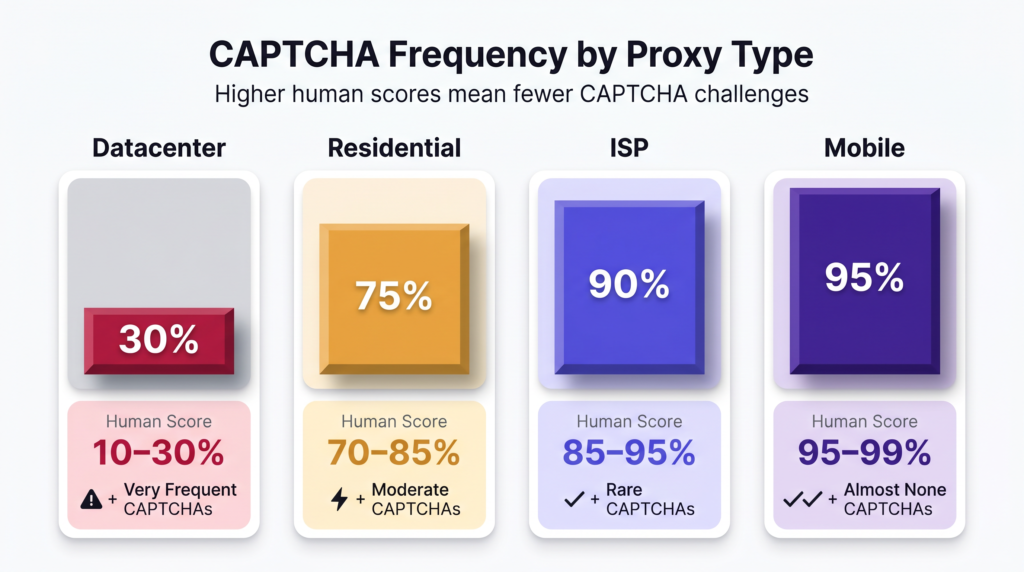
Proxy type
Different proxy types vary in their ability of user mimicry – a crucial characteristic which security systems use to verify the legitimacy of your connection. The grading is as follows:
IP reputation score
Trust score is a metric used by websites and security systems to predict if the traffic is coming from a real user. In terms of proxies, IP reputation score depends mostly on cleanliness of the provider’s IP pools, thus it’s important to choose reputable providers that guarantee trust scores of 95% and more.
To additionally improve the trust score, retain the geographical consistency of your connection and choose dedicated proxies as they are much more stable and cleaner than shared ones used by many users, often simultaneously. In the case of private proxies, your IP reputation depends exclusively on your online activity.
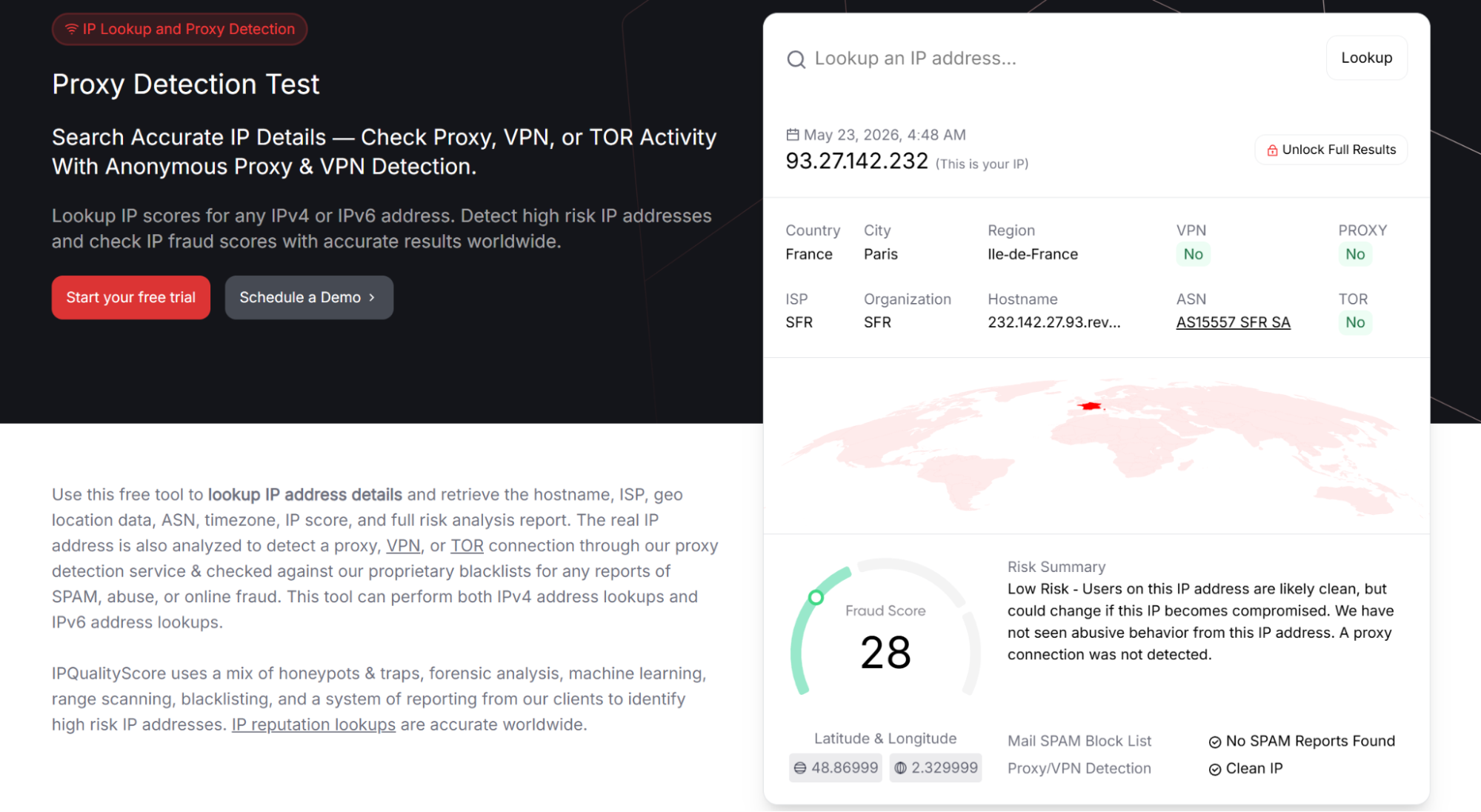
Once you acquire a proxy and connect to it, you can check your IP reputation score in real time using IPQualityScore (IPQS) IP Fraud Checker :
Or AbuseIPDB :
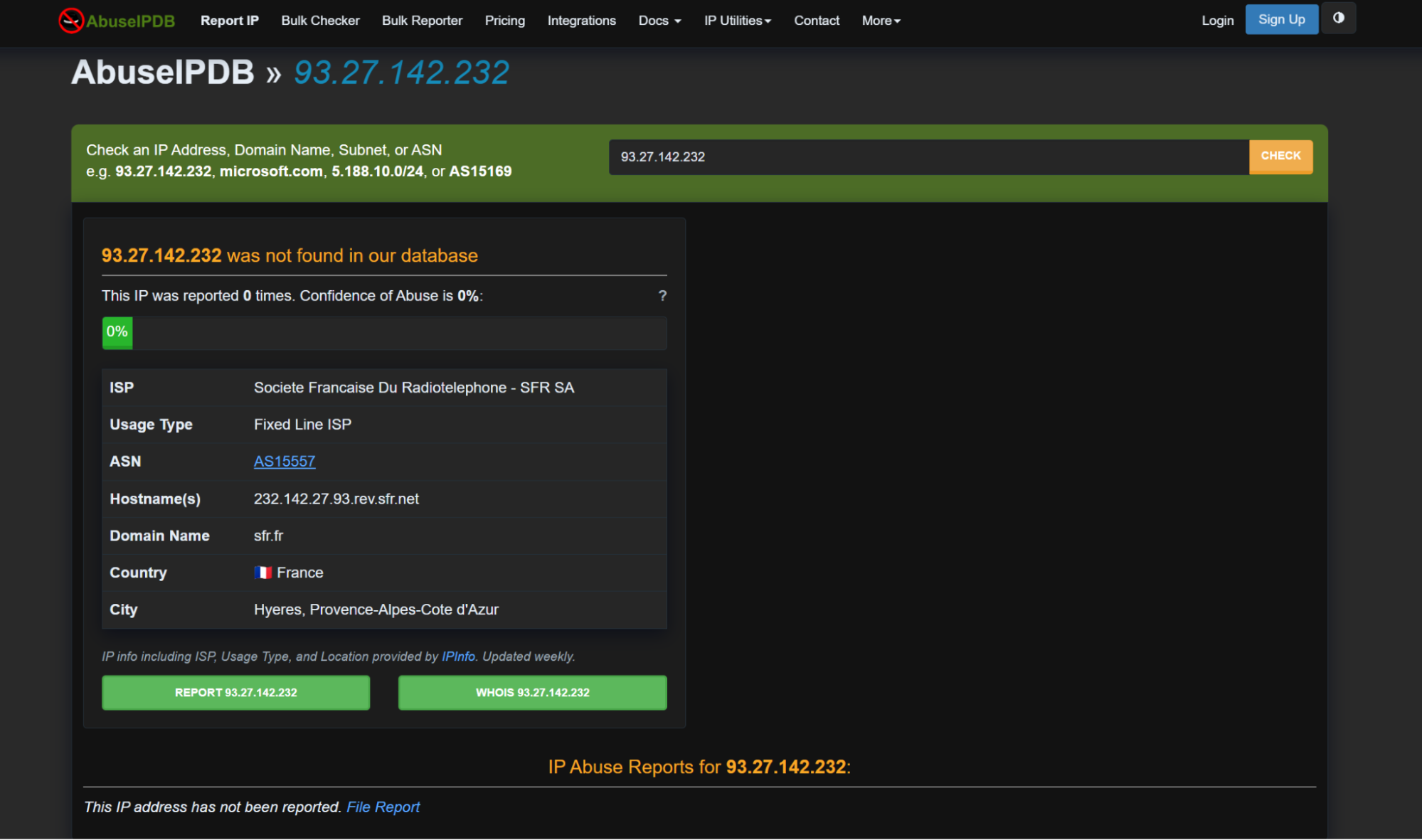
Both tests were concluded using Floppydata’s proxy, the provider offers millions of clean IPs and ensures a 95% trust score.
Here, the fraud score range is:
- 0-30% – Clean human IP, ultimately no CAPTCHA and no recognition of proxy/VPN usage
- 31-74% – Low risk, allowed entry to most websites, occasional soft CAPTCHA, proxy/VPN usage detected (often flags commercial VPNs and clean datacenter ranges)
- 75-89% – Moderate risk, aggressive CAPTCHA loops especially on strict networks (Cloudflare), high probability of being blocked from fintech/payment services and receiving shadowbans on social media.
- 90-100% – High risk, hard blocks on most websites, IP is recognised as a compromised botnet node, compromised connection, or dangerous hosting network, in many cases these IPs are linked to known cyberattacks and/or other illegal online activity.
How to Set Up a Proxy Pool
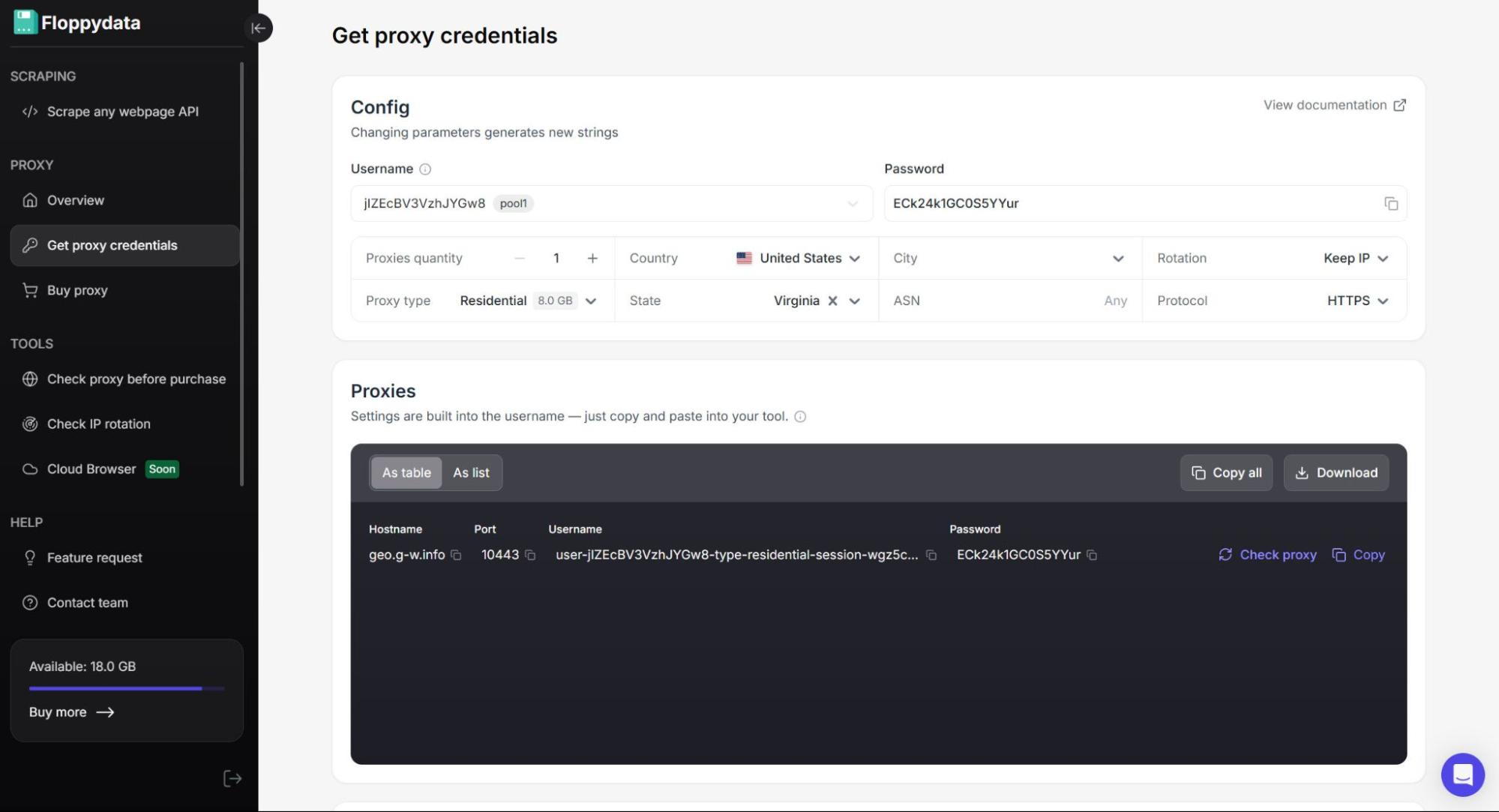
Lastly, let’s go over how to acquire your proxy strings through Floppydata’s dashboard.
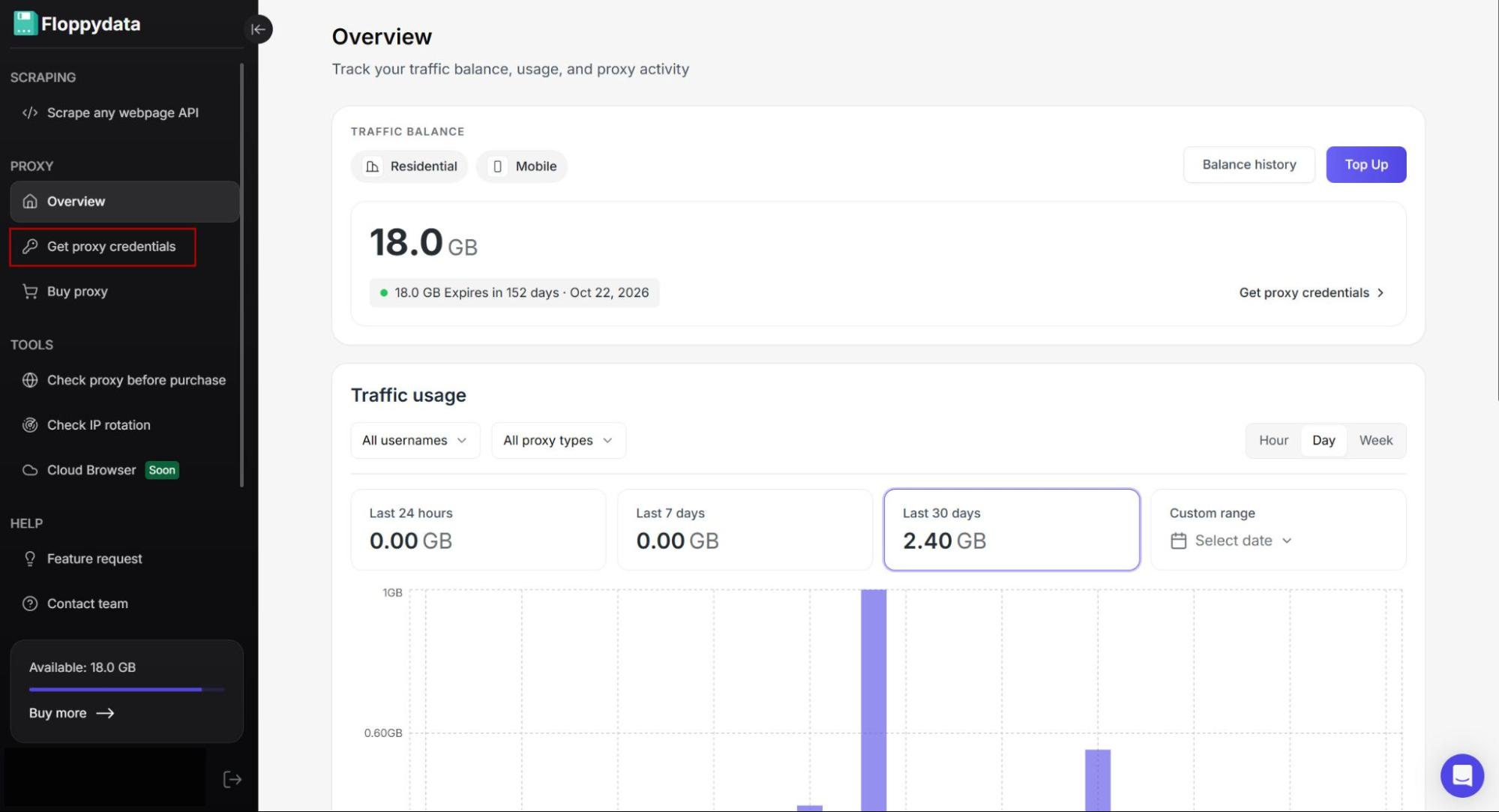
Step 1:
Once you sign into the service you will be met with the “Overview” page of the dashboard, that tracks all relevant information about your profile, such as traffic usage, bandwidth balance, and subscription. Navigate to the panel on the left and click the “Get proxy credentials” tab to access the Proxy Configurator.
Step 2:
There, the username and password are automatically generated for your account, all you have to do is input your desired configuration parameters, such as:
- IP quantity and type;
- Country;
- Rotation;
- Protocol.
For precise geo-targeting you can also input “City”, “State”, and “ASN” parameters.
As you’re entering the parameters, your proxy string, a.k.a. “username”, is being configured automatically in the field labeled “Proxies” right below. When you’re happy with your configuration parameters, simply click “Copy” to grab all credentials, or copy each one individually.
Conclusion
Internet censorship is an unfortunate worldwide trend that doesn’t concern only those who have never experienced its impact first-hand. However, research shows that restrictions and violations of user privacy are constantly looming over even the most free of regions, while for many countries an increase in online censorship is right around the corner.
In today’s day and age, circumvention tools have become a standard of internet hygiene for those seeking access to banned content and information, as well as for netizens trying to maintain control over their privacy.