Introduction
Zyte claims to solve many common web scraping challenges, such as IP bans, CAPTCHAs, unexplained blocks, and partially formatted data, using AI-powered data extraction and intelligent proxy management.
To be fair, Zyte does a decent job of categorizing websites into tiers based on anti-bot difficulty. Simple sites cost less, while protected sites cost more, which makes sense on paper.
The issue is that it does not always handle heavily protected targets as smoothly as you’d expect. And because the pricing is higher than the market average, the cost can stack up fast as you scale. For many teams, that makes Zyte harder to justify for long-term use.
If you find yourself in that category, you’re probably already searching for reliable Zyte alternatives that offer similar scraping results with more predictable pricing.
In this article, we’ll take a closer look at Zyte and compare it with our top 5 Zyte alternatives (and some honorable mentions) to consider in 2026.
TLDR
To save you seven minutes of reading, here’s the summary.
TLDR
To save you seven minutes of reading, here’s the summary.
| Feature | Floppydata | Scrapeless | ZenRows | ScraperAPI | ScrapingBee | Scrape.do |
| Geo coverage | 195+ countries | 195+ countries | 50+ countries | 50+ countries | Multi-country | 160+ countries |
| Proxy types | Residential, Mobile, Datacenter | Residential, ISP, Datacenter | Residential | Residential + Datacenter | Rotating proxies | Residential + Mobile (higher tiers) |
| Custom parsing | Limited | Limited | Limited | Basic | Basic | ❌ |
| Pricing | From $1/GB | From $10 (+ subscriptions) | From €62.99 / month | From $49 / month | From $49 / month | From $29 / month |
| JavaScript rendering | ✅ | ✅ | ✅ | ✅ | ✅ | ✅ |
| Task scheduling | ❌ | ✅ | ❌ | ✅ | ❌ | ❌ |
| Free trial | ✅ | ✅ | ✅ | ✅ | ✅ | ✅ |
What is Zyte?
Zyte has been a leader in web data extraction for over 15 years, but it didn’t start out as Zyte.
It was originally known as Scrapinghub, and its focus was mostly on scraping tools and the Scrapy ecosystem.
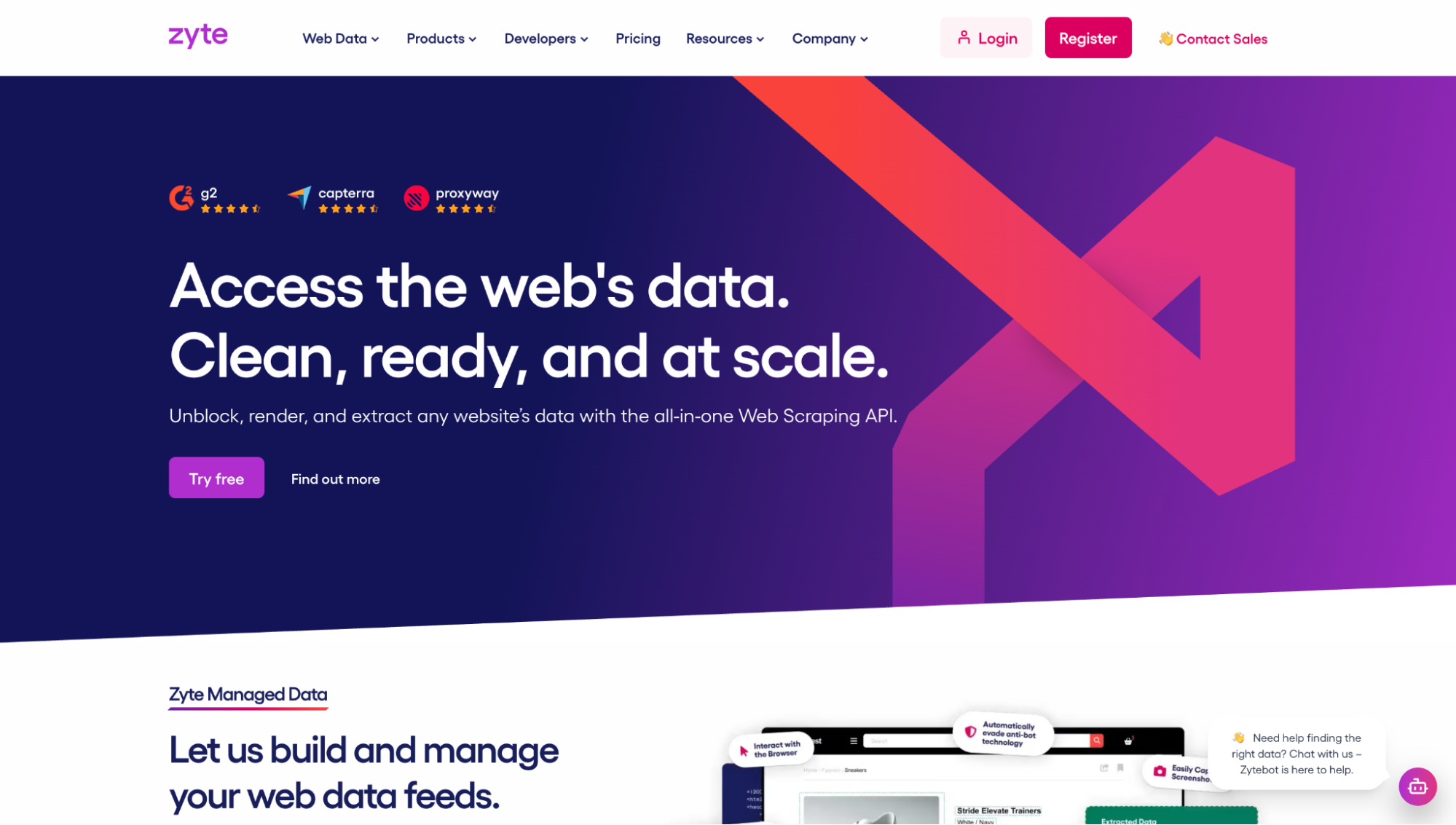
In 2021, the company rebranded to Zyte and shifted its focus toward fully managed AI web data solutions. With that change, it also became one of the first scraping APIs to integrate AI directly into its platform.
With Zyte’s AI features, you can generate ready-to-use structured data straight from the dashboard. No selectors, no parsing logic, and no manual fixes are needed from the user when sites change their HTML.
This is genuinely useful for teams who want data without writing any code. You can point it at a product page and get back clean JSON with key fields like title, price, and availability. The AI figures out where to find each value on the page.
Zyte also maintains Scrapy, the popular open-source Python framework for building scrapers. And beyond Scrapy, the company offers an all-in-one ecosystem for smart proxy handling, cloud-based scraping, and AI-powered data extraction.
Key products and services
1. Zyte API (Web Scraping API)
The Zyte API is the backbone of Zyte’s data extraction services. It lets teams scrape pages at scale without managing their own infrastructure.
Zyte API does more than return raw HTML. It is bootstrapped with AI to extract parsed data from your target sites. Instead of writing custom parsing logic for every site, Zyte attempts to identify the relevant data points and returns structured outputs you can plug straight into your pipeline.
2. Web Scraping Copilot
Web Scraping Copilot is Zyte’s AI coding assistant for building custom spiders. It generates code and supports deployment from inside VS Code.
You simply describe what you want to scrape, and it generates a complete Scrapy workflow. This tool helps you build, ship, and run spiders on Zyte’s infrastructure with fewer manual steps.
3. Scrapy Cloud
If you prefer a more hands-on approach, Zyte offers Scrapy Cloud. It lets you run, schedule, and manage crawlers in the cloud without setting up servers yourself. You can monitor scraping jobs, view logs, and scale up crawls when needed.
4. Zyte API Playground
The Zyte API Playground is an interactive environment for testing the API. It shows different configuration options, real-time scraping results, and the cost of each request. This transparency helps you estimate your spend before you commit to a plan.
Pricing
Zyte offers a free trial that includes $5 worth of credits. After that, it runs on pay-as-you-go pricing with optional monthly minimum commitments. In practice, you can expect to pay anywhere from around $100 to $500 per month or more, depending on usage levels and website difficulty.
As a result, the cost per request can spike when you scrape sites with heavy anti-bot measures or those that require browser rendering and premium proxies.
You can think of Zyte’s pricing bands roughly like this:
- Pay as you go
- $100/month minimum
- $200/month minimum
- $500/month minimum
- Enterprise plans
Zyte’s Scrapy Cloud (for running your own spiders) is priced separately. Plans start at $9 per month for one unit of compute, with additional costs for higher capacity and premium features.
Drawbacks of Zyte
- No direct proxy access
Zyte used to offer Smart Proxy Manager, formerly known as Crawlera. You could not buy a pool of residential IPs directly. Instead, you paid for a managed service that used datacenter IPs by default.
If you needed residential IPs, you had to request a residential plan or add-on. That typically started around $300/month and required KYC verification.
Today, Zyte works differently. The API automatically detects if a website is difficult to scrape and will switch from a datacenter IP to a residential IP on the fly. If Zyte decides a target needs residential proxies to succeed, that request will cost more credits.
- Credit and tier-based pricing can be tricky
On paper, Zyte handling headless browsers, residential proxies, and datacenter proxies for you sounds great. You do not need to think about infrastructure, and Zyte decides what each site needs.
But as you scale, this sets you up for unpredictable pricing spikes. The cost per 1,000 requests can swing from about $0.13 to roughly $16, depending on the domain. That is more than a 100x difference, and you only discover a site’s tier once you start scraping it.
- Poor performance at scale
Users report slow response times on Zyte when retrieving data from complex sites, sometimes around 10 seconds per request.
That delay is easy to ignore on small tests, but at hundreds of thousands or millions of pages, those extra seconds quickly add up. You spend more time waiting and may even rack up extra compute costs on your own side.
Now that you’ve seen what Zyte offers and where it falls short, let’s look at the best options to replace it.
Top Zyte alternatives
In this section, we will compare services that solve the same problems with different pricing, features, and trade-offs. If Zyte feels too expensive, too slow, or too unpredictable, the providers below will feel much easier to build around.
1. Floppydata
Floppydata delivers high success rates, strong performance, and top-tier customer support. It’s trusted by both startups and larger teams, and it’s one of the easiest recommendations for anyone looking for a capable Zyte alternative in 2026.
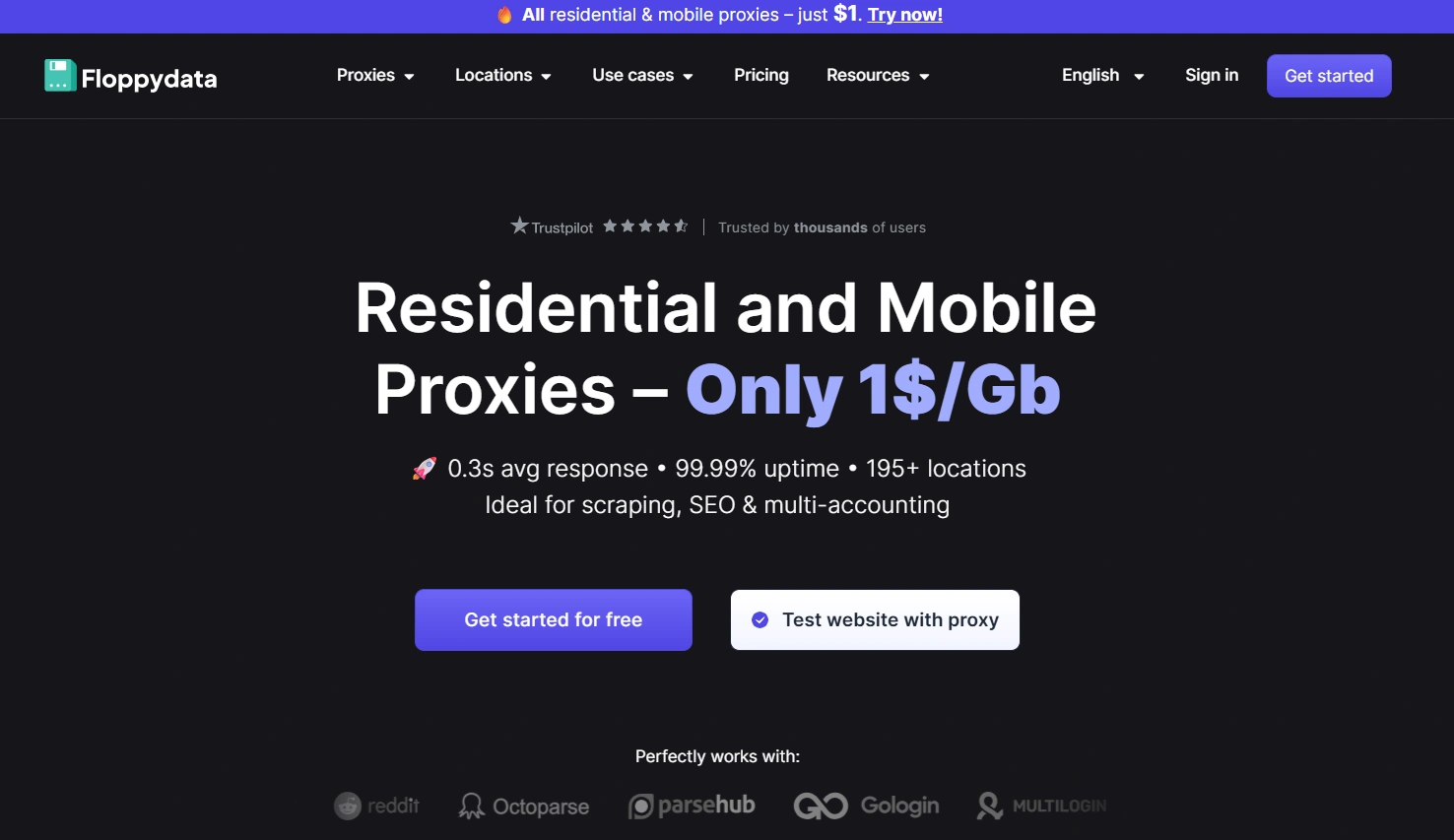
A big reason for choosing Floppydata is IP quality. Clean IPs reduce bans, cut down CAPTCHAs, and improve scrape consistency at scale.
While Zyte leans into an all-in-one managed approach, Floppydata focuses on giving you a reliable proxy infrastructure you can plug into anything. That includes your own scrapers, browser automation, or third-party tools.
Floppydata offers residential, mobile, and datacenter proxies, with coverage across 195+ countries.
And when you need to access tougher websites, Floppydata’s Web Unlocker helps you skip the usual trial-and-error. You can just pass a URL, and it returns the content, without spending hours tweaking headers, cookies, or retry logic.
This makes Floppydata a strong choice if Zyte’s credit system feels confusing or too expensive. With Floppydata, you mostly pay for bandwidth, so usage stays easier to predict as you scale.
Key features
| Feature | What it does |
| Global proxy coverage | 65 million IPs in 195+ countries |
| Multiple proxy types | Residential, mobile, datacenter & ISP proxies |
| Web Unlocker | No code scraping tool for scraping any site. |
| Instant proxy testing | Try any target URL and see key connection details before you commit to scaling. |
| Targeting controls | Country and city targeting support, plus ASN-level signals when you need cleaner routing. |
| Sticky sessions | Available |
| Usage Analytics | Available. |
| Tool integrations | Works smoothly with common scraping stacks and automation tools (browsers, scripts, crawlers). |
| 24/7 support | Fast human support via email, live chat, and Discord |
Pricing
Floppydata keeps pricing simple and predictable.
- Residential proxy: Starts at $1/GB
- Mobile proxy: Starts at $1/GB
- Datacenter proxy: Starts at $0.6/GB
- ISP Proxies: Starts at $5/IP
- Web Unlocker: custom pricing based on volume and target, contact support inside the dashboard
Pros Vs. Cons
| Pros | Cons |
| No code Web Unlocker | You still need your own scraper or third-party tools for parsing |
| Simple flat pricing with no hidden fees | |
| Non-expiring traffic | |
| Strong customer support | |
| Fast response times | |
| No surprise jumps in cost. | |
| Works well with your own scrapers and tools |
2. Scrapeless
Scrapeless is a next-generation cloud browser automation platform purpose-built for AI agents and modern web scraping workflows. Unlike traditional proxy-based solutions, Scrapeless combines a customizable, anti-detection cloud browser with intelligent automation capabilities, making it ideal for complex, multi-step web interactions that require human-like behavior and reliable execution at scale.
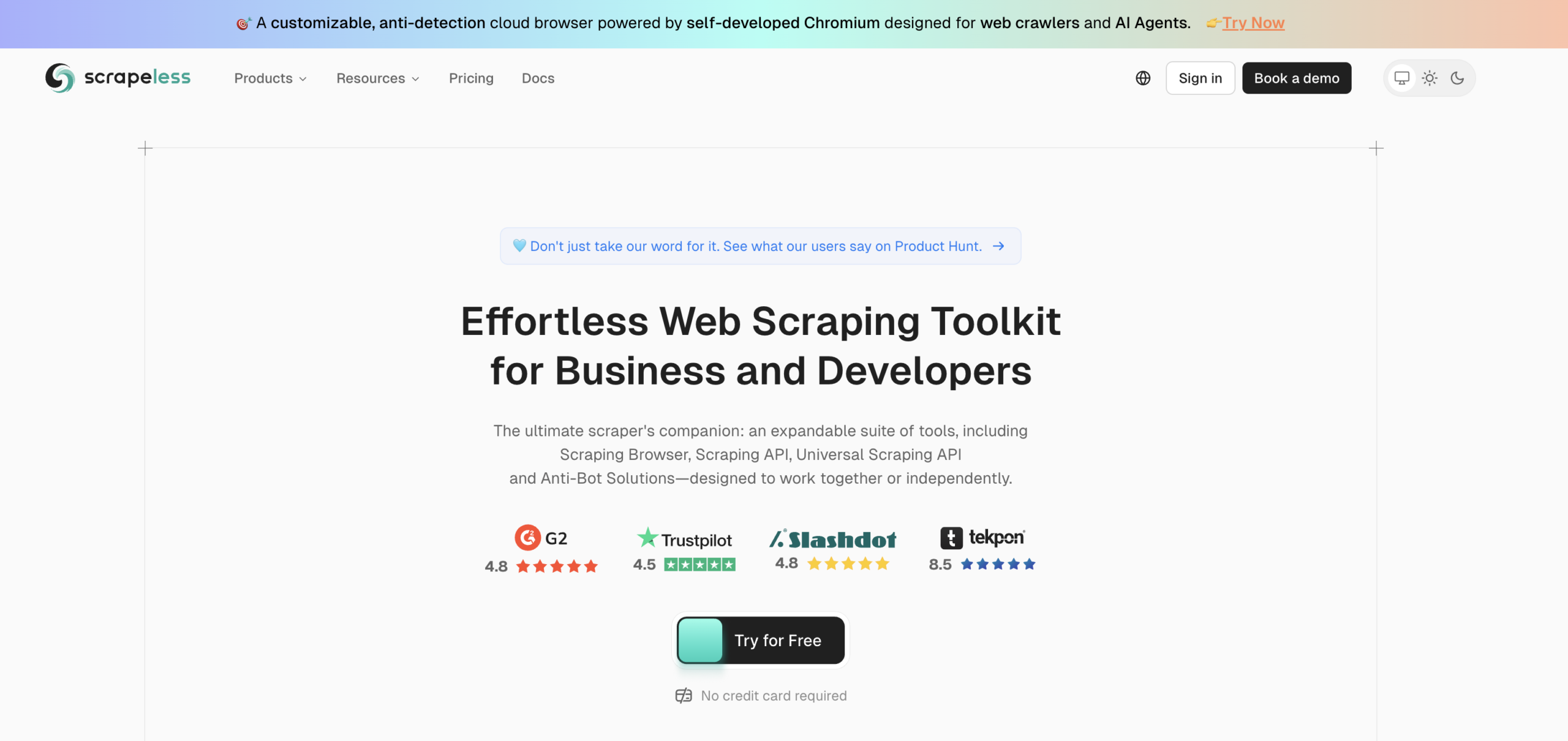
What sets Scrapeless apart is its AI-Agent-First Architecture. The platform is designed to seamlessly integrate with AI workflows—whether you’re using Claude, GPT-4, or other LLMs—allowing agents to autonomously navigate websites, fill forms, extract structured data (e-commerce, recruiting, leads generation), and complete transactions without manual intervention. This makes it particularly valuable for teams building agentic automation systems where reliability and cost-predictability are critical.
Scrapeless also provides a dedicated Scraping API for simpler use cases (Shopee, Amazon, ChatGPT, etc.) and a comprehensive proxy infrastructure (residential, IPv6, datacenter, and static ISP proxies) across 195+ countries, giving you flexibility to choose between full browser automation or lightweight API-based scraping depending on your needs.
Key Features
| Feature | Description |
| AI-Native Browser Automation | Purpose-built for AI agents with token-efficient element references (@e1, @e2) instead of complex CSS selectors, reducing LLM token usage by up to 70% |
| Cloud-Based Execution | No local browser installation required. Runs entirely in Scrapeless’s cloud infrastructure with automatic JavaScript rendering |
| Enterprise-Grade Anti-Detection | Self-developed Chromium with fingerprint randomization, behavioral analysis evasion, and automatic CAPTCHA solving for reCAPTCHA v2, Cloudflare Turnstile, and AWS Challenge |
| Built-In Residential Proxies | 195+ countries with ISP-level geo-targeting (country, state, city). Automatic IP rotation between sessions with 99%+ success rates |
| Intelligent Session Management | Automatic cookie preservation, authentication token management, and IP consistency within sessions |
| Multi-Tab & Window Support | Handle complex browsing scenarios with multiple tabs and windows for parallel workflows |
| Structured Data Extraction | Markdown rendering, accessibility tree extraction, and visual data capture for multimodal AI models |
| Session Recording & Live Debugging | Real-time inspection and post-mortem analysis with detailed error logs and performance metrics |
| Custom Proxy Integration | Bring your own proxy infrastructure or use Scrapeless’s built-in residential proxies |
| Universal Scraping API | Lightweight API for simple HTML scraping, SERP extraction, and e-commerce data collection |
Pricing
Scrapeless offers flexible, consumption-based pricing with optional monthly subscriptions for additional discounts:
- New User Trial: Get up to $30 in free trial credits to test the platform risk-free
- Minimum Recharge: $10 minimum to get started
Subscription Plans (with discounts on per-service costs):
- Growth: $49/month → 10% discount on all services
- Scale: $199/month → 15% discount on all services
- Business: $399/month → 20% discount on all services
- Enterprise: Custom pricing with discounts up to 50%, dedicated support, and tailored SLAs
Flexible payment options include monthly, yearly (save 10%), or pay-as-you-go. No long-term contracts required.
Pros vs Cons
| Pros | Cons |
| AI-Agent optimized with token-efficient element references | Newer platform compared to established vendors |
| Cost-effective for complex workflows with transparent pricing | Learning curve for advanced features like custom fingerprints |
| Exceptional anti-detection with self-developed Chromium | Smaller IP pool than some enterprise providers for niche geographies |
| Seamless AI integration with Claude Code, Cursor, VS Code + Copilot | |
| Predictable consumption-based costs with no surprise bills | |
| Multi-step automation with session persistence and multi-tab support | |
| Comprehensive toolkit: browser automation, API, and proxies in one platform | |
| Live debugging and session recording for troubleshooting |
Best For:
- AI agent developers building autonomous workflows with Claude, GPT-4, or other LLMs
- Complex multi-step automation requiring account-based scraping and form filling
- Cost-conscious teams seeking transparent pricing with no hidden fees
- Enterprises needing reliability with 99%+ success rates and dedicated SLA support
- Teams requiring both browser automation and lightweight API scraping
3. Zenrows
ZenRows is an appealing alternative to Zyte for users on a tighter budget. Both providers are similar in terms of features, with both supporting browser rendering, headless browsers, and anti-bot handling.
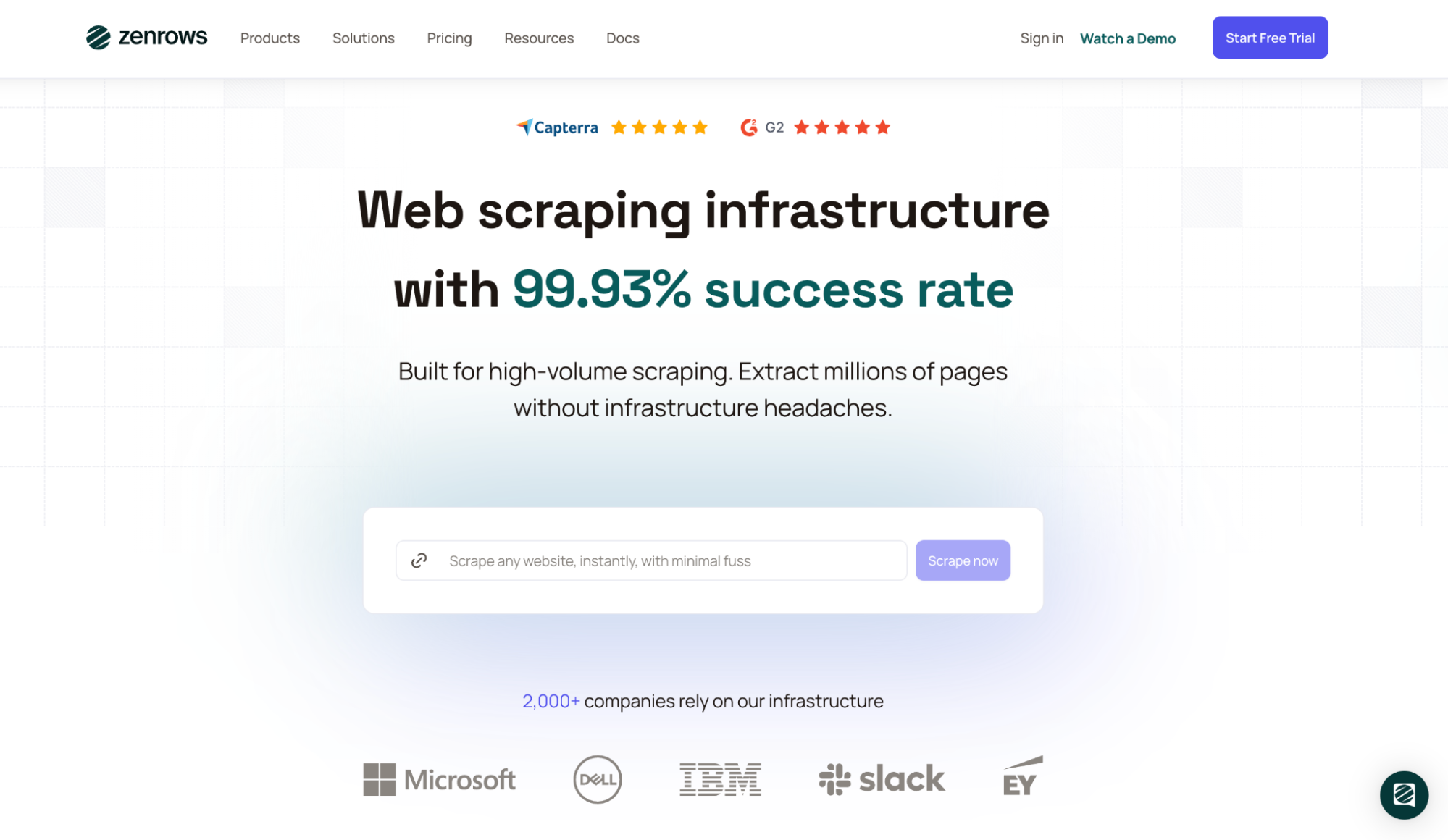
ZenRows is also developer-friendly. You can integrate it through a simple REST API, or use its libraries for Python, Node.js, and other common stacks, which makes it easy to plug into most workflows.
At the center of the product is the ZenRows Universal Scraping API. It handles rotating proxies, headless browser rendering, and CAPTCHA solving in one request. ZenRows also offers an automatic parsing feature, but it’s not available on all sites.
ZenRows offers a 14-day free trial that lets you scrape up to 1,000 simple URLs. After that, it moves to credit-based pricing. The entry plan starts at €62.99 per month and roughly covers over 100,000 basic results. Compared to Zyte’s entry tier ($100 minimum), ZenRows is easier to start with, especially for smaller teams.
Commendably, ZenRows also offers residential proxies, with access to around 55 million IPs across 50+ countries. The downside is that the proxy pricing can feel high once you factor in bandwidth limits, especially at scale.
Also, ZenRows does not offer mobile proxies or ISP proxies, which can matter if you need more precise targeting or harder-to-block sessions.
Key features
- AI Web Unblocker
- Universal Scraping API
- Residential proxies
- Screenshot API
- API playground
- Scraping browser
Pricing
- Free trial: 14 days, up to 1,000 URLs
- Developer: €62.99 per month
- Startup: €116.99 per month
- Business: €269.99 per month
- Enterprise: from $4,000 per month
Pros vs cons
| Pros | Cons |
| Easy setup and integration | Credit-based usage can be hard to predict |
| 14-day free trial | No mobile or ISP proxies |
| Residential IP pool in 50+ countries | Residential proxies are pricey |
| API playground helps you estimate cost upfront | Auto-parsing does not work everywhere |
| Very high entry point of $69 | |
| Credits do not carry over month-to-month |
4. ScraperAPI
ScraperAPI has been around since 2018, and it positions itself as a simple plug-and-play scraping solution. Its core product is a scraping API that exposes a single endpoint. You send a URL, and it returns the raw HTML or parsed JSON (on some templates).
Feature-wise, ScraperAPI sits around the industry average. It supports residential proxies, geolocation, and JavaScript rendering.
Residential and mobile IPs are included by default on higher plans, so you do not pay a separate add-on for those. The service also maintains a pool of over 40 million IPs worldwide and handles geotargeting to 50 plus countries.
Where ScraperAPI really shines is its pre-built templates for SERP and e-commerce scraping. You give the template a search query or product URL and get structured data back without building anything from scratch, which can save you a lot of time.
ScraperAPI doesn’t offer fancy AI parsing or specialty endpoints. Instead, it focuses on being a universal scraping API that just works for most sites. That lean approach makes it easy to integrate and relatively affordable, though costs can rise when you scrape protected sites or rely heavily on JavaScript rendering.
Key Features
- Scraping API (single endpoint for any URL)
- Structured endpoints for SERP and e-commerce data
- Async scraper for bulk jobs
- DataPipeline scheduler for recurring crawls
- 40M+ IP proxy pool with residential support
Pricing
ScraperAPI uses a tiered credit based model with a fixed number of API credits per month. There’s also a free trial and a free plan, which makes it easy to test the service before committing.
- Free trial: 7 days
- Free plan: 1,000 API calls per month
- Hobby: $49 per month
- Startup: $149 per month
- Business: $299 per month
- Scaling: $475 per month
Pros vs Cons
| Pros | Cons |
| Free plan available for testing and small projects | Limited geolocation on starting plans (mainly US and EU) |
| Easy integration | Credit-based pricing can feel unpredictable at scale |
| Pre-built SERP and e-commerce templates | You may still burn credits on blocked requests in some cases |
| API playground for quick testing | No deep AI extraction layer like Zyte |
| Built-in scheduler (DataPipeline) for recurring jobs | Credits do not roll over from month to month |
| Multiple data export formats |
5. ScrapingBee
ScrapingBee is a web scraping API that handles headless browsers and rotating proxies for you. It’s built for teams that want a simple endpoint that can fetch web data reliably, without running Playwright or Puppeteer on their own servers.
ScrapingBee also offers more features than the average scraping API, which makes it a strong option if your targets are modern websites but not the most heavily protected ones.
It works through an endpoint where you can request a page as HTML or even as a screenshot. You can inject custom JavaScript into the page context to click buttons, scroll, or wait for elements to appear. This flexibility is useful for scraping more complex pages, even when the site isn’t heavily protected.
ScrapingBee also includes a built-in Google Search API, which makes it easier to collect SERP data without getting blocked. And because the docs are beginner-friendly, many developers find it easy to integrate quickly. They also support no-code automation tools like Make and Zapier.
Pricing is credit-based, similar to other scraping APIs. Basic requests cost fewer credits, while headless browser rendering consumes more credits. There’s no long-term free plan, but new users get a free trial with credits to test the service.
Key Features
- Web Scraping API
- Custom JavaScript execution
- Screenshot capture
- Google Search API
- API playground
- Integrations with Make and other no-code tools
- Markdown scraper for turning pages into markdown
- AI data extraction to get structured output
Pricing
ScrapingBee’s pricing is similar to ScraperAPI’s tiers but measured in API credits per month. There is no permanent free plan, but you do get a free trial.
- Free trial: 1,000 credits
- Freelance: $49 per month
- Startup: $99 per month
- Business: $249 per month
- Business+: $599 per month
Pros vs Cons
| Pros | Cons |
| Custom JS support | JS rendering can burn through credits quickly |
| Built in Google Search API | Not the cheapest option at scale |
| Good documentation and code samples | No webhook support |
| Integrates smoothly with no code tools | Limited AI features |
| Multiple data export formats | Credits do not roll over from month to month |
6. Scrape.do
And rounding off our list, we have Scrape.do
Like most Zyte alternatives, Scrape.do provides a plug-and-play Web Scraping API. You send a URL, and it returns the page content while handling proxy rotation and common blocking issues in the background.
Now, Scrape.do is built for speed. If you are already parsing HTML yourself and mainly need to unblock sites, it can be a better fit than Zyte.
Zyte leans more toward managed extraction and structured data workflows, while Scrape.do leans more toward “fetch the page fast and let developers handle the rest.” For most developers who are comfortable working with HTML, this tradeoff is ideal.
Scrape.do also claims a large proxy network of over 110 million IPs. However, it does not fully disclose its IP sourcing methods, which may matter for teams that care about compliance and proxy transparency.
Also, full access to residential and mobile routing is typically tied to higher plan tiers, so smaller plans may be more limited.
Key Features
- Web scraping API
- Amazon scraper API
- JavaScript rendering and headless browser support
- Geo targeting for many countries
- Sticky sessions for session-based scraping
Pricing
Scrape.do includes a free trial with 1,000 successful API credits. Refunds are quite rare, but they typically offer them within the first three days of purchase.
Here’s how the plans are structured:
- Free: $0 per month
- Hobby: $29 per month
- Pro: $99 per month
- Business: $249 per month
Pros vs Cons
| Pros | Cons |
| Generous free plan | No auto-parsing |
| Fast response times | Newer provider |
| Affordable pricing | Proxy sourcing is not fully transparent |
| Easy to integrate with a simple API | Lower success rates |
| No native AI integration |
Honorable Mentions
Not every Zyte alternative fits neatly into the “scraping API” category. Some tools are built for enterprise scale, while others are made for non-technical users who want data without writing code.
If you do not need another plug-and-play API, but you still want a strong option worth considering, these honorable mentions are worth a look.
Oxylabs
This list would not feel complete without Oxylabs. Oxylabs is a household name, and it’s known for its massive proxy network and enterprise-focused tooling.
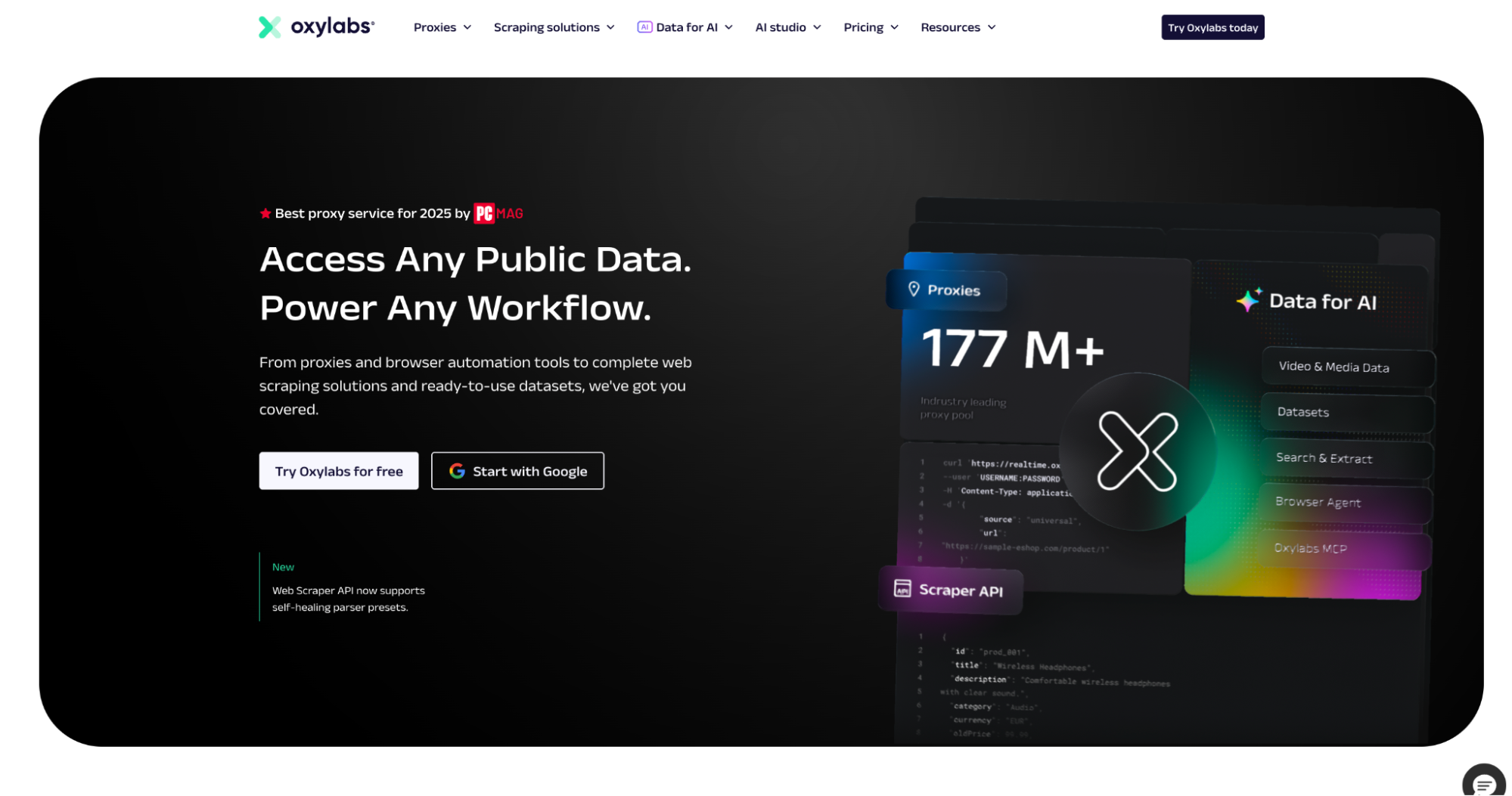
It is mainly a proxy service (and data API provider), not a simple plug-and-play scraping API like Zyte. That said, Oxylabs also offers scraping products like Web Scraper API, Unblocking Browser, and OxyCopilot.
Oxylabs offers an impressive network of over 177 million residential IPs and 2 million datacenter IPs globally. That kind of scale is useful when you need fresh IPs, high concurrency, and stable delivery across many regions.
But Oxylabs is built for larger businesses. Pricing is on the high end, and while there is a free trial for qualified users, most teams will need to talk to sales, KYC, and negotiate a custom plan.
Octoparse
Octoparse is a user-friendly web scraping tool that allows users to extract data from websites without any coding. Instead of working through an API, it uses a point-and-click interface where you visually select what you want to extract.
Octoparse also offers cloud extraction for more advanced workloads, so you can run scrapers on their infrastructure instead of keeping your machine online.
For teams that want to move quickly with simple or medium complexity scrapes, it can be a practical no-code alternative to running custom Zyte spiders.
What to Pick?
Choosing the right option depends on what you used Zyte for in the first place.
For Web Scraping API and unblocking
- Floppydata Web Unlocker
Best overall option if you want high success rates and predictable pricing. - ZenRows
Best for teams that want a simple “all-in-one” API with strong unblocking capabilities. - Scrape.do
Best for budget scraping at scale, especially if you already parse HTML yourself.
For no/low code scraping
- Octoparse
Best for beginners and non-technical teams. - ScrapingBee
Best for scraping modern websites with minimal engineering effort.
Final thoughts
Zyte is still a solid option for some teams, but it is not always the best long-term choice once costs start stacking up.
If you want more control and better pricing, a proxy provider like Floppydata paired with your own scrapers, can be hard to beat. It gives you high-quality proxies, excellent support, and a strong Web Unlocker for tougher websites, without forcing you into complex tier-based pricing.
If you want to see how fast unblocking can feel, test Floppydata’s Web Unlocker with 5 free scrapes.
FAQ
Why look for Zyte alternatives?
Zyte is a popular web scraping API, but users often seek tools with simpler pricing, broader features, easier setup, or better support depending on scraping needs.
What are strong Zyte alternatives?
Top options include Floppydata, Apify, Decodo (formerly Smartproxy), Oxylabs, Bright Data, and ScrapingBee - each offering solid web scraping, proxies, or data extraction APIs.
How do these alternatives compare to Zyte?
Alternatives may have easier onboarding, transparent pricing, larger proxy networks, or all-in-one scraping APIs tailored for different scales and budgets.